Please solve this project in a clear way because I'm going to do a presentation on it.
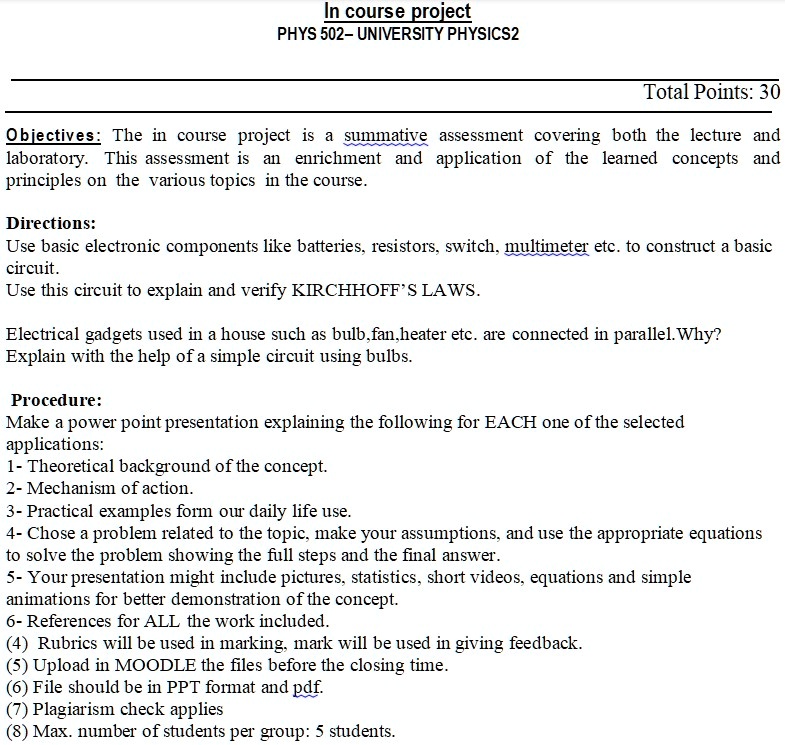
Objectives: The in-course project is a summative assessment covering both the lecture and laboratory. This assessment is an enrichment and application of the learned concepts and principles on the various topics in the course.
Directions:
Use basic electronic components like batteries, resistors, switch, multimeter, etc. to construct a basic circuit.
Use this circuit to explain and verify KIRCHHOFF'S LAWS.
Electrical gadgets used in a house such as bulbs, fans, heaters, etc. are connected in parallel. Why? Explain with the help of a simple circuit using bulbs.
Procedure:
Make a PowerPoint presentation explaining the following for EACH one of the selected applications:
1- Theoretical background of the concept.
2- Mechanism of action.
3- Practical examples from our daily life use.
4- Choose a problem related to the topic, make your assumptions, and use the appropriate equations to solve the problem showing the full steps and the final answer.
5- Your presentation might include pictures, statistics, short videos, equations, and simple animations for better demonstration of the concept.
6- References for ALL the work included.
(4) Rubrics will be used in marking, marks will be used in giving feedback.
(5) Upload in MOODLE the files before the closing time.
(6) File should be in PPT format and PDF.
(7) Plagiarism check applies
(8) Max. number of students per group: 5 students.
In-course project
PHYS 502-UNIVERSITY PHYSICS 2
Total Points: 30
Objectives: The in-course project is a summative assessment covering both the lecture and laboratory. This assessment is an enrichment and application of the learned concepts and principles on the various topics in the course.
Directions: Use basic electronic components like batteries, resistors, switch, multimeter, etc. to construct a basic circuit. Use this circuit to explain and verify KIRCHHOFF'S LAWS.
Electrical gadgets used in a house such as bulbs, fans, heaters, etc. are connected in parallel. Why? Explain with the help of a simple circuit using bulbs.
Procedure: Make a PowerPoint presentation explaining the following for EACH one of the selected applications: 1- Theoretical background of the concept. 2- Mechanism of action. 3- Practical examples from our daily life use 4- Choose a problem related to the topic, make your assumptions, and use the appropriate equations to solve the problem showing the full steps and the final answer 5- Your presentation might include pictures, statistics, short videos, equations, and simple animations for better demonstration of the concept. 6- References for ALL the work included 4 Rubrics will be used in marking, marks will be used in giving feedback. 5 Upload in MOODLE the files before the closing time. 6 File should be in PPT format and PDF. (7 Plagiarism check applies (8 Max. number of students per group: 5 students