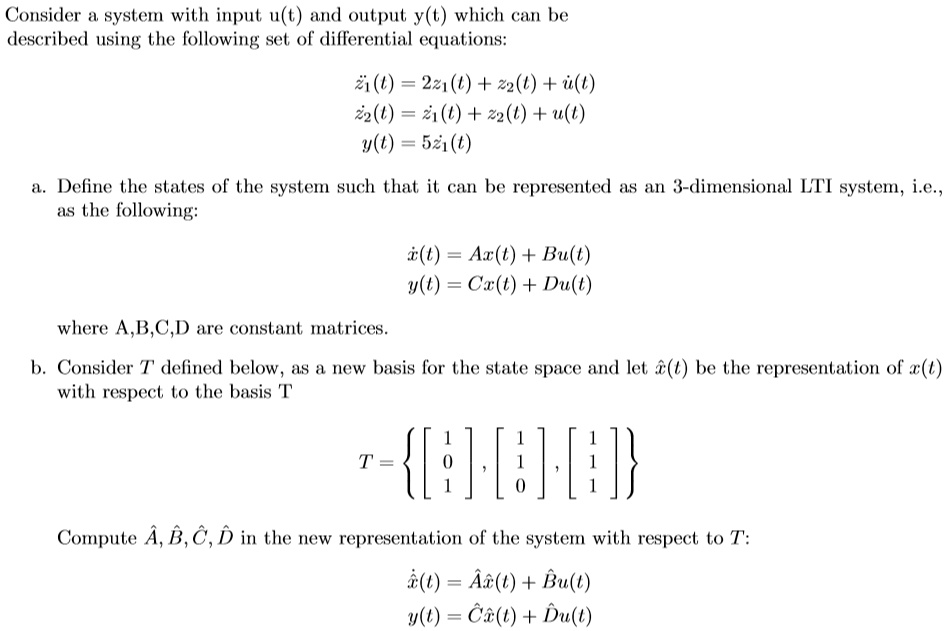
Consider a system with input u(t) and output y(t) which can be described using the following set of differential equations:
$\dot{z}_1(t) = 2z_1(t) + z_2(t) + u(t)$
$\dot{z}_2(t) = z_1(t) + z_2(t) + u(t)$
y(t) = 5z_1(t)
a. Define the states of the system such that it can be represented as an 3-dimensional LTI system, i.e., as the following:
$\dot{x}(t) = Ax(t) + Bu(t)$
y(t) = Cx(t) + Du(t)
where A,B,C,D are constant matrices.
b. Consider T defined below, as a new basis for the state space and let $\hat{x}(t)$ be the representation of x(t) with respect to the basis T
$T = \left\{ \begin{bmatrix} 1 \\ 0 \\ 1 \end{bmatrix}, \begin{bmatrix} 1 \\ 1 \\ 0 \end{bmatrix}, \begin{bmatrix} 1 \\ 1 \\ 1 \end{bmatrix} \right\}$
Compute $\hat{A}$, $\hat{B}$, $\hat{C}$, $\hat{D}$ in the new representation of the system with respect to T:
$\dot{\hat{x}}(t) = \hat{A}\hat{x}(t) + \hat{B}u(t)$
y(t) = $\hat{C}\hat{x}(t) + \hat{D}u(t)$