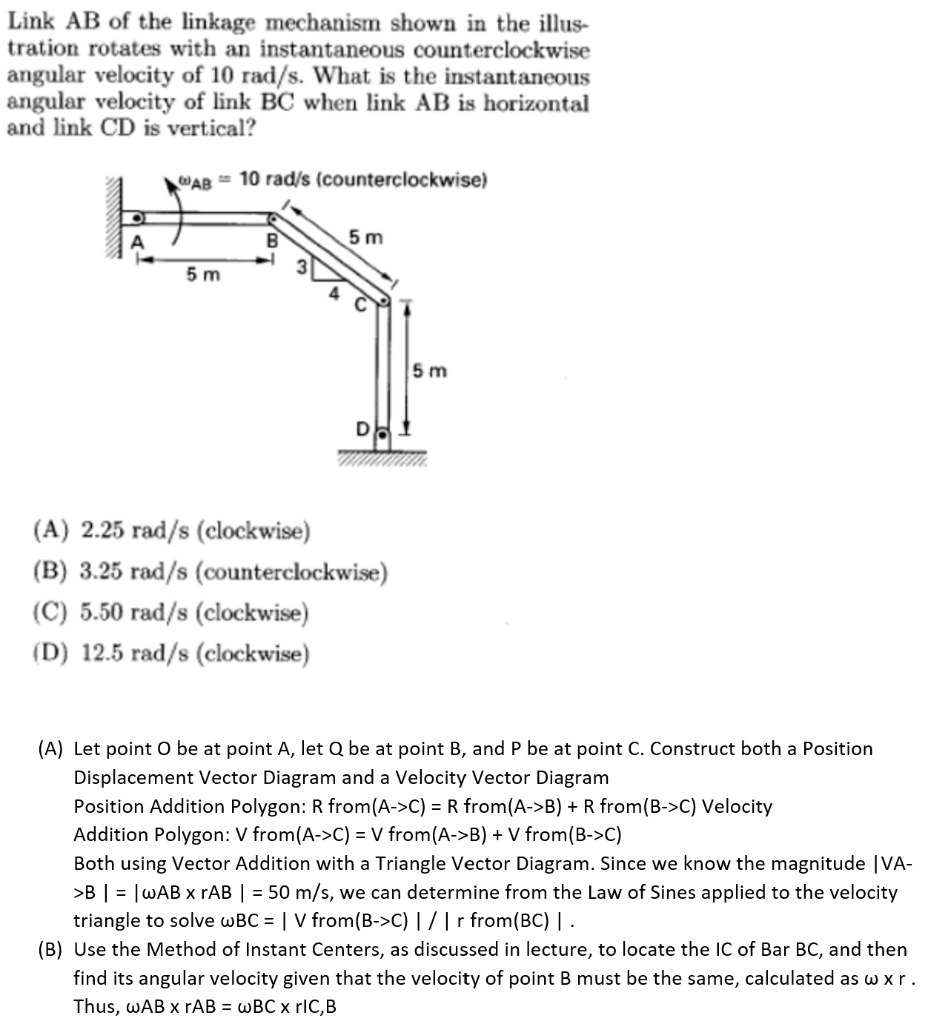
Link AB of the linkage mechanism shown in the illus-
tration rotates with an instantaneous counterclockwise
angular velocity of 10 rad/s. What is the instantaneous
angular velocity of link BC when link AB is horizontal
and link CD is vertical?
$\omega_{AB}$ = 10 rad/s (counterclockwise)
A
B
5 m
3
5 m
4
C
D
5 m
(A) 2.25 rad/s (clockwise)
(B) 3.25 rad/s (counterclockwise)
(C) 5.50 rad/s (clockwise)
(D) 12.5 rad/s (clockwise)
(A) Let point O be at point A, let Q be at point B, and P be at point C. Construct both a Position
Displacement Vector Diagram and a Velocity Vector Diagram
Position Addition Polygon: R from (A$\rightarrow$C) = R from(A$\rightarrow$B) + R from (B$\rightarrow$C) Velocity
Addition Polygon: V from(A$\rightarrow$C) = V from(A$\rightarrow$B) + V from (B$\rightarrow$C)
Both using Vector Addition with a Triangle Vector Diagram. Since we know the magnitude $|V_{A}
\rightarrow B| = |\omega_{AB} \times r_{AB}| = 50 m/s, we can determine from the Law of Sines applied to the velocity
triangle to solve $\omega_{BC} = |V_{from(B\rightarrow C)}|/|r_{from(BC)}|$.
(B) Use the Method of Instant Centers, as discussed in lecture, to locate the IC of Bar BC, and then
find its angular velocity given that the velocity of point B must be the same, calculated as $\omega \times r$.
Thus, $\omega_{AB} \times r_{AB} = \omega_{BC} \times r_{IC, B}$