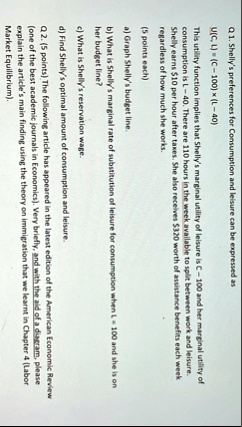
Q1. Shelly's preferences for Consumption and leisure can be expressed as
$$U(C, L) = (C-100) \times (L-40)$$
This utility function implies that Shelly's marginal utility of leisure is C-100 and her marginal utility of
consumption is L-40. There are 110 hours in the week available to split between work and leisure.
Shelly earns $10 per hour after taxes. She also receives $320 worth of assistance benefits each week
regardless of how much she works.
(5 points each)
a) Graph Shelly's budget line.
b) What is Shelly's marginal rate of substitution of leisure for consumption when L=100 and she is on
her budget line?
c) What is Shelly's reservation wage.
d) Find Shelly's optimal amount of consumption and leisure.
Q2. (5 points) The following article has appeared in the latest edition of the American Economic Review
(one of the best academic journals in Economics). Very briefly, and with the aid of a diagram, please
explain the article's main finding using the theory on immigration that we learnt in Chapter 4 (Labor
Market Equilibrium).