Ace - AI Tutor
Ask Our Educators
Textbooks
My Library
Flashcards
Scribe - AI Notes
Notes & Exams
Download App
victoria cortes

victoria c.

Divider

Questions asked

BEST MATCH

A thin uniform rigid bar of length $L$ and mass $M$ is hinged at point $O$, located at a distance of $\frac{L}{3}$ from one of its ends. The bar is further supported using springs, each of stiffness $k$, located at the two ends. A particle of mass $m = \frac{M}{4}$ is fixed at one end of the bar, as shown in the figure. For small rotations of the bar about $O$, the natural frequency of the system is (A) $\sqrt{\frac{5k}{M}}$ (B) $\sqrt{\frac{5k}{2M}}$ (C) $\sqrt{\frac{3k}{2M}}$ (D) $\sqrt{\frac{3k}{M}}$

View Answer
divider
BEST MATCH

Angiotensin 2: A. is a vasodilator B. stimulates the release of aldosterone from the adrenal cortex C. both of the above D. none of the above

View Answer
divider
BEST MATCH

4. Use the Euclidean Algorithm to find gcd(42823, 6409). Show the steps of the algorithm. Solution: Solution goes here.

View Answer
divider
BEST MATCH

A reduction in money supply would result in: A. a rightward shift of the AS curve. B. a leftward shift of the AS curve. C. a rightward shift of the AD curve. D. a leftward shift of the AD curve.

View Answer
divider
BEST MATCH

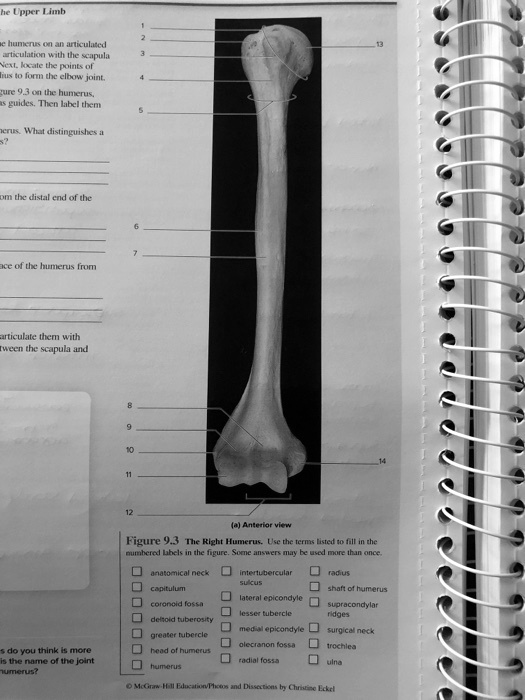
The Upper Limb The humerus forms an articulated articulation with the scapula. Next, locate the points of articulation between the humerus and the ulna to form the elbow joint. Use the provided guides to label them. What distinguishes a humerus from the distal end of the scapula is the name of the joint between the scapula and the humerus. (a) Anterior view Figure 9.3 The Right Humerus. Use the terms listed to fill in the numbered labels in the figure. Some answers may be used more than once: anatomical neck, intertubercular sulcus, capitulum, shaft of humerus, lateral epicondyle, coronoid fossa, supracondylar ridges, medial epicondyle, surgical neck, greater tubercle, lesser tubercle, deltoid tuberosity, olecranon fossa, trochlea, head of humerus, radial fossa, ulna. What do you think is the name of the joint between the scapula and the humerus?
View Answer
divider
BEST MATCH

Question 13 2 Points The amygdala, hippocampus, caudate nucleus, and anterior cingulated cortex are all implicated in A personality disorders. B mood disorders. C schizophrenia. D anxiety disorders.

View Answer
divider
BEST MATCH

Which pairs of compounds are enantiomers (optical isomers)? HC\(CH_3\)\(CH_2CH_3\)C\(CH_2CH_3\)(CH_3) H\(CH_2CH_3\)C\(CH_3\)(CH_2CH_3) H\(CH_3\)C\(OH\)(CH_2CH_3)\(HC=CH_2\) HO\(CH_3\)C\(H\)(CH_2CH_3)\(HC=CH_2\) HS\(CH_3\)C\(H\)(CH_2CH_3)\(CH_3\) H\(CH_2CH_3\)C\(SH\)(CH_3)\(CH_2CH_3\) H_3C\(CH_2CH_3\)C\(H\)(H) H\(CH_2CH_3\)C\(CH_3\)(H)

View Answer
divider
BEST MATCH

PROBLEM 1: Final grades in Professor Booba's course are calculated as a weighted average of the midterm and final exam. The midterm is weighted at 0.4 and the final is weighted at 0.6. Semester grades on the midterm exam were normally distributed with $\mu_m = 63$ and $\sigma^2_m = 14$. Grades on the final exam were also normally distributed with $\mu_f = 75$ and $\sigma^2_f = 20$. Performance on both exams were positively correlated with a sample covariance, $\sigma_{mf} = 0.05$, Question 1 Refer to Problem 1. The average final grade in Professor Booba's course is Blank 1 (Please enter two decimals) Blank 1 Add your answer Question 2 Refer to Problem 1. The variance of the distribution of final grades was Blank 1 (please enter two decimals) Blank 1 Add your answer

View Answer
divider
BEST MATCH

Consider the following methods: public static void printIncreasingSeries(final String s, final int n) { if (n < 0) { throw new IllegalArgumentException(); } if (s == null) { throw new NullPointerException(); } if (n == 0) { return; } printIncreasingSeries(s, n - 1); printLineOfStrings(s, n); } public static void printLineOfStrings(final String s, final int n) { if (n < 0) { throw new IllegalArgumentException(); } printSeriesOfStrings(s, n); System.out.println(); } For the call below, select the output printIncreasingSeries("X", 5); O XXXXX XXXX X XXX XOXOX O X XX XXX XXXX XXXXX O XXXXX XXX XX X OX XX XXXX XXXXX XOXOX

View Answer
divider
BEST MATCH

Solve the following recursion: \begin{equation*} T(n) = \begin{cases} \Theta(1) & \text{if } n = 1\\ T(n - 1) + \Theta(n) & \text{if } n > 1 \end{cases} \end{equation*} [Hint: Master Method does not apply]

View Answer
divider