Ace - AI Tutor
Ask Our Educators
Textbooks
My Library
Flashcards
Scribe - AI Notes
Notes & Exams
Download App
victoria keller

victoria k.

Divider

Questions asked

BEST MATCH

Endotoxins are produced only by gram-negative bacteria. Group of answer choices True False

View Answer
divider
BEST MATCH

The 'whites of the eye' is due to: Select one: O a. sclera O b. choroid O c. retina O d. vitreous

View Answer
divider
BEST MATCH

To write the equation of the line tangent to the curve y = x at the point (x, y) = (4, 2), we will need the slope of that tangent line and a point on the tangent line. Use the limit definition of derivative to find the slope of the tangent line, m_tan, to y = x at x = 4. m_tan = f'(4) = lim x->4 (f(x) - f(4))/(x - 4) = lim x->4 (x - 4) Incorrect: Your answer is incorrect.

View Answer
divider
BEST MATCH

A graphing calculator is recommended. The following function is given. g(x) = x^4 - 4x^3 - 12x^2 (a) Find all the local maximum and minimum values of the function and the value of x at which each occurs. State each answer correct to two decimals. local maximum (x, y) = local minimum (x, y) = (-1.37, -8.72) (smaller x-value) local minimum (x, y) = (larger x-value) (b) Find the open intervals on which the function is increasing and on which the function is decreasing. State each answer correct to two decimals. (Enter your answers using interval notation.) increasing decreasing

View Answer
divider
BEST MATCH

11) Adverse Selection in the Labor Market (Parts a - b) An employer faces two types of employees. Regular workers are 80% of the population and generate $100,000 in productivity. Exceptional workers are 20% of the population, and generate $140,000 in productivity. Employees know their types, and have alternative employment opportunities yielding $80,000 for regular workers and $110,000 for exceptional workers. Employers don't know the employees' types, but they do know the value of their outside options, as well as the proportion of each type of worker in the population. 16 1 point 11) Adverse Selection in the Labor Market (Part a) If the employer offers a salary equal to the weighted average productivity in the population, what will be the employer's per-employee profit? $0 -$8,000 -$20,000 $4,000 $10,000 17 1 point 11) Adverse Selection in the Labor Market (Part b) Suppose instead that the employer anticipates and protects itself from adverse selection. In this case, it would offer a salary of $ type your answer... and generate per-employee profits of $ type your answer...

View Answer
divider
BEST MATCH

5. Let $f_n: [a, b] \rightarrow \mathbb{R}$ be a sequence of functions that converges uniformly to 0. Also, suppose that, for each $x \in [a, b]$, the sequence {$|f_n(x)|$} is monotonically decreasing, and that $f_n(x) \le 0$ for even n and $f_n(x) \ge 0$ for odd n. (a) Show that $\sum_{n=1}^{\infty} f_n$ is pointwise convergent. (b) Show that $\sum_{n=1}^{\infty} f_n$ is uniformly convergent. (Hint: First show that, if {$t_n$} is any monotonically decreasing sequence of positive numbers tending to zero, then the limit $t = \sum_{n=1}^{\infty} (-1)^{n+1} t_n$ exists and satisfies $0 \le t \le t_1$.)

View Answer
divider
BEST MATCH

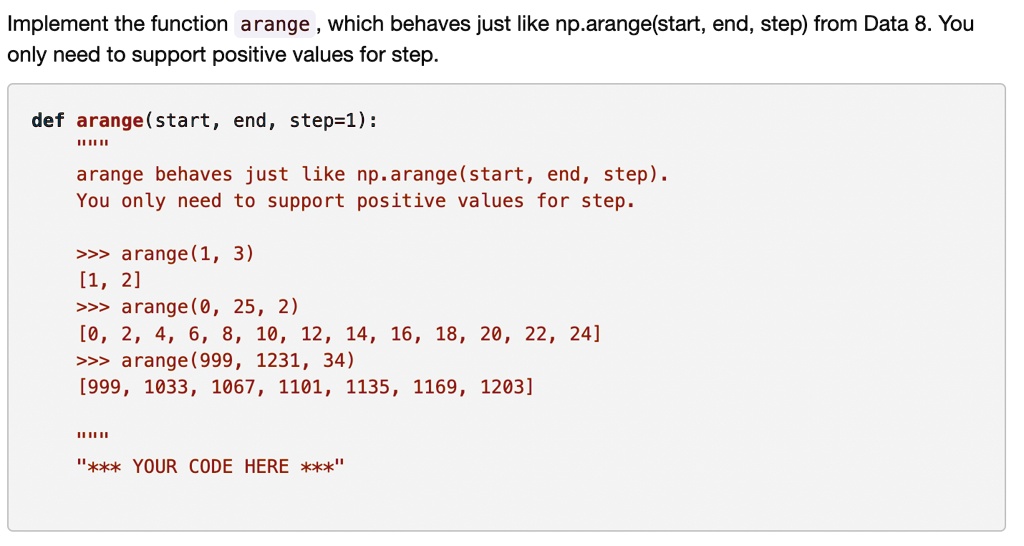
Implement the function arange, which behaves just like np.arange(start, end, step) from Data 8. You only need to support positive values for step. def arange(start, end, step=1): ...... arange behaves just like np.arange(start, end, step). You only need to support positive values for step. >>> arange(1, 3) [1, 2] >>> arange(0, 25, 2) [0, 2, 4, 6, 8, 10, 12, 14, 16, 18, 20, 22, 24] >>> arange(999, 1231, 34) [999, 1033, 1067, 1101, 1135, 1169, 1203] ...... "*** YOUR CODE HERE ***"
View Answer
divider
BEST MATCH

Text: Counters, Moore Machines, Sequence Detector using an FSM PART A: Combine the code given to you on Moodle in the xhdl examples, Creating a D Latch and D Flip-Flop" into one file that implements both. Simulate your new file to demonstrate the difference between a latch and a flip-flop. The only inputs should be CLK and X, which will be tied to the input of each device, and the only outputs should be QL and QFF. Hint: With careful design of your X waveform and the clock, you will only need a couple (relatively long) clock pulses to do this. II. Using schematic capture with an available up/down counter in your software, design a modulo-7 counter that starts at 10 and counts down to 4. Show at least one full cycle in your simulation. Don't forget to include (in your report) a state diagram of the actual counter you designed. Using JK flip flops and gates (not decoders or mux's), design and simulate a counter, which will count through the eight digits of one partner's student ID number. Design using a Moore machine as discussed in class. What you need to do in this project: 1. Develop a Moore Machine state diagram 2. Use the state diagram to create a state table still using letters for the states 3. Assign binary numbers to the states 4. Flip flops. PART B: 5. Using Karnaugh maps, develop simplified excitation and output equations from the 6. 7. IV. Design and simulate a three-bit up/down Gray Code counter to the specifications of the following function table. Use D flip-flops with a Decoder. You will need a 4:16 decoder and NAND gates for the combinational logic. The key to this problem is a correct, carefully constructed state diagram and then state table. No Karnaugh maps in your simulation. Inputs Cir W Operation UP/DOWN COUNTER BLOCK DIAGRAM clear all flip flops count UP in Gray Code count DOWN in Gray Code We wish to design a Moore machine which will detect the sequence 0010 and output 1. Draw the state diagram and develop a state table for D flip flops. Simulate solutions using the following input sequence: 100101011001010:

View Answer
divider
BEST MATCH

29. Herbie's utility function is U(x, y)=x+8y-y^2/2, where x is the number of x's he consumes per week and y is the number of y's he consumes per week. Herbie has $200 a week to spend. The price of x is $1. The price of y is currently $4 per unit. Herbie has received an invitation to join a club devoted to the consumption of y. If he joins the club, Herbie can get a discount on the purchase of y. If he belonged to the club, he could buy y for $1 a unit. How much is the most Herbie would be willing to pay to join this club? a. $33 b. $21 c. $4.50 d. $16.50 e. None of the above.

View Answer
divider
BEST MATCH

Draw the state diagram and state table of a Mealy type sequence recognizer for 1011 that has an input w and an output z. The FSM has to generate z = 1 when the values of w were 101 in three previous clock cycles and the current value is 1; otherwise, z = 0. Overlapping is allowed. First write down a hand example similar to what is shown in the notes. Repeat the above problem but change to non-overlapping. First write down a hand example. Non-overlapping should be shown clearly in the hand example. In addition, complete the following: a. Write down the state table with states assigned. b. Design the circuit on paper. Show K-maps. Use positive-edge triggered flip-flops. Draw the complete circuit.

View Answer
divider