Ace - AI Tutor
Ask Our Educators
Textbooks
My Library
Flashcards
Scribe - AI Notes
Notes & Exams
Download App
vincent moore

vincent m.

Divider

Questions asked

BEST MATCH

What is the key distinction made between professional work relationships and personal relationships, particularly concerning the aspect of dealing with people’s problems? A. Professional relationships are solely focused on achieving personal goals B. Professional relationships have clearer parameters and guidelines C. Deliberately choosing to live with needy people is healthy D. Both professional and personal relationships lack boundaries

View Answer
divider
BEST MATCH

Prove the lemma: Let n be a positive integer greater than 1 and K is a field. Let ε(n) be a primitive nth root of unity. Let σ : K(ε(n))->C be a K-homomorphism. Then σ(ε(n)) is an n-th root of 1.

View Answer
divider
BEST MATCH

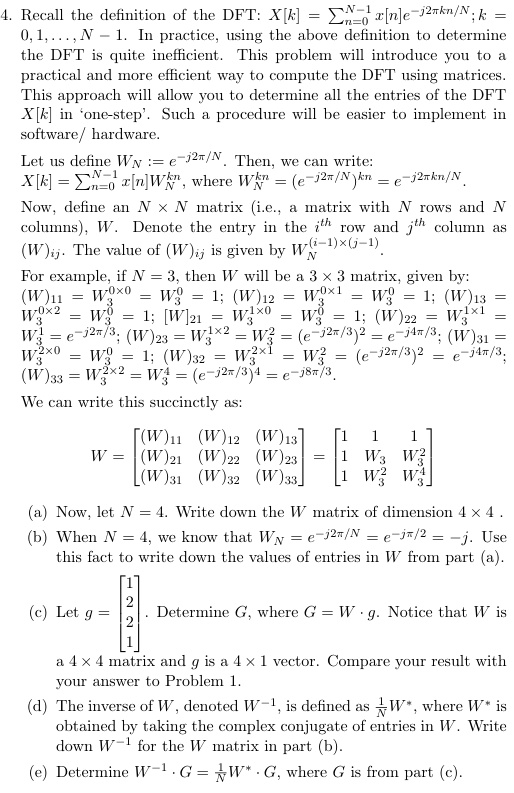
Recall the definition of the DFT: x[k]=sum_(n=0)^(N-1) x[n]e^(-j2pi k(n)/(N));k= 0,1,dots,N-1. In practice, using the above definition to determine the DFT is quite inefficient. This problem will introduce you to a practical and more efficient way to compute the DFT using matrices. This approach will allow you to determine all the entries of the DFT x[k] in 'one-step'. Such a procedure will be easier to implement in software/ hardware. Let us define W_(N):=e^(-j2(pi )/(N)). Then, we can write: x[k]=sum_(n=0)^(N-1) x[n]W_(N)^(kn), where W_(N)^(kn)=(e^(-j2(pi )/(N)))^(kn)=e^(-j2pi k(n)/(N)). Now, define an N imes N matrix (i.e., a matrix with N rows and N columns), W. Denote the entry in the i^(th ) row and j^(th ) column as (W)_(ij). The value of (W)_(ij) is given by W_(N)^((i-1) imes (j-1)). For example, if N=3, then W will be a 3 imes 3 matrix, given by: (W)_(11)=W_(3)^(0 imes 0)=W_(3)^(0)=1;(W)_(12)=W_(3)^(0 imes 1)=W_(3)^(0)=1;(W)_(13)= W_(3)^(0 imes 2)=W_(3)^(0)=1;[W]_(21)=W_(3)^(1 imes 0)=W_(3)^(0)=1;(W)_(22)=W_(3)^(1 imes 1)= W_(3)^(1)=e^(-j2(pi )/(3));(W)_(23)=W_(3)^(1 imes 2)=W_(3)^(2)=(e^(-j2(pi )/(3)))^(2)=e^(-j4(pi )/(3));(W)_(31)= W_(3)^(2 imes 0)=W_(3)^(0)=1;(W)_(32)=W_(3)^(2 imes 1)=W_(3)^(2)=(e^(-j2(pi )/(3)))^(2)=e^(-j4(pi )/(3)) (W)_(33)=W_(3)^(2 imes 2)=W_(3)^(4)=(e^(-j2(pi )/(3)))^(4)=e^(-j8(pi )/(3)). We can write this succinctly as: W=[[(W)_(11),(W)_(12),(W)_(13)],[(W)_(21),(W)_(22),(W)_(23)],[(W)_(31),(W)_(32),(W)_(33)]]=[[1,1,1],[1,W_(3),W_(3)^(2)],[1,W_(3)^(2),W_(3)^(4)]] (a) Now, let N=4. Write down the W matrix of dimension 4 imes 4. (b) When N=4, we know that W_(N)=e^(-j2(pi )/(N))=e^(-j(pi )/(2))=-j. Use this fact to write down the values of entries in W from part (a). (c) Let g=[[1],[2],[2],[1]]. Determine G, where G=W*g. Notice that W is a 4 imes 4 matrix and g is a 4 imes 1 vector. Compare your result with your answer to Problem 1. (d) The inverse of W, denoted W^(-1), is defined as (1)/(N)W^(**), where W^(**) is obtained by taking the complex conjugate of entries in W. Write down W^(-1) for the W matrix in part (b). (e) Determine W^(-1)*G=(1)/(N)W^(**)*G, where G is from part (c). 0,1,...,N 1. In practice, using the above definition to determine the DFT is quite inefficient. This problem will introduce you to a practical and more efficient way to compute the DFT using matrices. This approach will allow you to determine all the entries of the DFT X[k] in one-step'. Such a procedure will be easier to implement in software/ hardware. Let us define Wv := e-j2r/N. Then, we can write: X[k]=Lh=3x[n]Wn,where Wkn=(e-j2/N)kn=e-j2nkn/N Now, define an N N matrix (i.e., a matrix with N rows and N columns), W. Denote the entry in the ith row and jth column as For example, if N = 3, then W will be a 3 3 matrix, given by: We can write this succinctly as: W11W12 = M W21(W22 M) (W)31(W)32 [1 1 11 1 W3 W3 1 W3 W1] (a) Now, let N = 4. Write down the W matrix of dimension 4 4 . (b) When N = 4,we know that Wv = e-j2/N = e-jr/2 = -j. Use this fact to write down the values of entries in W from part (a) 1] cLet g= Determine G. where G = Wg. Notice that W is 1 a 4 4 matrix and g is a 4 1 vector. Compare your result with your answer to Problem 1. (d) The inverse of W, denoted W1, is defined as W*, where W* is obtained by taking the complex conjugate of entries in W. Write down W-1 for the W matrix in part (b). (e) Determine W-1 . G = W* . G, where G is from part (c).
View Answer
divider
BEST MATCH

The text appears to be free of spelling, typographical, grammatical, OCR, and mathematical errors.

View Answer
divider
BEST MATCH

Greece: Using fiscal policy to avoid the meltdown and debt crisis of 2009. As a result of the combined effects of the Great Recession and the European sovereign debt crisis, GDP of Greece declined from €281.44 billion in 2008 to €176.5 billion in 2015 . a. What is the percentage change in GDP of Greece during this period? b. By how much should autonomous expenditure have risen to prevent the slide in Greece's GDP, given that marginal propensity to consume is 0.6 ? c. Using your answer to part (b), explain why the Greek Parliament rejected the austerity measures that lender nations sanctioned for Greece. d. The Greek reform program aimed to improve incentives to private investors. Suppose, the government spending increased by €15.5 billion, by how much does the country's GDP increase? 10.Greece: Using fiscal policy to avoid the meltdown and debt crisis of 2009 As a result of the combined effects of the Great Recession and the European sovereign debt crisis,GDP of Greece declined from C281.44 billion in 2008 to E176.5 billion in 2015. a. What is the percentage change in GDP of Greece during this period? b. By how much should autonomous expenditure have risen to prevent the slide in Greece's GDP, given that marginal propensity to consume is 0.6? c. Using your answer to part (b),explain why the Greek Parliament rejected the austerity measures that lender nations sanctioned for Greece. d. The Greek reform program aimed to improve incentives to private investors. Suppose, the government spending increased by C15.5 billion, by how much does the country's GDP increase? U155X2.5=38.75

View Answer
divider
BEST MATCH

RR RY YY w 0.7 1 0.2 f(R) = p = 0.8 How do we expect the freq. of R to change from this generation to the next? (p' equation) Did f(R) increase, decrease or stay the same? Why? To answer this, we want to know the expected f(R) at equilibrium (p-hat equation)

View Answer
divider
BEST MATCH

7.14 The switch in the circuit in Fig. P7.14 has been closed for a long time before opening at $t = 0$. Find $v_o(t)$ for $t = 0^+$. Figure P7.14

View Answer
divider
BEST MATCH

Problem 13-4A Pro Com Ltd. issues 8,100, $6 cumulative preferred shares (convertible into two common shares apiece) at $62, and 15,000 common shares (at $30 such) at the beginning of 2012. During the years 2013 and 2014, the following transactions affected Pro Com's shareholders' equity accounts: 2013 Jan. 10 Paid $13,000 of annual dividends to preferred shareholders. 2014 Jan. 10 Paid annual dividend to preferred shareholders and a $3,700 dividend to common shareholders. Mar. 1 The preferred shares were converted into common shares. Journalize each of the transactions. (Credit account titles are automatically indented when the amount is entered. Do not indent manually. If no entry is required, select "No Entry" for the account titles and enter 0 for the amounts.) Date Account Titles and Explanation 2013 Jan. 10 Debit Credit Date Account Titles and Explanation Debit Credit 2014 Jan. 10 Mar. 1

View Answer
divider
BEST MATCH

Which statement is correct? Select the best answer. Answer 2 Points Keypad Keyboard Shortcuts A rebound of the economy back to potential GDP works only in response to a shift to the right in aggregate demand. According to Keynesian analysis, in the short run, a rise in aggregate demand results in a new equilibrium, which is at the same original level of output, but at a higher price level. Under the neoclassical perspective on macroeconomics, when economic output rises above potential GDP, there is a labor shortage.

View Answer
divider
BEST MATCH

Which of the following illustrates the 6 permutations of 3 letters F,B, and O taken 2 at a time? A. F,B,O,F,B,O B. FB, FO, BF, FB, FO, BF C. FB, FO, BO, BF, OF, OB D. FBO, OBF, FBO, OBF, FBO, OBF

View Answer
divider