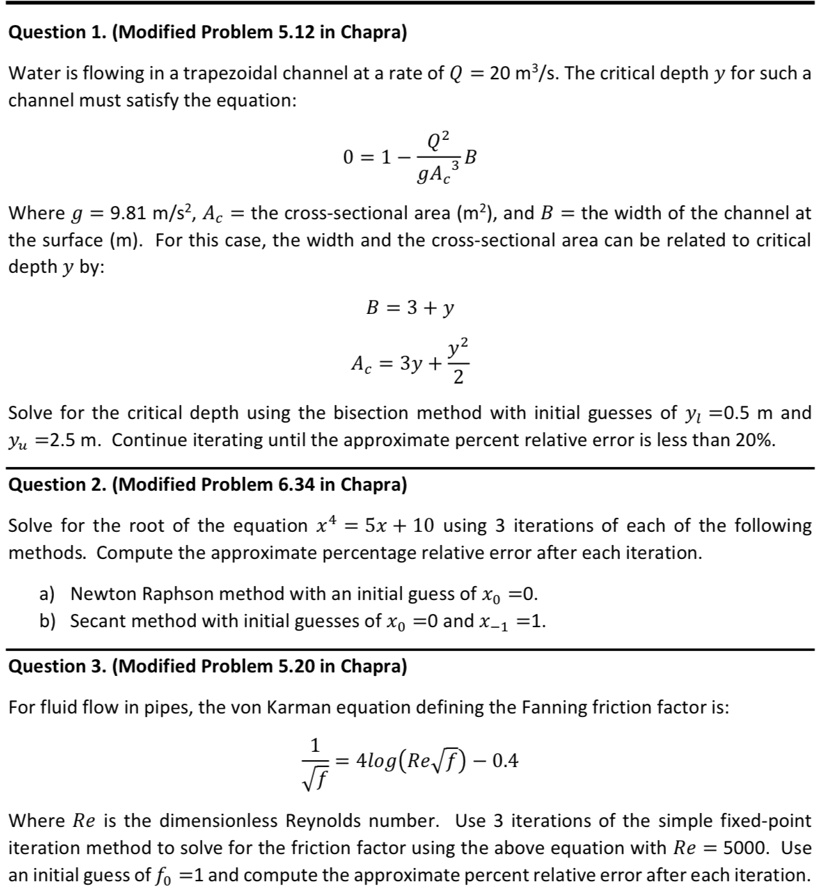
Question 1. (Modified Problem 5.12 in Chapra)
Water is flowing in a trapezoidal channel at a rate of $Q = 20 m^3/s$. The critical depth y for such a
channel must satisfy the equation:
$0 = 1 - \frac{Q^2}{gA_c^3B}$
Where $g = 9.81 m/s^2$, $A_c = $ the cross-sectional area ($m^2$), and $B = $ the width of the channel at
the surface (m). For this case, the width and the cross-sectional area can be related to critical
depth y by:
$B = 3 + y$
$A_c = 3y + \frac{y^2}{2}$
Solve for the critical depth using the bisection method with initial guesses of $y_l = 0.5 m$ and
$y_u = 2.5 m$. Continue iterating until the approximate percent relative error is less than 20%.
Question 2. (Modified Problem 6.34 in Chapra)
Solve for the root of the equation $x^4 = 5x + 10$ using 3 iterations of each of the following
methods. Compute the approximate percentage relative error after each iteration.
a) Newton Raphson method with an initial guess of $x_0 = 0$.
b) Secant method with initial guesses of $x_0 = 0$ and $x_{-1} = -1$.
Question 3. (Modified Problem 5.20 in Chapra)
For fluid flow in pipes, the von Karman equation defining the Fanning friction factor is:
$\frac{1}{\sqrt{f}} = 4log(Re\sqrt{f}) - 0.4$
Where Re is the dimensionless Reynolds number. Use 3 iterations of the simple fixed-point
iteration method to solve for the friction factor using the above equation with $Re = 5000$. Use
an initial guess of $f_0 = 1$ and compute the approximate percent relative error after each iteration.