Ace - AI Tutor
Ask Our Educators
Textbooks
My Library
Flashcards
Scribe - AI Notes
Notes & Exams
Download App
Biology

P

Divider

Books Assigned

Organic Chemistry

Organic Chemistry

Janice… 4th Edition
Achievement 1,120 solutions
Organic Chemistry

Organic Chemistry

John McMurry 8th Edition
Achievement 1,402 solutions
Principles of Biochemistry

Principles of Biochemistry

David L.… 7th Edition
Achievement 1,889 solutions
Principles of Biochemistry

Principles of Biochemistry

Albert… 5th Edition
Achievement 1,680 solutions
Lehninger Principles of Biochemistry

Lehninger Principles of…

David L.… 6th Edition
Achievement 1,006 solutions
Lehninger Principles of Biochemistry

Lehninger Principles of…

David L.… 7th Edition
Achievement 1,802 solutions
Organic Chemistry

Organic Chemistry

Janice… 6th Edition
Achievement 1,751 solutions
Organic Chemistry

Organic Chemistry

Marc Loudon,… 6th Edition
Achievement 1,270 solutions
Lehninger Principles of Biochemistry

Lehninger Principles of…

David L.… 8th Edition
Achievement 1,062 solutions

Viewed Questions

Show the product of the Diels-Alder reaction of the following diene with 3-buten-2-one, $\mathrm{H}_{2} \mathrm{C}=\mathrm{CHCOCH}_{3}$. Make sure you show the full stereochemistry of the reaction product.
(FIGURE CANT COPY)

Show the product of the Diels-Alder reaction of the following diene with 3-buten-2-one, $\mathrm{H}_{2} \mathrm{C}=\mathrm{CHCOCH}_{3}$. Make sure you show the full stereochemistry of the reaction product. (FIGURE CANT COPY)

Organic Chemistry

 When ethylbenzene is reacted with nitric acid, three possible benzenes containing both a nitro group and an ethyl group are obtained. Draw and name them.

When ethylbenzene is reacted with nitric acid, three possible benzenes containing both a nitro group and an ethyl group are obtained. Draw and name them.

Fundamentals of General, Organic, and Biological Chemistry

Draw a mechanism for each of the three reactions shown in Figure $21-34,$ detailing the pathway for the synthesis of mevalonate from acetyl-CoA.

Draw a mechanism for each of the three reactions shown in Figure $21-34,$ detailing the pathway for the synthesis of mevalonate from acetyl-CoA.

Principles of Biochemistry

What changes in metabolic pattern would result from a mutation in the muscle carnitine acyltransferase 1 in which the mutant protein has lost its affinity for malonyl-CoA but not its catalytic activity?

Lehninger Principles of Biochemistry

Questions asked

BEST MATCH

3) Staphylococcus epidermis 4) Salmonella enterica 5) Micrococcus luteus b) Staphylococcus aureus 7) Escherichia coli 8) \( { }_{0}^{\omega} \) Providencia stuartii 9) Serratia marcescens 10) Shigella Hexneri 11) Bacillus subtilis

View Answer
divider
ANSWERED

Anand Jangid verified

Numerade educator

Gram stain colonies - + Aerotolerance Facultative Aerotolerance Obligate aerobe + - anaerobe DNase Decarboxylates Facultative Obligate lysine anaerobe aerobe - + Catalase test Nitrate Reduction Moraxella - + catarrhalis Streptococcus Staphylococcus - + thermophilus epidermidis Alcaligenes Pseudomonas Starch faecalis putida Hydrolysis + - - + Micrococcus Sulfur Lactose luteus Reduction Fermentation 2,3-butanediol - + fermentation + - Providencia Citrobacter Bacillus Bacillus stuartii freundii - + subtilis megaterium Enterobacter Escherichia aerogenes coli

View Answer
divider
BEST MATCH

Make a flow chart similar to the shared image, but for THESE listed organisms for a biochemical test of an unknown bacterium lab: 1. Klebsiella pneumonia 2. Pseudomonas aeruginosa 3. Staphylococcus epidermidis 4. Salmonella enterica 5. Micrococcus luteus 6. Staphylococcus aureus 7. Escherichia coli 8. Providencia stuartii 9. Serratia marcescens 10. Shigella flexneri 11. Bacillus subtilis 12. Citrobacter freundii 13. Mycobacterium smegmatis 14. Alcaligenes faecalis 15. Bacillus megaterium 16. Bacillus licheniformis 17. Proteus mirabilis 18. Enterobacter aerogenes Figure 42.2: List of all possible unknown organisms

View Answer
divider
ANSWERED

Ivan Kochetkov verified

Numerade educator

Neurological examination of a 64-year-old man revealed loss of discriminative touch, vibration, and pain sensations in the left leg and foot. Sensory acuity was normal in other parts of the body. Damage to which of the following structures could account for this deficit? A. left medial somatosensory cortex B. right media; somatosensory cortex C. left ventral posterolateral nucleus of the thalamus D. left lateral midbrain E. right medial medulla F. left lateral pons

View Answer
divider
ANSWERED

Tavis Lam verified

Numerade educator

Consider the alkylation reactions below. In each reaction, predict which product (A or B) will be the major product. Explain your reasoning in each case.

View Answer
divider
ANSWERED

Tavis Lam verified

Numerade educator

Indicate whether each of the reactions below (A and B) will occur as written? For each reaction, indicate Yes if the reaction will occur or No if it will not occur. Explain why in each case.

View Answer
divider
ANSWERED

Ivan Kochetkov verified

Numerade educator

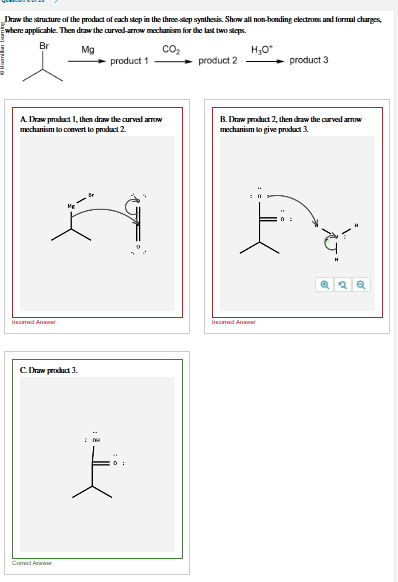
Draw the structure of the product of each step in the 3-step synthesis. Show all non-bonding electrons & formal charges, where applicable. Then draw the curved-arrow mechanism for the last two steps. Br-CH(CH3)2 --Mg--> product 1 --CO2--> product 2 --H3O+--> product 3

View Answer
divider
ANSWERED

Klei Yskollari verified

Numerade educator

Question 1: Indicate whether each of the reactions below (A and B) will occur as written. For each reaction, indicate Yes if the reaction will occur or No if it will not occur. Explain why in each case.

View Answer
divider
ANSWERED

Shalini Tyagi verified

Numerade educator

Draw the structure of the product of each step in the three-step synthesis. Show all non-bonding electrons and formal charges, where applicable. Then draw the curved-arrow mechanism for the last two steps. A. Draw product 1, then draw the curved arrow mechanism to convert to product 2. B. Draw product 2, then draw the curved arrow mechanism to give product 3. C. Draw product 3.
View Answer
divider
ANSWERED

Tavis Lam verified

Numerade educator

2) Indicate whether each of the reactions below (#1 or #2) will occur as written (Yes or No). Explain why for each case.

View Answer
divider