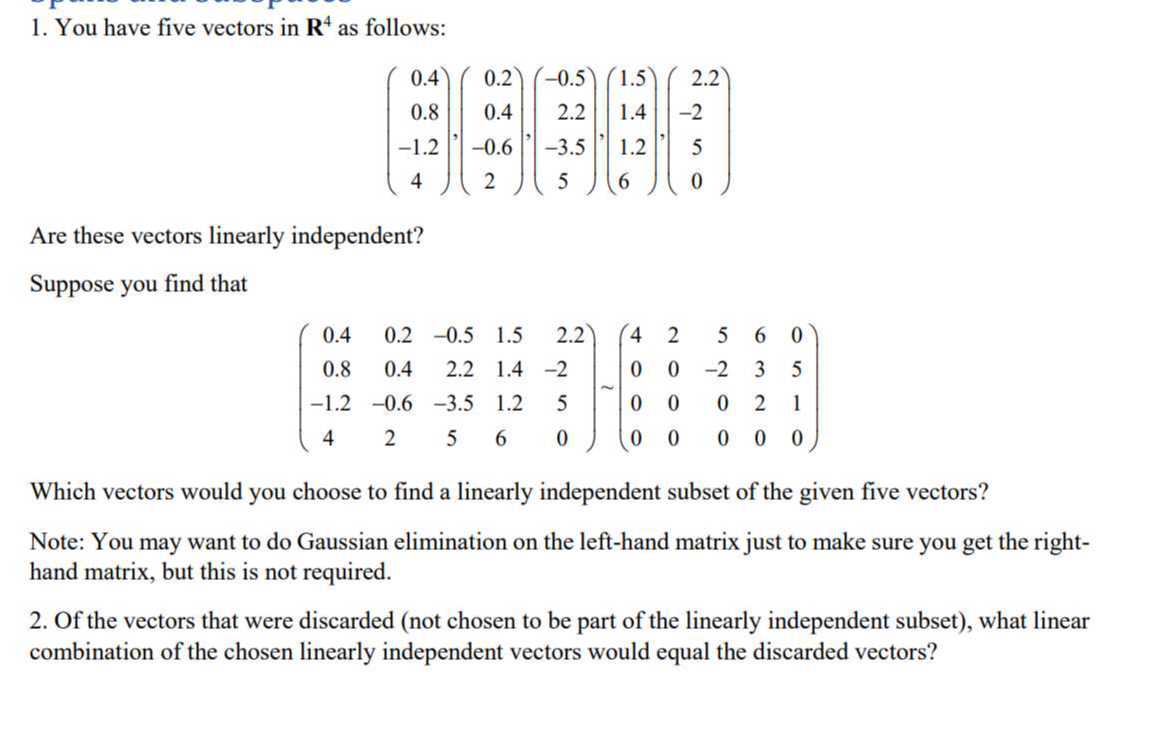
1. You have five vectors in \( \mathbf{R}^{4} \) as follows:
\[
\left(\begin{array}{c}
0.4 \\
0.8 \\
-1.2 \\
4
\end{array}\right),\left(\begin{array}{c}
0.2 \\
0.4 \\
-0.6 \\
2
\end{array}\right),\left(\begin{array}{c}
-0.5 \\
2.2 \\
-3.5 \\
5
\end{array}\right),\left(\begin{array}{l}
1.5 \\
1.4 \\
1.2 \\
6
\end{array}\right),\left(\begin{array}{c}
2.2 \\
-2 \\
5 \\
0
\end{array}\right)
\]
Are these vectors linearly independent?
Suppose you find that
\[
\left(\begin{array}{rrrlc}
0.4 & 0.2 & -0.5 & 1.5 & 2.2 \\
0.8 & 0.4 & 2.2 & 1.4 & -2 \\
-1.2 & -0.6 & -3.5 & 1.2 & 5 \\
4 & 2 & 5 & 6 & 0
\end{array}\right) \sim\left(\begin{array}{rrrrr}
4 & 2 & 5 & 6 & 0 \\
0 & 0 & -2 & 3 & 5 \\
0 & 0 & 0 & 2 & 1 \\
0 & 0 & 0 & 0 & 0
\end{array}\right)
\]
Which vectors would you choose to find a linearly independent subset of the given five vectors?
Note: You may want to do Gaussian elimination on the left-hand matrix just to make sure you get the righthand matrix, but this is not required.
2. Of the vectors that were discarded (not chosen to be part of the linearly independent subset), what linear combination of the chosen linearly independent vectors would equal the discarded vectors?