Ace - AI Tutor
Ask Our Educators
Textbooks
My Library
Flashcards
Scribe - AI Notes
Notes & Exams
Download App
wanda goodman

wanda g.

Divider

Questions asked

BEST MATCH

Let r(x)=tan^(3)(x). Which of the following best describes its fundamental algebraic structure? Composition. A composition f(g(x)) of basic functions Sum. A sum f(x) g(x) of basic functions Product. A product f(x)*g(x) of basic functions Quotient. A quotient f(x)/(g)(x) of basic functions Determine f(x) and g(x). f(x)= g(x)=

View Answer
divider
BEST MATCH

One difference between mitosis and meiosis is O mitosis produces cells genetically identical to the parent cell, but meiosis does not O mitosis produces more daughter cells than meiosis O mitosis requires only one parent cell, but meiosis requires two parent cells O mitosis produces haploid cells, but meiosis produces diploid cells

View Answer
divider
BEST MATCH

Where on the ECG trace would you expect to hear the first heart sound? A. P wave B. QRS C. RS D. S-T interval E. T wave

View Answer
divider
BEST MATCH

In class we discussed how when strategies become too all encompassing, they create the primary problem of:

View Answer
divider
BEST MATCH

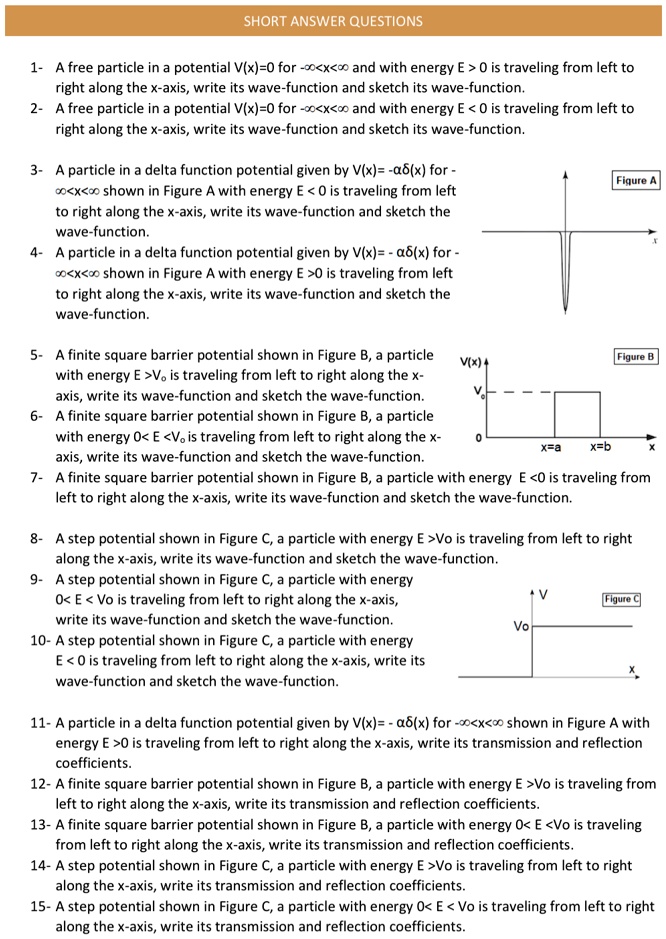
SHORT ANSWER QUESTIONS 1- A free particle in a potential V(x)=0 for E>0 is traveling from left to right along the x-axis, write its transmission and reflection coefficients. 2- A free particle in a potential V(x)=0 for E<0 is traveling from left to right along the x-axis, write its transmission and reflection coefficients. 3- A particle in a delta function potential given by V(x)=-alpha delta (x) for -infty<x<infty with energy E>0 is traveling from left to right along the x-axis, write its transmission and reflection coefficients. 4- A finite square barrier potential shown in Figure B, a particle with energy E>Vo is traveling from left to right along the x-axis, write its transmission and reflection coefficients. 5- A finite square barrier potential shown in Figure B, a particle with energy 0 is traveling from left to right along the x-axis, write its transmission and reflection coefficients. 6- A step potential shown in Figure C, a particle with energy E>V is traveling from left to right along the x-axis, write its transmission and reflection coefficients. 7- A step potential shown in Figure C, a particle with energy 0 is traveling from left to right along the x-axis, write its transmission and reflection coefficients. 8- A step potential shown in Figure C, a particle with energy E<0 is traveling from left to right along the x-axis, write its wave-function and sketch the wave-function. 9- A finite square barrier potential shown in Figure B, a particle with energy E<0 is traveling from left to right along the x-axis, write its wave-function and sketch the wave-function. 10- A step potential shown in Figure C, a particle with energy E>V o is traveling from left to right along the x-axis, write its wave-function and sketch the wave-function. 11- A step potential shown in Figure C, a particle with energy 0 is traveling from left to right along the x-axis, write its wave-function and sketch the wave-function.
View Answer
divider
BEST MATCH

what factors are associated with screen time in risk of obesity in children?

View Answer
divider
BEST MATCH

Consider the following sentence: "If you follow the commands of God, lead a righteous life, and submit to religious authority, then you will be given eternal life." Does this sentence constitute an argument? Why or why not? If it is an argument, then identify the conclusion.

View Answer
divider
BEST MATCH

Which of the following would be used when referring to multi-drug resistance in Mycobacterium? ? MDR-TB ? MRSA ? MDR ? CRE ? ESBL

View Answer
divider
BEST MATCH

Given x(t) = e^(-t)u(t), h(t) = e^(-t)u(-t). Find y(t) = x(t) * h(t), where * represents convolution. y(t) = ∫e^(1/2) y(t) = ∫e^(lt)

View Answer
divider
BEST MATCH

6 of 10 (2)Work out (1)/(2)+(2)/(5) Give your answer in its simplest form.

View Answer
divider