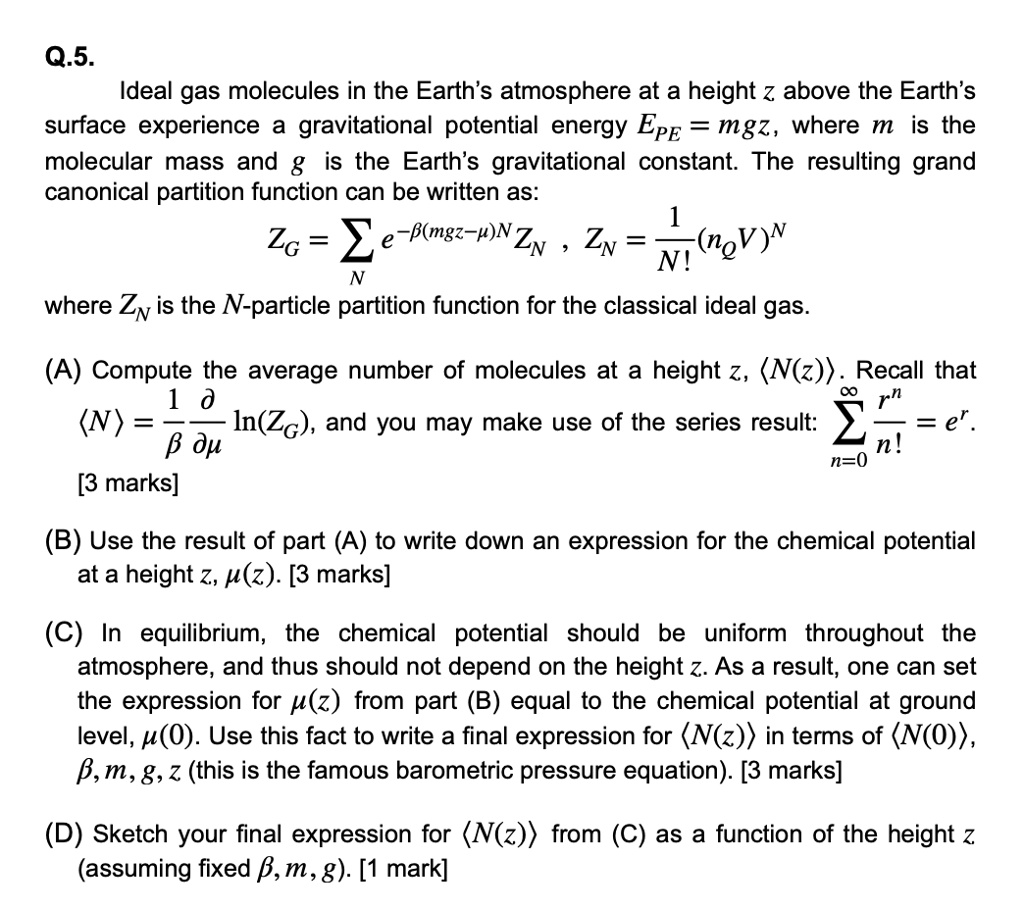
Q.5.
Ideal gas molecules in the Earth's atmosphere at a height $z$ above the Earth's
surface experience a gravitational potential energy $E_{PE} = mgz$, where $m$ is the
molecular mass and $g$ is the Earth's gravitational constant. The resulting grand
canonical partition function can be written as:
$Z_G = \sum_N e^{-\beta(mgz-\mu)N} Z_N$, $Z_N = \frac{1}{N!}(n_Q V)^N$
where $Z_N$ is the $N$-particle partition function for the classical ideal gas.
(A) Compute the average number of molecules at a height $z$, $\langle N(z) \rangle$. Recall that
$\langle N \rangle = \frac{1}{\beta} \frac{\partial}{\partial \mu} \ln(Z_G)$, and you may make use of the series result: $\sum_{n=0}^{\infty} \frac{r^n}{n!} = e^r$.
[3 marks]
(B) Use the result of part (A) to write down an expression for the chemical potential
at a height $z$, $\mu(z)$. [3 marks]
(C) In equilibrium, the chemical potential should be uniform throughout the
atmosphere, and thus should not depend on the height $z$. As a result, one can set
the expression for $\mu(z)$ from part (B) equal to the chemical potential at ground
level, $\mu(0)$. Use this fact to write a final expression for $\langle N(z) \rangle$ in terms of $\langle N(0) \rangle$,
$\beta$, $m$, $g$, $z$ (this is the famous barometric pressure equation). [3 marks]
(D) Sketch your final expression for $\langle N(z) \rangle$ from (C) as a function of the height $z$
(assuming fixed $\beta$, $m$, $g$). [1 mark]