Ace - AI Tutor
Ask Our Educators
Textbooks
My Library
Flashcards
Scribe - AI Notes
Notes & Exams
Download App
wendy brown

wendy b.

Divider

Questions asked

BEST MATCH

Question 13 of 19 © Macmillan Learning A chromosomal segment that breaks off and attaches to another chromosome is what type of mutation? O inversion O duplication O translocation O deletion O reciprocal translocation

View Answer
divider
BEST MATCH

Choose another medical isotope and report on the uses, half-life, decay type(s), and any safety concerns. Be sure to cite your sources fully.

View Answer
divider
BEST MATCH

L^(-1){(s+1)/(s^(2)-4s)} 18. $\mathcal{L}^{-1}\left\{ \frac{s+1}{s^2 - 4s} \right\}$

View Answer
divider
BEST MATCH

Part A What is the most important abiotic factor in any ecosystem? Nutrients Temperature Energy Precipitation Submit Request Answer vide Feedback

View Answer
divider
BEST MATCH

Thyroxine and calcitonin are secreted by the Question 2 options: A) pituitary gland. B) heart. C) thyroid gland. D) kidneys. E) gonads.

View Answer
divider
BEST MATCH

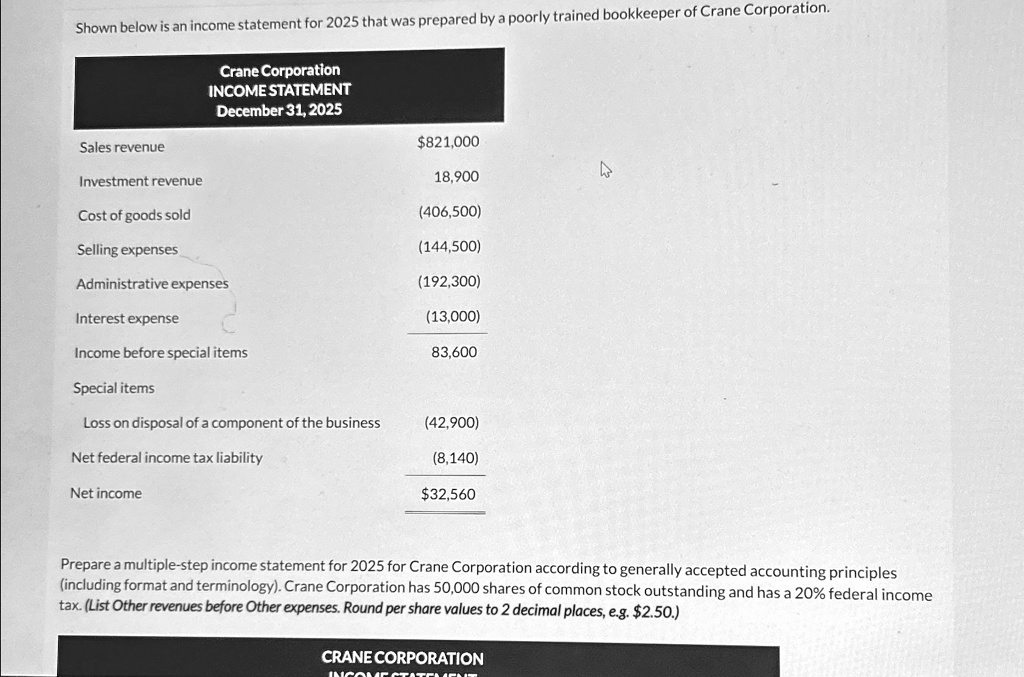
Shown below is an income statement for 2025 that was prepared by a poorly trained bookkeeper of Crane Corporation. Crane Corporation INCOME STATEMENT December 31, 2025 Sales revenue $821,000 Investment revenue 18,900 Cost of goods sold (406,500) Selling expenses (144,500) Administrative expenses (192,300) Interest expense (13,000) Income before special items 83,600 Special items Loss on disposal of a component of the business (42,900) Net federal income tax liability (8,140) Net income $32,560 Prepare a multiple-step income statement for 2025 for Crane Corporation according to generally accepted accounting principles (including format and terminology). Crane Corporation has 50,000 shares of common stock outstanding and has a 20% federal income tax. (List Other revenues before Other expenses. Round per share values to 2 decimal places, e.g. $2.50.) CRANE CORPORATION INCON
View Answer
divider
BEST MATCH

28. What is the value of a standard "non-behavioral" language assessment? a. Develop interventions for individuals with disabilities b. Provide norm-referenced assessment scores c. Diagnose specific disorders d. Determine operant weaknesses

View Answer
divider
BEST MATCH

Problems 2.1 (a) With initial point $x_0 = \begin{bmatrix} 0 \\ 0 \end{bmatrix}^T$, perform two conjugate gradient (CG) iterations (preferably by hand with help from MATLAB for straightforward but tedious calculations) for the Rosenbrock function $f(x_1, x_2) = (x_1 - 1)^2 + 100(x_1^2 - x_2)^2$. Refer to Example 1.4 for its gradient. Use optimized step size $\alpha_o = 0.0625$ for the first iteration and the same step size for the second iteration. 58 (b) The Rosenbrock function possesses a global minimizer $x^* = \begin{bmatrix} 1 \\ 1 \end{bmatrix}^T$ at which $f(x^*) = 0$. Evaluate the performance of CG algorithm in comparison with the basic GD in terms of closeness of the iterates to the global solution and reduction in the objective function achieved by each iteration of the algorithms. For your reference, it is also known that with the initial point $x_0 = \begin{bmatrix} 0 \\ 0 \end{bmatrix}^T$ the first two basic GD iterations yield $x_1^{(GD)} = \begin{bmatrix} 0.1250 \\ 0 \end{bmatrix}$, $f(x_1^{(GD)}) = 0.79$ and $x_2^{(GD)} = \begin{bmatrix} 0.1326 \\ 0.0244 \end{bmatrix}$, $f(x_2^{(GD)}) = 0.7571$

View Answer
divider
BEST MATCH

Nicole and Ethan want to remodel their kitchen in 5 years. They estimate the job will cost $15,000. How much must they invest now at an annual interest rate of 3.5% compounded monthly to achieve their goal? Include units of measurement in your answers. Round your answers to the nearest cent.

View Answer
divider
BEST MATCH

BC:4.1 Use Matlab and the conv() command to calculate and plot $y[n]$ vs $n$, where $\gamma[n] = \alpha[n] * \beta[n] = \beta[n] * \alpha[n]$ for each of the $\alpha[n]$ and $\beta[n]$ pairs below. For full credit, include your commented Matlab source code and plots of all nonzero values of $y[n]$ vs $n$. a.) $\alpha[n] = (-0.9)^{n-2} (\delta[n+2] + \delta[n] + \delta[n-1])$ $\beta[n] = \cos(0.25\pi n) (u[n-1] - u[n-5])$ b.) $\alpha[n] = 36(\frac{n}{2}-1)(u[n] - u[n-4])$ $\beta[n] = \frac{1}{(n+1)}(u[n-2] - u[n-6])

View Answer
divider