Ace - AI Tutor
Ask Our Educators
Textbooks
My Library
Flashcards
Scribe - AI Notes
Notes & Exams
Download App
wendy c-rdoba

wendy c.

Divider

Questions asked

BEST MATCH

Vaporization is the process by which molecules transition from the liquid phase to the gas phase. In a closed container, as a liquid vaporizes, gas molecules cannot escape. These gas-phase molecules move randomly and may collide with the liquid surface, resulting in the molecules re-entering the liquid phase through condensation. When the rate of vaporization equals the rate of condensation, dynamic equilibrium is established, meaning the amounts of liquid and vapor remain constant over time. The pressure exerted by the vapor in equilibrium with the liquid at a given temperature is known as the vapor pressure. The vapor pressure of a liquid depends on temperature and the intermolecular forces present. Liquids with strong intermolecular forces have lower vapor pressures because their molecules are less likely to escape into the gas phase. Conversely, liquids with weak intermolecular forces have higher vapor pressures. As temperature increases, kinetic energy increases, allowing more molecules to overcome intermolecular forces and escape into the gas phase, thus increasing vapor pressure. 1. Which term describes the condition when a liquid's rate of vaporization equals its rate of condensation in a closed container? Equilibrium vapor pressure Static equilibrium Saturation point Dynamic equilibrium 2. How does increasing the temperature affect the vapor pressure of a liquid? It decreases vapor pressure by reducing molecular motion. It has no effect on vapor pressure. It increases vapor pressure by providing more kinetic energy to molecules. It decreases vapor pressure by strengthening intermolecular forces. 3. Liquids with strong intermolecular forces exhibit: Low vapor pressures because molecules escape less readily. High vapor pressures due to easy vaporization. Vapor pressures independent of temperature. No vapor pressure at all.

View Answer
divider
BEST MATCH

Which action best demonstrates assertive communication when reporting a change in the client's status? Telling the provider, "His blood pressure was up to 180/99 at 091.5 this morning. Would you like to change his medications?" Telling the provider, "You need to order more blood pressure medicine because his numbers are higher." Asking the provider, "Do you think his blood pressure is a little high today?" Recording the change in the electronic health record.

View Answer
divider
BEST MATCH

The best way to differentiate between Staphylococcus aureus and Staphylococcus epidermidis is Question 7 options: catalase test coagulase test gram stain hemolysis test (blood agar)

View Answer
divider
BEST MATCH

Explain what happens to a population if it exceeds the carrying capacity?

View Answer
divider
BEST MATCH

In the case of a second-order instrument, indicate the effect of different degrees of damping on the time response. 2.9. State briefly how the dynamic characteristics of an instrument affect its usage. 2.10. A tungsten resistance thermometer with a range of -270 to +1100°C has a quoted inaccuracy of ±1.5% of full-scale reading. What is the likely measurement error when it is reading a temperature of 950°C? 2.11. A batch of steel rods is manufactured to a nominal length of 5 meters with a quoted tolerance of ±2%, What is the longest and shortest length of rod to be expected in the batch? 2.12. What is the measurement range for a micrometer designed to measure diameters between 5.0 and 7.5 cm? 2.13. A tungsten/5% rhenium-tungsten/26% rhenium thermocouple has an output e.m.f. as shown in the following table when its hot (measuring) junction is at the temperatures shown. Determine the sensitivity of measurement for the thermocouple in mV/°C. mV °C 4.37 8.74 13.11 17.48 250 500 750 1000 2.14. Define sensitivity drift and zero drift. What factors can cause sensitivity drift and zero drift in instrument characteristics?

View Answer
divider
BEST MATCH

Periodic Pulse Generator: This system generates an active-high pulse (10 us) every 60 ms. S S Periodic Pulse P 10 us Generator P ... 60 ms ... Operation: The circuit starts generating the periodic pulse when the s signal (usually a one-cycle pulse) is asserted. ? Input: s (start signal). Outputs: p (60ms periodic pulse). Clock frequency: 100 MHz. Sketch the circuit: FSM + Datapath components. Specify all the I/Os of the FSM, as well as the signals connecting the FSM and the Datapath components (as in Problem 2). ? Suggestion: The Datapath only needs two counters (one for 60 ms and one for 10 us). You can use the parametric counter with enable and synchronous clear (my_genpulse_sclr). 0 0 Counter Q: 10 us counter. For a clock period of 10 ns, it counts from 0 to 999. Counter R: 60 ms counter. For a clock period of 10 ns, it counts from 0 to $6 \times 10^6$ - 1. Provide the State Diagram (in ASM form) of the FSM.

View Answer
divider
BEST MATCH

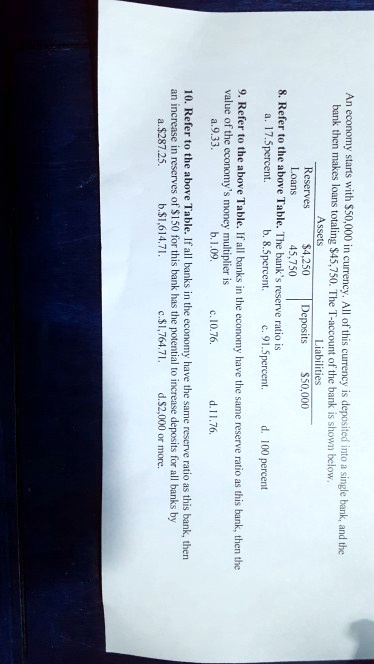
An economy starts with $50,000 in currency. All of this currency is deposited into a single bank, and the bank then makes loans totaling $45,750. The T-account of the bank is shown below. Assets Liabilities Reserves Loans $4,250 Deposits $50,000 45,750 a. 17.5percent. b. 8.5percent. c. 91.5percent. d. 100 percent 8. Refer to the above Table. The bank's reserve ratio is 9. Refer to the above Table. If all banks in the economy have the same reserve ratio as this bank, then the value of the economy's money multiplier is a.9.33. b.1.09. c.10.76. d.11.76. 10. Refer to the above Table. If all banks in the economy have the same reserve ratio as this bank, then an increase in reserves of $150 for this bank has the potential to increase deposits for all banks by a.$287.25. b.$1,614.71. c.$1,764.71. d.$2,000 or more.
View Answer
divider
BEST MATCH

Which of the following antibiotics used in lab has a mode of action similar to penicillin? Select one: a. Gentamicin b. Ampicillin c. Erythromycin d. Chloramphenicol e. Tetracycline

View Answer
divider
BEST MATCH

F E H J D A

View Answer
divider
BEST MATCH

Problem 3. (10 points) For the circuit below, find the labeled node voltage. For the transistor, $k_nW/L = 2mA/V^2$, $V_t = 0.5V$.

View Answer
divider