Ordinary Differential Equations Question. Please refer to the image. Solve all parts 1 to 8 (1-8 are part of a single problem) in detail. Thanks!
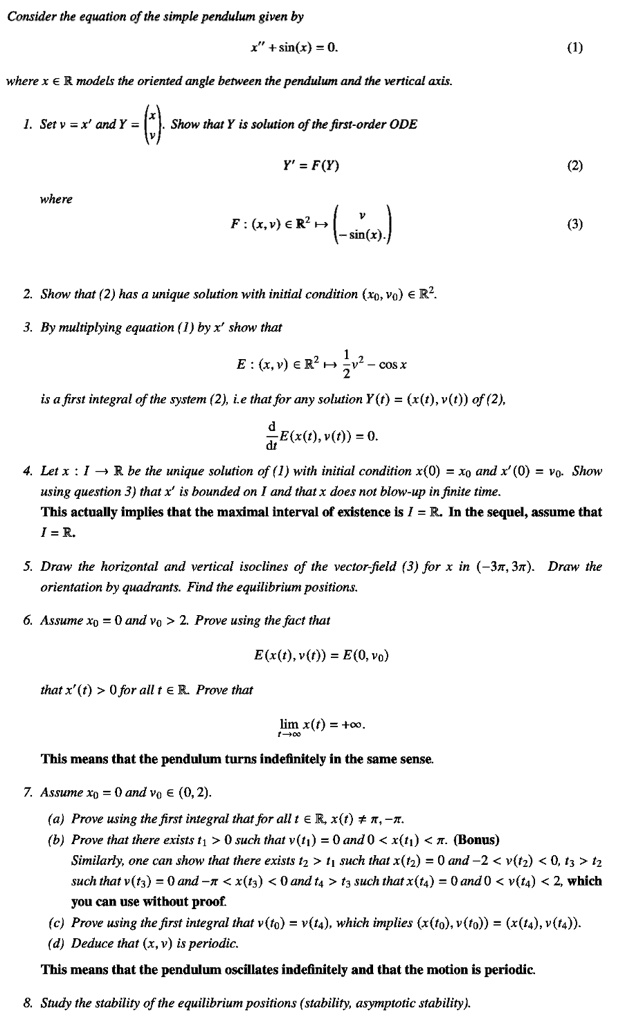
Consider the equation of the simple pendulum given by
x + sinx = 0.
(1)
where x ∈ R models the oriented angle between the pendulum and the vertical axis.
1. Set v = x and Y.
Show that Y is a solution of the first-order ODE
Y = F(Y)
(2)
where
F: x ∈ R
(3)
2. Show that (2) has a unique solution with initial condition (x0, v0) ∈ R
3. By multiplying equation (1) by x' show that
1 ∈ x ∈ R - cosx 2
is a first integral of the system 2), i.e., that for any solution Y(t) = x(t), v(t) of 2
x(t)v(t) = 0 dt
4. Let x: I - R be the unique solution of (1) with initial condition x(0) = x0 and x0) = v0. Show using question 3) that x' is bounded on I and that x does not blow-up in finite time. This actually implies that the maximal interval of existence is I = R. In the sequel, assume that I = R.
5. Draw the horizontal and vertical isoclines of the vector-field (3) for x in -3, 3. Draw the orientation by quadrants. Find the equilibrium positions.
6. Assume x0 = 0 and v0 > 2. Prove using the fact that
Ex, vt = E0, vo
that x't) > 0 for all t ∈ R. Prove that
lim x = +.
This means that the pendulum turns indefinitely in the same sense.
7. Assume x0 = 0 and v0 0, 2
(a) Prove using the first integral that for all t ∈ R, x't-. (b) Prove that there exists t > 0 such that v(t) = 0 and 0 < x(t) <. Bonus Similarly, one can show that there exists t2 > t such that x(t2) = 0 and -2 < v(t) < 0, t3 > t such that v(t3) = 0 and - < x(t3) < 0 and t4 > t3 such that x(t4) = 0 and 0 < v(t4) < 2, which you can use without proof. c Prove using the first integral that vto = vt4), which implies xto, vto) = xt4), vt4) (d) Deduce that (x, v) is periodic.
This means that the pendulum oscillates indefinitely and that the motion is periodic
8. Study the stability of the equilibrium positions (stability, asymptotic stability)