Ace - AI Tutor
Ask Our Educators
Textbooks
My Library
Flashcards
Scribe - AI Notes
Notes & Exams
Download App
wendy hernandez

wendy h.

Divider

Questions asked

BEST MATCH

A smaller standard deviation implies less variability in the data. A. True â—» B. False

View Answer
divider
BEST MATCH

The nerve most likely to be damaged by a fracture of the ethtmoid bone is:

View Answer
divider
BEST MATCH

How does the price elasticity of demand influence a firm's pricing strategy?

View Answer
divider
BEST MATCH

Problem 1. Let $p > 0$ and $b > 1$ be real numbers. For the Riemann integral, $I := \int_1^b x^{p-1} dx$ perform the direct substitution with $u = \ln(x)$, $x = e^u$ to get an integral $J$ on $u$. For the new integral's integrand, $g(u)$, find its antiderivative $G(u)$. Compute the integral $J$ using the Fundamental Theorem of Calculus. Check that this agrees with the usual formula for the integral $I$, obtained via the Fundamental Theorem of Calculus.

View Answer
divider
BEST MATCH

What is a scientific theory? A rough explanation attempting to account for a set of preliminary observations An educated guess An opinion A well-tested hypothesis

View Answer
divider
BEST MATCH

Interpret the following blood types. If unusual, give reason and possible cause. Group Anti A Anti B Anti A,B Anti D Rh Control RA RB A1lectin Causes _____ 4+ 2+ 4+ 1+ = = 4+ _____ = = = = = 4+ 4+ _____ 4+ = 4+ = = 2+ 4+ 4+ _____ = 1+ 1+ 2+ = 4+ 4+ ____ = 4+ 4+ 2+ = 4+ = ____ 4+ 4+ 4+ 4+ 4+ 4+ 4+ ____ 2+ = 2+ 2+ = = 4+ ____ 4+ 4+ 4+ 2+ = = =

View Answer
divider
BEST MATCH

18. Write the amide formed in the reaction between the following molecules: 1. CH$_3$CH$_2$COOH + CH$_3$CH$_2$NH$_2$ ? 2. C$_2$H$_5$COOH + CH$_3$NH$_2$ ? 3. C$_6$H$_5$COOH + C$_2$H$_5$NH$_2$ ?

View Answer
divider
BEST MATCH

4- s1 and s2 are the poles of a second order system, the following statements are said about the poles i. s1 is real and s2 is complex. ii. Both s1 and s2 are real. iii. s1 is real and less than -1 while s2 is real negative but greater than -1. iv. Both s1 and s2 are complex. Which of the following is true? a) Only (iv) is correct b) (i) (ii) and (iii) are correct c) Only (ii) and (iv) are correct d) None of (a) (b) or (c) above are correct e) None of (i) (ii) (iii)and (iv) are correct

View Answer
divider
BEST MATCH

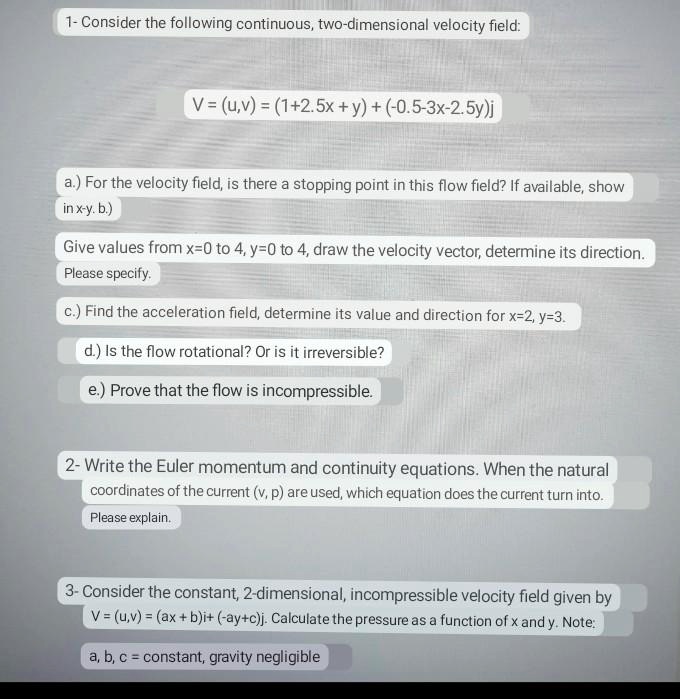
1- Consider the following continuous, two-dimensional velocity field: V = (u,v) = (1+2.5x + y) + (-0.5-3x-2.5y)j a.) For the velocity field, is there a stopping point in this flow field? If available, show in x-y. b.) Give values from x=0 to 4, y=0 to 4, draw the velocity vector, determine its direction. Please specify. c.) Find the acceleration field, determine its value and direction for x=2, y=3. d.) Is the flow rotational? Or is it irreversible? e.) Prove that the flow is incompressible. 2- Write the Euler momentum and continuity equations. When the natural coordinates of the current (v, p) are used, which equation does the current turn into. Please explain. 3- Consider the constant, 2-dimensional, incompressible velocity field given by V = (u,v) = (ax + b)i+ (-ay+c)j. Calculate the pressure as a function of x and y. Note: a, b, c = constant, gravity negligible
View Answer
divider
BEST MATCH

Multiple Choice 1. If the activation energy is small the kinetics are: a. fast b. slow c. at equilibrium d. non-existent 2. Chemical equilibrium is when: a. The rate of the forward reaction is approaching the rate of the backward reaction. b. The rate of the forward reaction is equal to the rate of the backward reaction. c. The rate of the backward reaction is approaching the rate of the forward reaction. d. The sum of the forward and backward reaction rates is equal to one. 3. If you add reactants to a system in equilibrium, which way will equilibrium shift? a. Towards products b. Nowhere—it will stay steady. c. Towards the side with the fewer number of moles d. Toward reactants 4. Write a balanced reaction for which the following rate relationships are true: $\frac{1}{2}\frac{\Delta[N_2O_5]}{\Delta t} = -\frac{1}{4}\frac{\Delta[NO_2]}{\Delta t} = -\frac{\Delta[O_2]}{\Delta t}$ a. $2N_2O_5 \rightarrow 4NO_2 + O_2$ b. $4NO_2 + O_2 \rightarrow 2N_2O_5$ c. $2N_2O_5 \rightarrow NO_2 + 4O_2$ d. $\frac{1}{4}NO_2 + O_2 \rightarrow \frac{1}{2}N_2O_5$ 5. When two reagents collide, they do not always react. Why? a. They are not in the proper orientation. b. There is not enough kinetic energy present c. Both a and b d. Neither a nor b

View Answer
divider