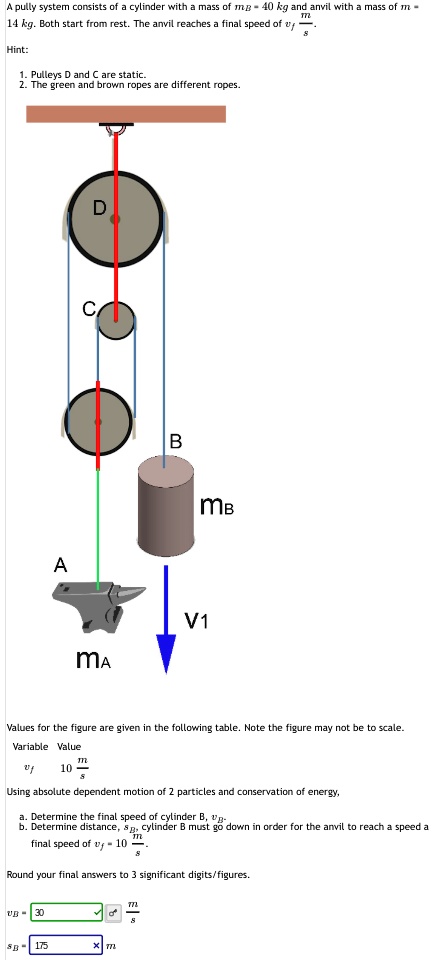
A pully system consists of a cylinder with a mass of m_(B)=40kg and anvil with a mass of m= 14 kg . Both start from rest. The anvil reaches a final speed of v_(f)(m)/(s).
Hint:
Pulleys D and C are static.
The green and brown ropes are different ropes.
Values for the figure are given in the following table. Note the figure may not be to scale.
Variable Value
v_(f),10(m)/(s)
Using absolute dependent motion of 2 particles and conservation of energy,
a. Determine the final speed of cylinder B,v_(B) -
b. Determine distance, s_(B), cylinder B must go down in order for the anvil to reach a speed a final speed of v_(f)=10((m))/((s)).
Round your final answers to 3 significant digit(s)/(f)igures.
\table[[v_(B),\sigma ^(')(m)/(s)],[s_(B),|_(m)]]=== A pully system consists of a cylinder with a mass of m_(B)=40kg and anvil with a mass of m= 14 kg . Both start from rest. The anvil reaches a final speed of v_(f)((m))/((s)).
Hint:
Pulleys D and C are static.
The green and brown ropes are different ropes.
Values for the figure are given in the following table. Note the figure may not be to scale.
Variable Value
v_(f),10((m))/((s))
Using absolute dependent motion of 2 particles and conservation of energy,
a. Determine the final speed of cylinder B,v_(B).
b. Determine distance, s_(B), cylinder B must go down in order for the anvil to reach a speed a final speed of v_(f)=10((m))/((s)).
Round your final answers to 3 significant digit(s)/(f)igures.