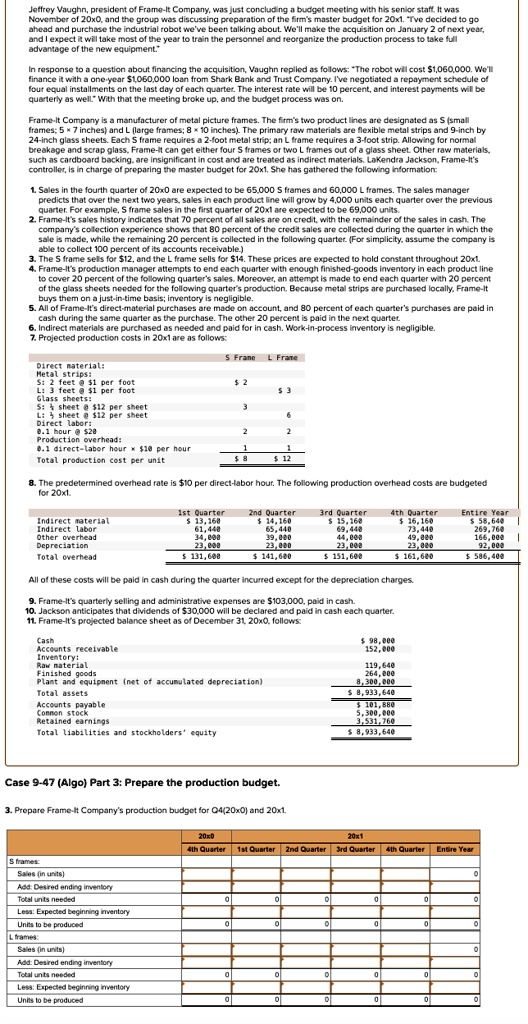
Jeffrey Vaughn, president of Frame-It Company, was just concluding a budget meeting with his senior staff. It was
November of 20x0, and the group was discussing preparation of the firm's master budget for 20x1. "Tve decided to go
ahead and purchase the industrial robot we've been talking about. We'll make the acquisition on January 2 of next year,
and I expect it will take most of the year to train the personnel and reorganize the production process to take full
advantage of the
equipment."
In response to a question about financing the acquisition, Vaughn replied as follows: "The robot will cost $1,060,000. We'll
finance it with a one-year $1,060,000 loan from Shark Bank and Trust Company. I've negotiated a repayment schedule of
four equal installments. the last day of each quarter. The interest rate will be 10 percent, and interest t payments ents will be
quarterly as well." With that the meeting broke up, and the budget process on.
Frame-It Company is a manufacturer of metal picture frames. The firm's two product lines are designated as S (small
frames: 5x7 inches) and L (large frames; 8x10 inches). The primary raw materials are flexible metal strips and 9-inch by
24-inch glass sheets. Each S frame requires a 2-foot metal strip; an L frame requires a 3-foot strip. Allowing for normal
breakage and scrap glass, Frame-It can get either four S frames or two L frames out of a glass sheet. Other raw materials,
such as as cardboard backing, are insignificant in cost and are treated as indirect materials. LaKendra Jackson, Frame-It's
controller, is in charge of preparing the master budget for 20x1. She has gathered the following information:
1. Sales in the fourth quarter of 20x0 are expected to be 65,000 S frames and 60,000 L frames. The sales manager
predicts that over the next ext two years, sales in each ach product line will grow by 4,000 units each each quarter over the previous
quarter. For example, S frame sales in the first quarter r of 20x1 are expected to be 69,000 units.
2. Frame-It's sales history indicates that 70 percent of all sales are on credit, with the remainder of the sales in cash. The
company's collection experience shows that 80 percent of the credit sales collected during the quarter in which the
sale is made, while the remaining 20 percent is collected in the following quarter. (For simplicity, assume the company is
able to collect 100 percent of its accounts receivable.)
3. The S frame sells for $12, and the L frame sells for $14. These prices expected to hold constant throughout 20x1.
Frame-It's production manager attempts to end each quarter with enough finished-goods inventory in each product line
to cover 20 percent of the following quarter's sales. Moreover, an attempt is made to end each quarter with 20 percent
of the glass sheets needed for the following quarter's production. Because metal strips are purchased locally, Frame-It
buys them on a just-in-time basis; inventory is negligible.
5. All of Frame-It's direct-material purchases are made on account, and 80 percent of each quarter's purchases are paid in
cash during the same quarter as the purchase. The other 20 percent is paid in the next quarter.
6. Indirect materials are purchased sneeded and paid for in cash. Work-in-process inventory is negligible.
7. Projected production costs in 20x1. as follows:
Direct material:
Metal strips
S: 2 feet $1 per foot
S Frame L Frame
$2
L: 3 feet $1 per foot
$3
Glass sheets:
S: sheet @ $12 per sheet
L: sheet $12 per sheet
Direct labor
0.1 hour @ $28
Production overhead:
0.1 direct-labor hour $10 per hour
Total production cost per unit
8. The predetermined overhead rate is $10 per direct-labor hour. The following production overhead costs are budgeted
for 20x1.
Indirect material
Indirect labor
Other overhead
Depreciation
Total overhead
1st Quarter
13,160
2nd Quarte
14,160
3rd Quarter
4th Quarter
Quarter
Entire Year
61,448
15,160
69,448
16,160
73,440
269,760
49,800
166,000
23,00
$ 131,600
,000
23,000
23,000
$ 141,600
$ 151,600
$ 161,600
586,
All of these costs will be paid in cash during the quarter incurred except for the depreciation charges.
9. Frame-It's quarterly selling and administrative expenses are $103,000, paid in cash.
10. Jackson anticipates that dividends of $30,000 will be declared and paid in cash each quarter.
11. Frame-It's projected balance sheet as of December 31, 20x0, follows:
Cash
Accounts receivable
Inventory:
Raw material
Finished goods
Plant equipment (net of accumulated depreciation)
Total assets
Accounts payable
Common stock
Retained earnings
Total liabilities and stockholders' equity
98.000
152,000
119,640
8,300,000
$ 8,933,640
3,531,760
$ 8,933,640
Case 9-47 (Algo) Part 3: Prepare the production budget.
3. Prepare Frame-It Company's production budget for Q4(20x0) and 20x1.
20x0
20x1
4th Quarter 1st Quarter 2nd Quarter 3rd Quarter 4th Quarter Entire Year
S frames:
Sales (in units)
Add: Desired ending inventory
Total units needed
0
이
Less: Expected beginning inventory
Units to be produced
0
L frames:
Sales (in units)
Add: Desired ending inventory
Total units needed
Less: Expected beginning inventory
Units to be produced