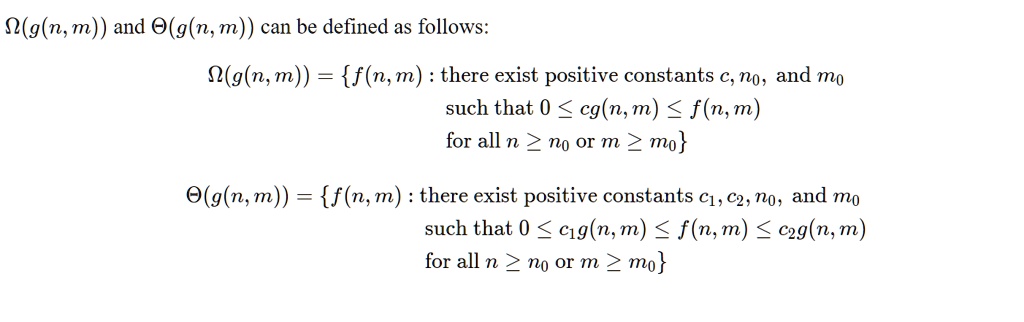
$\Omega(g(n, m))$ and $\Theta(g(n, m))$ can be defined as follows:
$\Omega(g(n, m)) = \{f(n, m) : \text{there exist positive constants } c, n_0, \text{ and } m_0 \\
\text{ such that } 0 \le cg(n, m) \le f(n, m) \\
\text{ for all } n \ge n_0 \text{ or } m \ge m_0\}$
$\Theta(g(n, m)) = \{f(n, m) : \text{there exist positive constants } c_1, c_2, n_0, \text{ and } m_0 \\
\text{ such that } 0 \le c_1g(n, m) \le f(n, m) \le c_2g(n, m) \\
\text{ for all } n \ge n_0 \text{ or } m \ge m_0\}$