Ace - AI Tutor
Ask Our Educators
Textbooks
My Library
Flashcards
Scribe - AI Notes
Notes & Exams
Download App
wesley robertson

wesley r.

Divider

Questions asked

BEST MATCH

National Park Service personnel are trying to increase the size of the bison population of the national park. If 241 bison currently live in the park, and if the population's rate of growth is 3 % annually, find how many bison there should be in 15 years.

View Answer
divider
BEST MATCH

E4 X fx A B C D E F G H 1 Stock A Stock B Portfolio 2 Expected Return = 10.000% 14.000% 12.400% 3 Standard Deviation = 18.410% 21.170% 5.340% 4 Reward to Risk Ratio = 5 6 7 In a few words, explain which of the above three is the best investment. 8 9 10 11 12 13 14 15 16 17 18 19 20

View Answer
divider
BEST MATCH

(a) Consider a functional of the form $\mathcal{L}[u, v] = \iint_{\Omega} f(x, y, u, v, u_x, u_y, v_x, v_y) \, dx \, dy$, where $u$ and $v$ are functions of $x$ and $y$ [we use the notation $a_b$ to denote the partial derivative $\partial a/\partial b$]. Assuming small variations $u \to u + \delta u$ and $v \to v + \delta v$ and using integration by parts, derive the two Euler-Lagrange equations satisfied by $u$ and $v$ in $\Omega$ associated with an extremum of $\mathcal{L}$ (you may ignore all contributions from boundary terms). (b) An elastic material deforms in two dimensions with a displacement field $\mathbf{u}(\mathbf{x}) = [u(x, y), v(x, y)]$, that minimises the total elastic energy $\mathcal{J} = \iint_{\Omega} \left[ \frac{1}{2} \mu (\nabla \mathbf{u} : \nabla \mathbf{u}^T) + \frac{1}{2} (\lambda + \mu) (\nabla \cdot \mathbf{u})^2 \right] dx \, dy$ where $\nabla \mathbf{u}$ is the displacement gradient tensor, defined as $\nabla \mathbf{u} = \begin{pmatrix} u_x & v_x \\ u_y & v_y \end{pmatrix}$, where $\mu$ and $\lambda$ are two material constants and where we use the notation $\mathbf{A} : \mathbf{B}$ to refer to the trace of the matrix product $\mathbf{A} \mathbf{B}$. (i) Show that $\mathcal{J} = \iint_{\Omega} \left[ \frac{\hat{\lambda}}{2} + \mu \right) (u_x^2 + v_y^2) + \frac{\mu}{2} (u_y^2 + v_x^2) + (\lambda + \mu) u_x v_y \right] dx \, dy$. (ii) Derive the two Euler-Lagrange equations satisfied by $u$ and $v$ and show that they can be combined into a single equation for $u$. (iii) In the one-dimensional limit where $v = 0$, $\partial u/\partial y = 0$ with boundary conditions $u(0) = 0$, $u(L) = \Delta$, show that the solution to the equation obtained in (ii) is linear in $x$.

View Answer
divider
BEST MATCH

40 25 75 15 30 73 80 10 27 35 29 Show all the steps of deleting 40 from the following binary search tree.

View Answer
divider
BEST MATCH

The text provided appears to be formatted and presented correctly. No errors were found.

View Answer
divider
BEST MATCH

Select all that apply Which two items have prompted consumer demand for environmentally sound produc government regulations international trade barriers deterioration of the physical environment the ethnic makeup of the market

View Answer
divider
BEST MATCH

A sample mean, sample size, and population standard deviation are provided below. Use the one-mean z-test to perform the required hypothesis test at the 1% significance level. x=29, n=19, sigma =4, H0: mu =26, Ha: mu >26 Question content area bottom Part 1 The test statistic is z=

View Answer
divider
BEST MATCH

Part I Find the one's complement of the binary number 11000000. Express your answer in binary form. One's complement = Submit Request Answer Part J Find the two's complement of the binary number 11000000. Express your answer in binary form. Two's complement = Submit Request Answer

View Answer
divider
BEST MATCH

Texts: Smart devices and the Internet of Things are becoming more common in our houses and businesses, and that trend is expected to continue. According to a University Journal article from the Journal of Business Research (2022), the perceived usefulness and trust in the IoT provider are key factors in driving domestic adoption. As this segment of technology continues to grow, we, as security professionals, must ensure they are securely implemented and maintained. Respond to the following in a minimum of 175 words: - Discuss the advantages and disadvantages of smart devices in your home and personal life. - Share an example of a smart device you use for yourself or your family. - As a student in a cybersecurity field, how has what you learned influenced whether you would include more smart devices in your life? Explain your reasons for wanting more or fewer connected devices in your life.

View Answer
divider
BEST MATCH

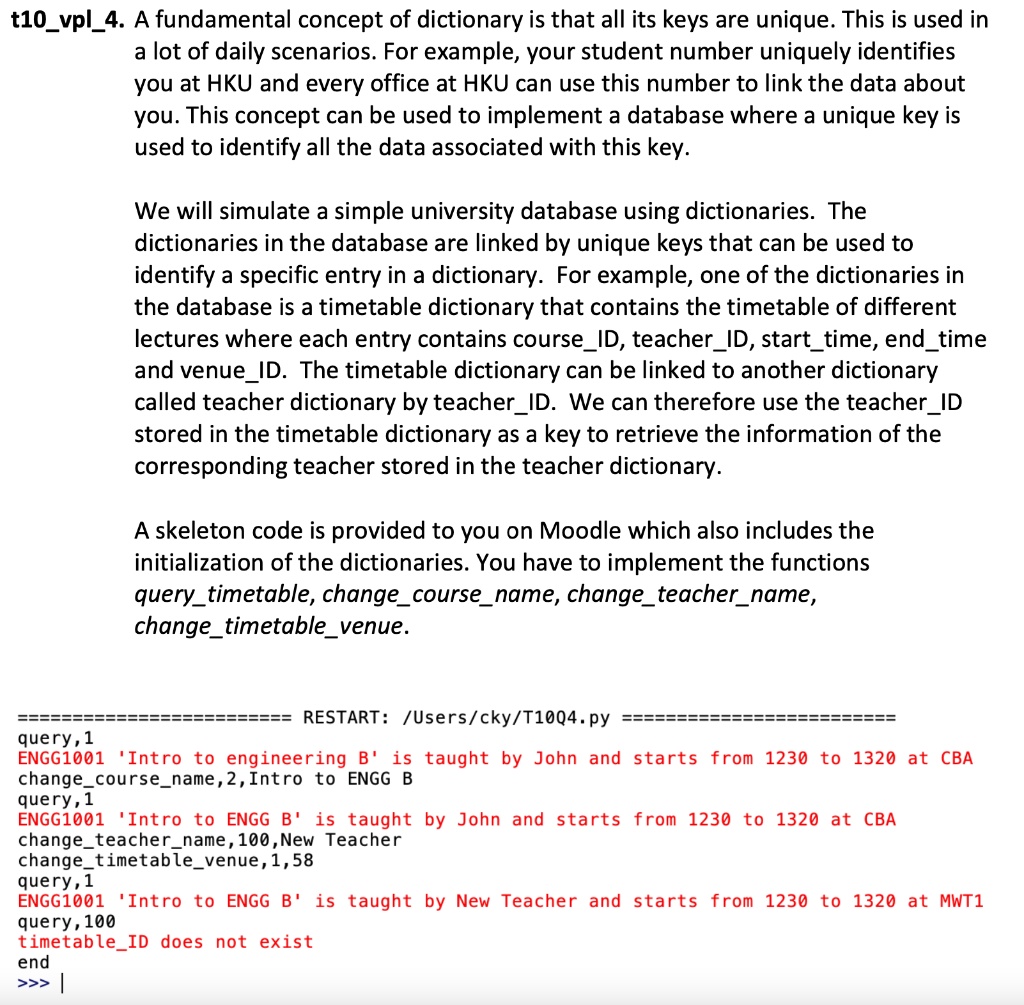
Text: Don't use ChatGPT to solve!!! # Each entry corresponds to a lecture's timetable in this semester. # Structure of timetable: # timetable_ID: [course_ID, teacher_ID, start_time, end_time, venue_ID] timetable_DB = { 1: [2, 100, "1230", "1320", 6], 2: [1, 101, "1330", "1520", 58], 3: [4, 101, "0930", "1220", 12], } # Each entry corresponds to the information of a course. # Structure of course: # course_ID: [code, name, faculty, department, curriculum] course_DB = { 1: ["ENGG1000", "Intro to Engineering A", "Faculty of Engineering", "NA", "UG"], 2: ["ENGG1001", "Intro to Engineering B", "Faculty of Engineering", "NA", "UG"], 3: ["ELEC7001", "Machine Learning", "Faculty of Engineering", "Dept. EEE", "PG"], 4: ["MATH1001", "Intro to Calculus", "Faculty of Science", "Dept. Math", "UG"], } # Each entry corresponds to the information of a teacher. # Structure of teacher: # teacher_ID: [name, start_date] teacher_DB = { 100: ["John", "2020-01-01"], 101: ["Mary", "2020-06-01"], 102: ["Peter", "2020-10-01"], } # Each entry corresponds to the information of a venue. # Structure of venue: # venue_ID: [name, capacity] venue_DB = { 6: ["CBA", 60], 7: ["CBC", 90], 12: ["RHT", 200], 58: ["MWT1", 120], } def query_timetable(timetable_ID): """Return a dictionary containing data related to this timetable_ID. If this key does not exist in the timetable dictionary, returns an empty dictionary. Arguments: timetable_ID: integer, key to the timetable_DB Return: A dictionary with keys "course_code", "course_name", "start_time", "end_time", "teacher_name", "venue_name". If the key does not exist, return an empty dictionary {} For example, if timetable_ID = 2, returns { "course_code": "ENGG1000", "course_name": "Intro to Engineering A", "start_time": "1330", "end_time": "1520", "teacher_name": "Mary", "venue_name": "MWT1", } """ global timetable_DB, course_DB, teacher_DB, venue_DB # Write your code here def change_course_name(course_ID, new_name): """Change the course name corresponding to course_ID to new_name. Assume the key exists. Arguments: course_ID: integer, key to the course_DB new_name: str, the name used to replace the existing name """ global timetable_DB, course_DB, teacher_DB, venue_DB # Write your code here def change_teacher_name(teacher_ID, new_name): """Change the teacher name corresponding to teacher_ID to new_name. Assume the key exists. Arguments: teacher_ID: integer, key to the teacher_DB new_name: str, the name used to replace the existing name """ global timetable_DB, course_DB, teacher_DB, venue_DB # Write your code here def change_timetable_venue(timetable_ID, new_venue_ID): """Change the venue_ID corresponding to timetable_ID to new_venue_ID. Assume the key exists. Arguments: timetable_ID: integer, key to the timetable_DB new_venue_ID: integer, the venue ID used to replace the existing ID """ global timetable_DB, course_DB, teacher_DB, venue_DB # Write your code here def print_query_result(result): if len(result) == 0: print("timetable_ID does not exist") else: print( f"{result['course_code']} '{result['course_name']}' is taught by {result['teacher_name']}" + f" and starts from {result['start_time']} to {result['end_time']}" + f" at {result['venue_name']}" ) command = [""] while command[0] != "end": command = input().split(",") if command[0] == "query": result = query_timetable(int(command[1])) print_query_result(result) elif command[0] == "change_course_name": change_course_name(int(command[1]), command[2]) elif command[0] == "change_teacher_name": change_teacher_name(int(command[1]), command[2]) elif command[0] == "change_timetable_venue": change_timetable_venue(int(command[1]), int(command[2]))
View Answer
divider