Name and Surname: pos
Student ID: 19204610012
Signature:
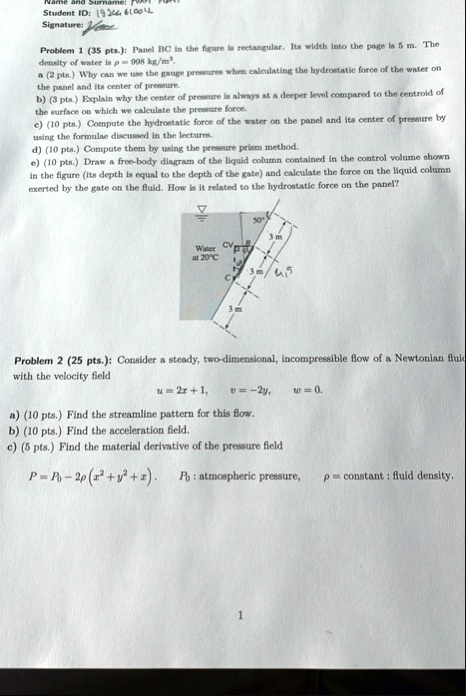
Problem 1 (35 pts.): Panel BC in the figure is rectangular. Its width into the page is 5 m. The
density of water is $\rho = 998 kg/m^3$.
a (2 pts.) Why can we use the gauge pressures when calculating the hydrostatic force of the water on
the panel and its center of pressure.
b) (3 pts.) Explain why the center of pressure is always at a deeper level compared to the centroid of
the surface on which we calculate the pressure force.
c) (10 pts.) Compute the hydrostatic force of the water on the panel and its center of pressure by
using the formulae discussed in the lectures.
d) (10 pts.) Compute them by using the pressure prism method.
e) (10 pts.) Draw a free-body diagram of the liquid column contained in the control volume shown
in the figure (its depth is equal to the depth of the gate) and calculate the force on the liquid column
exerted by the gate on the fluid. How is it related to the hydrostatic force on the panel?
▽
50°
3 m
Water CV
at 20°C
3 m
3 m
Problem 2 (25 pts.): Consider a steady, two-dimensional, incompressible flow of a Newtonian fluid
with the velocity field
$u = 2x + 1$,
$v = -2y$,
$w = 0$.
a) (10 pts.) Find the streamline pattern for this flow.
b) (10 pts.) Find the acceleration field.
c) (5 pts.) Find the material derivative of the pressure field
$P=P_0-2\rho (x^2+y^2+x)$. $P_0$: atmospheric pressure,
$\rho$: constant : fluid density.