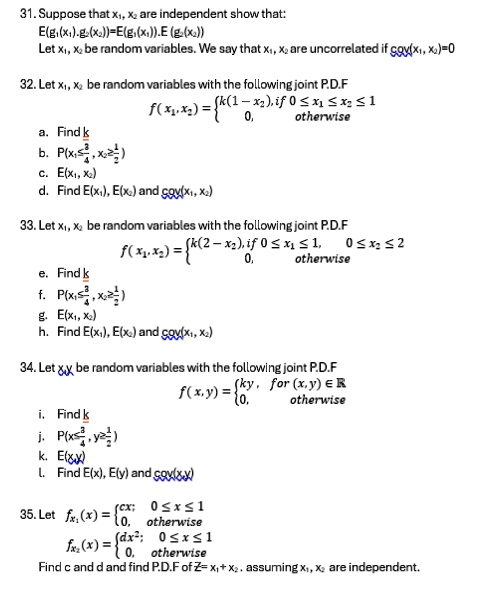
Suppose that x₁, x₂ are independent show that:
E(g₁(x₁)*g₂(x₂)) = E(g₁(x₁)) * E(g₂(x₂))
Let x₁, x₂ be random variables. We say that x₁, x₂ are uncorrelated if cov(x₁, x₂) = 0
Let x₁, x₂ be random variables with the following joint P.D.F
f(x₁, x₂) = {(k(1-x₂), if 0 <= x₁ <= x₂ <= 1), (0, otherwise):}
a. Find k
b. P(x₁ <= (π/4)/4, x₂ >= 1/2)
c. E(x₁, x₂)
d. Find E(x₁), E(x₂) and cov(x₁, x₂)
Let x₁, x₂ be random variables with the following joint P.D.F
f(x₁, x₂) = {(k(2-x₂), if 0 <= x₁ <= 1, 0 <= x₂ <= 2), (0, otherwise):}
e. Find k
f. P(x₁ <= -/4, x₂ >= 1/2)
g. E(x₁, x₂)
h. Find E(x₁), E(x₂) and cov(x₁, x₂)
Let x, x be random variables with the following joint P.D.F
f(x, y) = {(ky, for (x, y) in R), (0, otherwise):}
i. Find k
j. P(x <= 3/4, y >= 1/2)
k. E(x, x)
l. Find E(x), E(y) and cov(x, x)
Let f₁(x)(x) = {(cx, 0 <= x <= 1), (0, otherwise):}
f₂(x)(x) = {(dx², 0 <= x <= 1), (0, otherwise):}
Find c and d and find P.D.F of Z = x₁ + x₂, assuming x₁, x₂ are independent.
31. Suppose that x₁, x₂ are independent show that: E(gxgx) = E(g(x)) * E(g(x)) Let x₁, x₂ be random variables. We say that x₁, x₂ are uncorrelated if cov(, ) = 0
32. Let x, X be random variables with the following joint P.D.F
0,
otherwise
a. Find k b. P(xx) c. E(x₁, X) d. Find E(x₁), E(x₂) and cov(x)
33. Let x, be random variables with the following joint P.D.F 0 x 2 0, otherwise e. Find k f. P(xsx) g. Exx h. Find Ex), E(x) and cov(x)
34. Let & be random variables with the following joint P.D.F
(o,
otherwise
i. Find k j. P(xy) k. Exx l. Find Ex, E(y) and cov
0, otherwise
Find c and d and find P.D.F of Z = +, assuming, X are independent.