Question 1
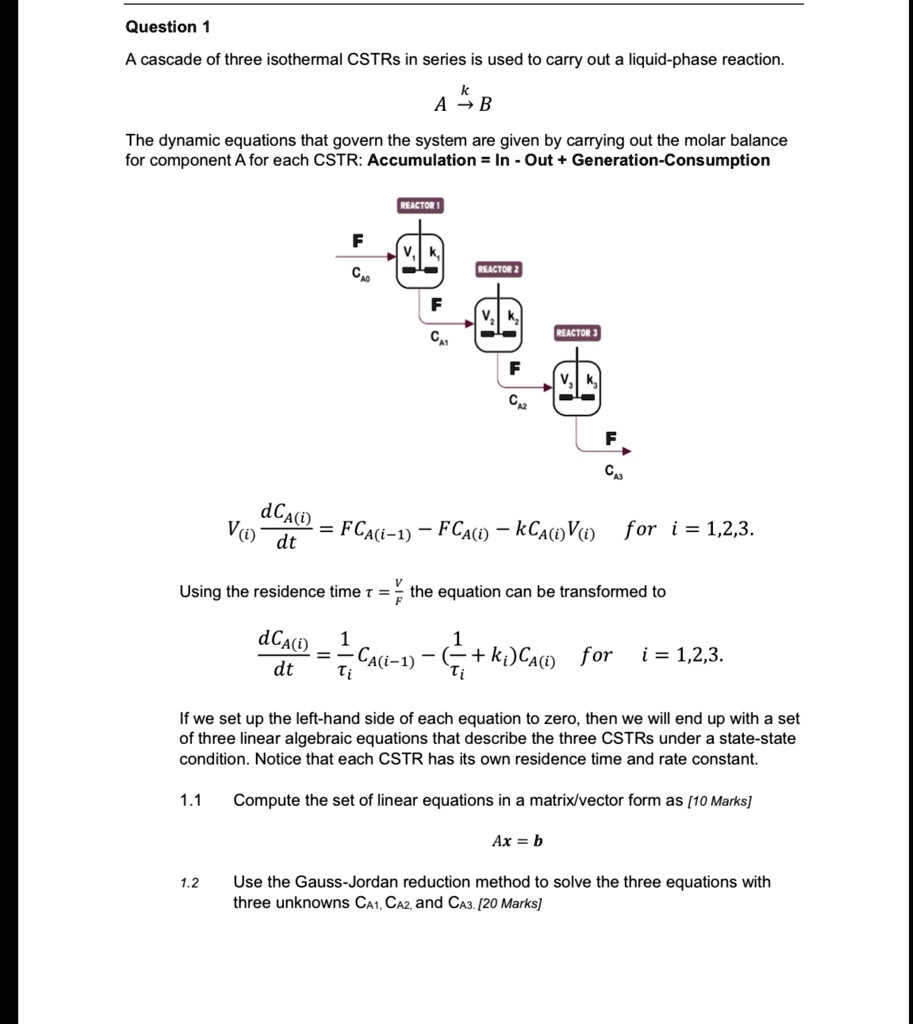
A cascade of three isothermal CSTRs in series is used to carry out a liquid-phase reaction.
$k$
A \rightarrow B
The dynamic equations that govern the system are given by carrying out the molar balance
for component A for each CSTR: Accumulation = In - Out + Generation-Consumption
REACTOR 1
F
REACTOR 2
$C_{A0}$
F
$C_{A1}$ REACTOR 3
F
$V_1$
$k_1$
$V_2$
$k_2$
$V_3$
$k_3$
F
$C_{A2}$
F
$C_{A3}$
$\frac{dC_{A(i)}}{dt} = FC_{A(i-1)} - FC_{A(i)} - kC_{A(i)}V_{(i)}$ for $i = 1,2,3$.
Using the residence time $\tau = \frac{V}{F}$ the equation can be transformed to
$\frac{dC_{A(i)}}{dt} = \frac{1}{\tau_i}C_{A(i-1)} - (\frac{1}{\tau_i} + k_i)C_{A(i)}$ for $i = 1,2,3$.
If we set up the left-hand side of each equation to zero, then we will end up with a set
of three linear algebraic equations that describe the three CSTRs under a state-state
condition. Notice that each CSTR has its own residence time and rate constant.
1.1 Compute the set of linear equations in a matrix/vector form as [10 Marks]
$Ax = b$
1.2 Use the Gauss-Jordan reduction method to solve the three equations with
three unknowns $C_{A1}$, $C_{A2}$, and $C_{A3}$. [20 Marks]