Questions asked
A small car of mass m and a large car of mass 4m drive along a highway at constant speed. They approach a curve of radius R. Both cars maintain the same acceleration a as they travel around the curve. How does the speed of the small car $v_s$ compare to the speed of the large car $v_L$, as they round the curve? ►View Available Hint(s) $v_s = \frac{1}{4}v_L$ $v_s = \frac{1}{2}v_L$ $v_s = v_L$ $v_s = 2v_L$ $v_s = 4v_L$
Lab3C: Sandwiches. We are going to design a program that determines how long a microwave oven at a sandwich shop will run. The program will prompt the user to enter how many of each sandwich type needs to be cooked. It will then print out the number of sandwiches entered for each sandwich type on separate lines and calculate the total amount of time the oven will have to run to cook them all. Below is a table showing how long each sandwich needs to stay in the oven: Small 30 seconds Medium 60 seconds Large 1 minute and 15 seconds Extra Large 2 minutes and 15 seconds The number of minutes and seconds must be printed as integers. Example runs are shown below. The user input is in bold. Sample run 1: Enter the number of small sandwiches: 2 Enter the number of medium sandwiches: 2 Enter the number of large sandwiches: 2 Enter the number of extra-large sandwiches: 2 You've entered 2 small sandwiches. You've entered 2 medium sandwiches. You've entered 2 large sandwiches. You've entered 2 extra-large sandwiches. Total cooking time is 10 minutes and 0 seconds.
4. [-/3 Points] DETAILS HRW10 7.P.022. MY NOTES PRACTICE ANOTHER A cave rescue team lifts an injured spelunker directly upward and out of a sinkhole by means of a motor-driven cable. The lift is performed in three stages, each requiring a vertical distance of 11.0 m. (1) First, the initially stationary spelunker is accelerated to a speed of 4.20 m/s. (2) He is then lifted at the constant speed of 4.20 m/s. (3) Finally he is decelerated to zero speed. How much work is done on the 78.0 kg rescuee by the force lifting him during each stage? stage (1) kJ stage (2) kJ stage (3) kJ Additional Materials eBook Submit Answer
For which set on the Venn diagram is green used? A C B Select one: a. $(A \cup B \cup C) \setminus (B \cap C)$ b. $(B \triangle C) \setminus A$ c. $(B \cup C) \setminus (A \cap B \cap C)$ d. $(B \cup C) \setminus (B \cap C)$ e. $A \cup (B \triangle C)$ Find a principal conjunctive normal form for function f(X,Y,Z) = (X \land Y) \lor \neg (X \land Z) (in answers $\neg$ denotes negation) Select one: a. $(X \land Y \land Z) \lor (X \land \neg Y \land \neg Z)$ b. $(\neg X \land \neg Y \land Z) \lor (\neg X \land Y \land \neg Z)$ c. $(\neg X \lor Y \lor Z) \land (X \lor \neg Y \lor Z)$ d. $(X \lor \neg Y \lor Z) \land (X \lor Y \lor \neg Z)$ e. $(X \land Y \land Z) \lor (X \land \neg Y \land Z)$
10. Glucose metabolism. To test for diabetes, a patient is subjected to a large quantity of sugar. The amount of glucose in the patient's urine is then measured over an interval [0,T]. If the amount of glucose is given by \(g(t) = 10 - 0.6t^2\), where \(t\) denotes hours, at what rate is the patient metabolizing the sugar two hours after the test begins?
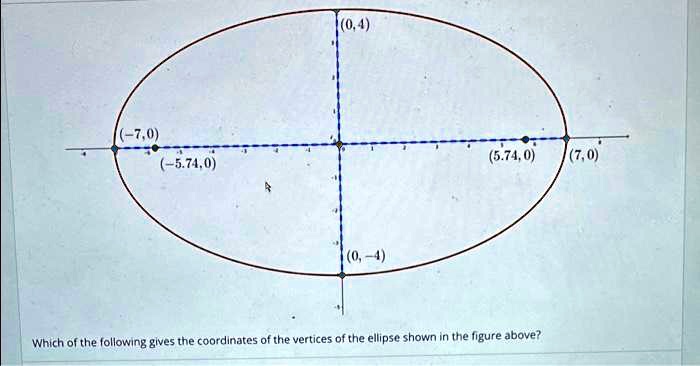
(-7,0) (-5.74,0) (0,4) (0,-4) (5.74,0) (7,0) Which of the following gives the coordinates of the vertices of the ellipse shown in the figure above?
For the following statements, fill in the table (T: true) or (F: False) (2 points) Question 1 2 3 4 Answer F T F T 1) AM is better than the DSBSC in bandwidth efficiency. 2) Synchronous detectors can be used to demodulate AM signals. 3) The bandwidth efficiency of Quadrature Amplitude modulation (QAM) is better than that of single side band (SSB) modulation. 4) If $x(t)$ and $y(t)$ have the same bandwidth B, then the bandwidth of the convolution $x(t) * y(t)$ is also B.
3. The engineering stress-strain curve for an alloy is shown in the plot below (the inset shows the first part of the curve) a. Determine the modulus of elasticity for this alloy. b. Find the yield strength at a 0.002 offset. c. If the specimen is cylindrical with a radius of 4mm what is the maximum load it can sustain before yielding occurs? d. What will the plastic strain be if the specimen is loaded to 325 MPa before the load is released? e. What is the tensile strength of the alloy? f. Compute the modulus of resilience. g. What is the ductility in percent elongation? h. What is the engineering stress value when the specimen fractures? i. At a strain value of 0.12 will true stress be higher or lower than engineering stress?
a. Make a polar plot of intensity $|\vec{P}|$ vs. $\theta$ for $0 \leq \theta \leq \pi$ for an infinitesimal (Hertzian) dipole and a half-wave electric dipole antenna (where total antenna length $2l = \lambda/2$). The intensity is given by $|\vec{P}| = \frac{1}{2\eta}|E_{\theta}|^2$, and you need consider only the $\theta$ dependence of the intensity, not its absolute magnitude. b. A radio transmitter broadcasts with a total radiated power of 100 kW. Assuming a half-wave dipole antenna, calculate the magnitude of the electric field and power density (W/m$^2$) at a distance $r = 30$ km. (You can assume $\theta = \frac{\pi}{2}$ and note that the current factor = 1) Hint: Find the driving current $I_m$ in the dipole using the radiation resistance and then calculate the electric field at distance $r$.
For the circuit shown, find the voltage v. Show your work. Box your answer. 42mA 1k$\Omega$ 3k$\Omega$ 2k$\Omega$ 36mA 6k$\Omega$ + v -