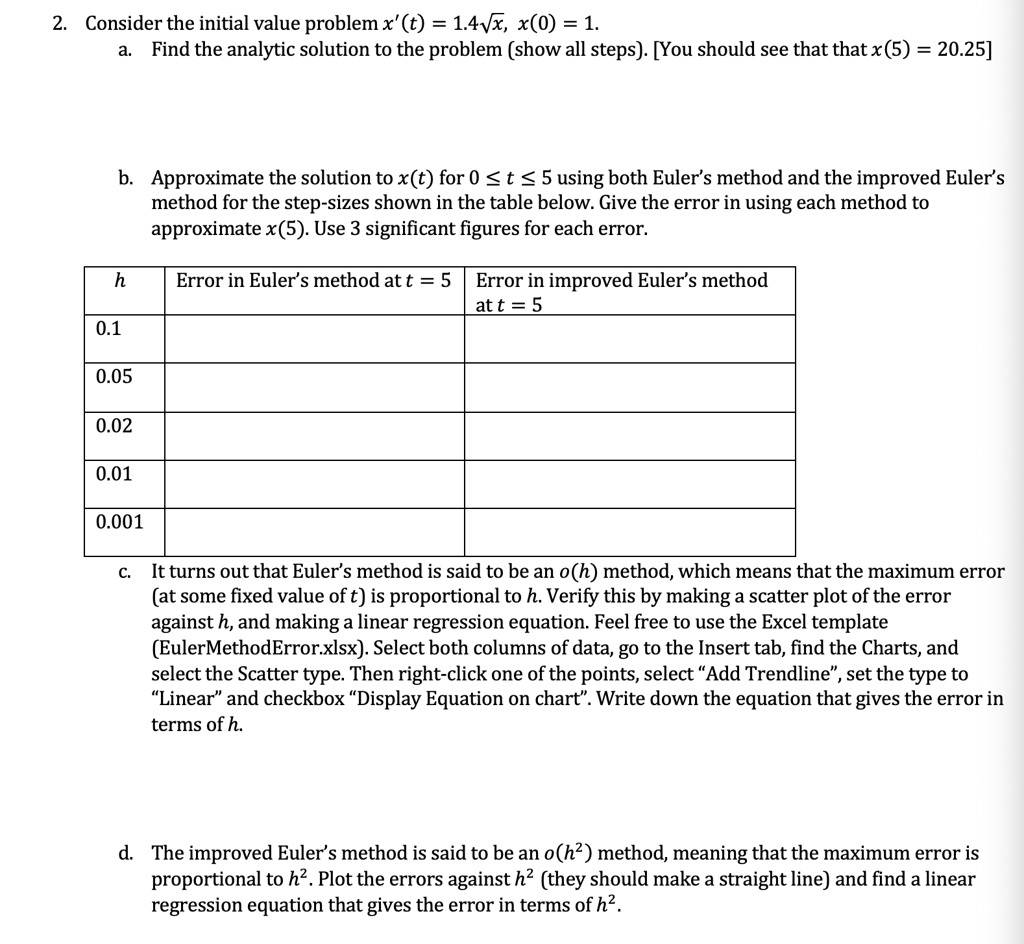
2. Consider the initial value problem x'(t) = 1.4\sqrt{x}, x(0) = 1.
a. Find the analytic solution to the problem (show all steps). [You should see that that x(5) = 20.25]
b. Approximate the solution to x(t) for 0 \le t \le 5 using both Euler's method and the improved Euler's\nmethod for the step-sizes shown in the table below. Give the error in using each method to\napproximate x(5). Use 3 significant figures for each error.
h\nError in Euler's method at t = 5 Error in improved Euler's method
at t = 5
0.1
0.05
0.02
0.01
0.001
c. It turns out that Euler's method is said to be an o(h) method, which means that the maximum error
(at some fixed value of t) is proportional to h. Verify this by making a scatter plot of the error
against h, and making a linear regression equation. Feel free to use the Excel template
(EulerMethodError.xlsx). Select both columns of data, go to the Insert tab, find the Charts, and
select the Scatter type. Then right-click one of the points, select "Add Trendline", set the type to
"Linear" and checkbox "Display Equation on chart". Write down the equation that gives the error in
terms of h.
d. The improved Euler's method is said to be an o(h²) method, meaning that the maximum error is
proportional to h². Plot the errors against h² (they should make a straight line) and find a linear
regression equation that gives the error in terms of h².