Sheridan Corp. has been making and selling a variety of tabletops for many years. L'Adell, product manager for two versions of the
company's tabletop products, Marbled and Solid, was comparing sales volumes for these two types of products. While she knew
Sheridan's sales for the Solid tops had been declining, she was surprised to see the competitors' tabletop sales had been increasing.
Was there something she didn't understand about her products' costs?
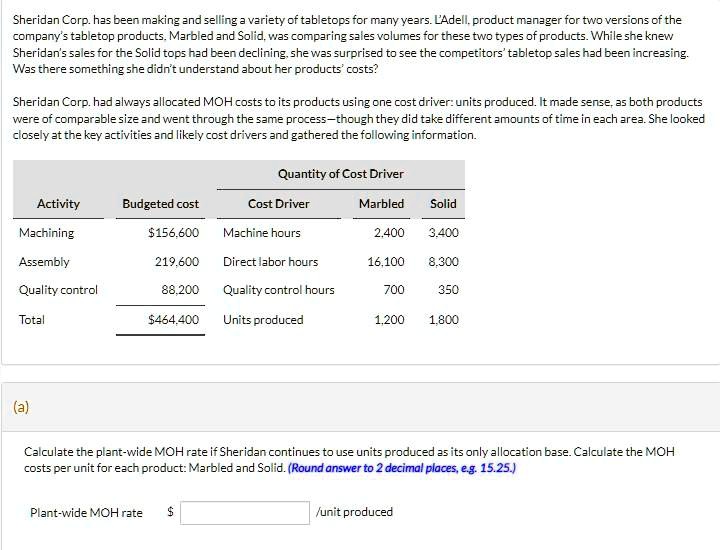
Sheridan Corp. had always allocated MOH costs to its products using one cost driver: units produced. It made sense, as both products
were of comparable size and went through the same process-though they did take different amounts of time in each area. She looked
closely at the key activities and likely cost drivers and gathered the following information.
Quantity of Cost Driver
Activity
Budgeted cost
Cost Driver
Marbled Solid
Machining
$156,600
Machine hours
2,400 3,400
Assembly
219,600
Direct labor hours
16,100
8,300
Quality control
88,200
Quality control hours
700
350
Total
$464,400
Units produced
1,200
1,800
(a)
Calculate the plant-wide MOH rate if Sheridan continues to use units produced as its only allocation base. Calculate the MOH
costs per unit for each product: Marbled and Solid. (Round answer to 2 decimal places, e.g. 15.25.)
Plant-wide MOH rate
$
/unit produced