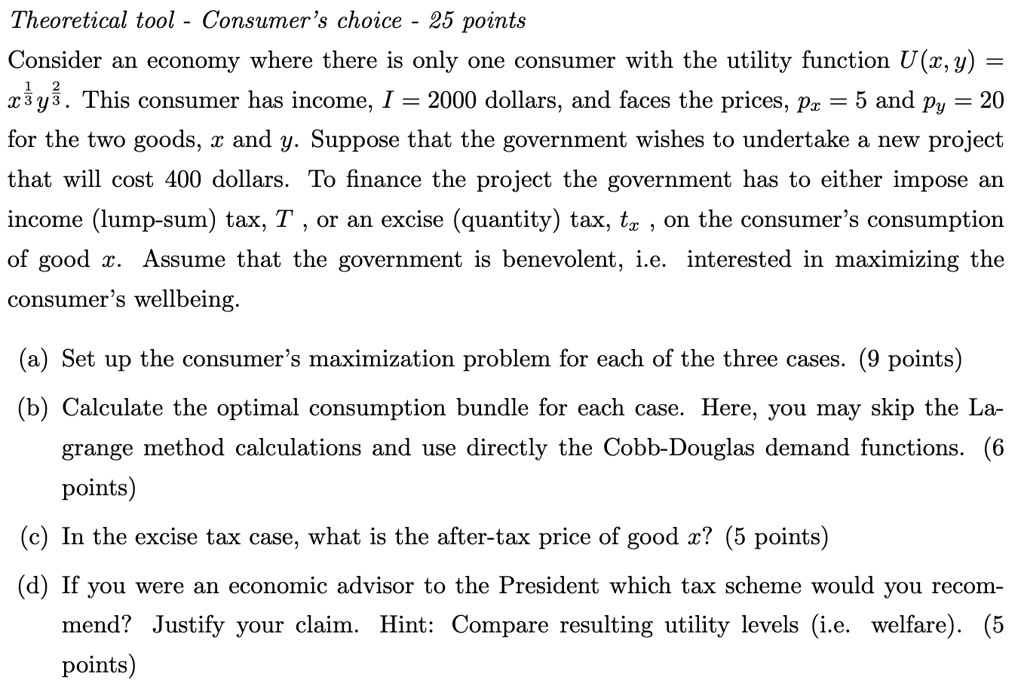
Theoretical tool - Consumer's choice - 25 points
Consider an economy where there is only one consumer with the utility function $U(x, y) = x^{\frac{1}{3}}y^{\frac{2}{3}}$. This consumer has income, $I = 2000$ dollars, and faces the prices, $p_x = 5$ and $p_y = 20$ for the two goods, $x$ and $y$. Suppose that the government wishes to undertake a new project that will cost 400 dollars. To finance the project the government has to either impose an income (lump-sum) tax, $T$, or an excise (quantity) tax, $t_x$, on the consumer's consumption of good $x$. Assume that the government is benevolent, i.e. interested in maximizing the consumer's wellbeing.
(a) Set up the consumer's maximization problem for each of the three cases. (9 points)
(b) Calculate the optimal consumption bundle for each case. Here, you may skip the Lagrange method calculations and use directly the Cobb-Douglas demand functions. (6 points)
(c) In the excise tax case, what is the after-tax price of good $x$? (5 points)
(d) If you were an economic advisor to the President which tax scheme would you recommend? Justify your claim. Hint: Compare resulting utility levels (i.e. welfare). (5 points)