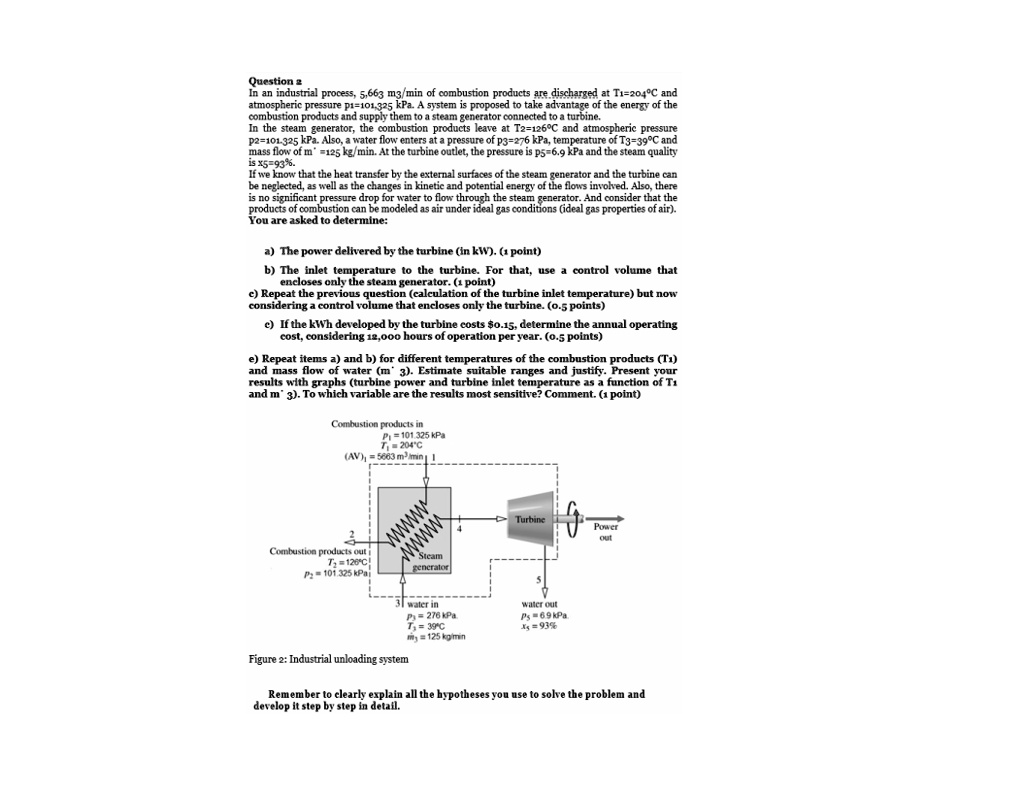
Question a: In an industrial process, 5,663 m3/min of combustion products are discharged at T1=204°C and atmospheric pressure pi=101,325 kPa. A system is proposed to take advantage of the energy of the combustion products and supply them to a steam generator connected to a turbine. In the steam generator, the combustion products leave at T2=126°C and atmospheric pressure p=101,325 kPa. Also, a water flow enters at a pressure of p3=276 kPa, temperature of T3=39°C, and mass flow of m=125 kg/min. At the turbine outlet, the pressure is p5=6.9 kPa and the steam quality is x5=93%. If we know that the heat transfer by the external surfaces of the steam generator and the turbine can be neglected, as well as the changes in kinetic and potential energy of the flows involved. Also, there is no significant pressure drop for water to flow through the steam generator. And consider that the products of combustion can be modeled as air under ideal gas conditions (ideal gas properties of air). You are asked to determine:
a) The power delivered by the turbine in kW. (1 point)
b) The inlet temperature to the turbine. For that, use a control volume that encloses only the steam generator. (1 point)
c) Repeat the previous question (calculation of the turbine inlet temperature) but now considering a control volume that encloses only the turbine. (0.5 points)
d) If the kWh developed by the turbine costs $0.15, determine the annual operating cost, considering 1,000 hours of operation per year. (0.5 points)
e) Repeat items a) and b) for different temperatures of the combustion products (Ti) and mass flow of water (m3). Estimate suitable ranges and justify. Present your results with graphs (turbine power and turbine inlet temperature as a function of Ti and m3). To which variable are the results most sensitive? Comment. (1 point)
Combustion products in P=101.325 kPa, T1=204°C, V=583 m3/min
Turbine
Combustion products out, T2=126°C, P=101.325 kPa
Steam
Water in, P3=276 kPa, T3=39°C, m=125 kg/min
Water out, P5=6.9 kPa, x5=93%
Figure 2: Industrial unloading system
Remember to clearly explain all the hypotheses you use to solve the problem and develop it step by step in detail.