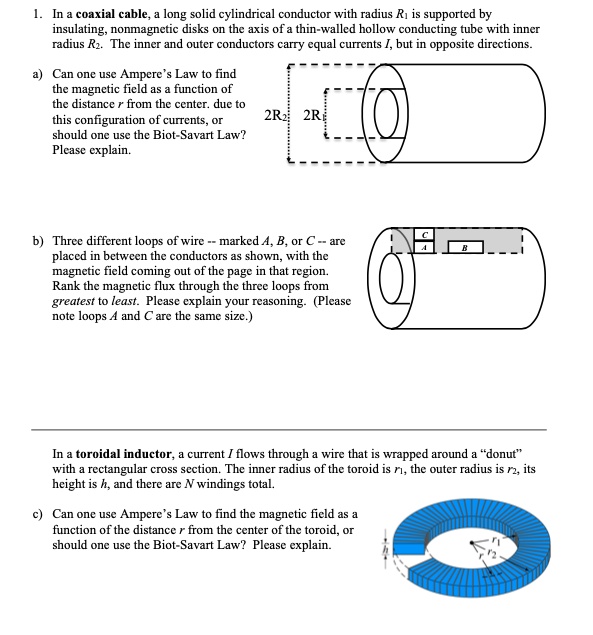
1. In a coaxial cable, a long solid cylindrical conductor with radius R? is supported by
insulating, nonmagnetic disks on the axis of a thin-walled hollow conducting tube with inner
radius R?. The inner and outer conductors carry equal currents I, but in opposite directions.
a) Can one use Ampere's Law to find
the magnetic field as a function of
the distance r from the center, due to
this configuration of currents, or
should one use the Biot-Savart Law?
Please explain.
2R? 2R?
b) Three different loops of wire -- marked A, B, or C -- are
placed in between the conductors as shown, with the
magnetic field coming out of the page in that region.
Rank the magnetic flux through the three loops from
greatest to least. Please explain your reasoning. (Please
note loops A and C are the same size.)
B
In a toroidal inductor, a current I flows through a wire that is wrapped around a \"donut\"
with a rectangular cross section. The inner radius of the toroid is r?, the outer radius is r?, its
height is h, and there are N windings total.
c) Can one use Ampere's Law to find the magnetic field as a
function of the distance r from the center of the toroid, or
should one use the Biot-Savart Law? Please explain.