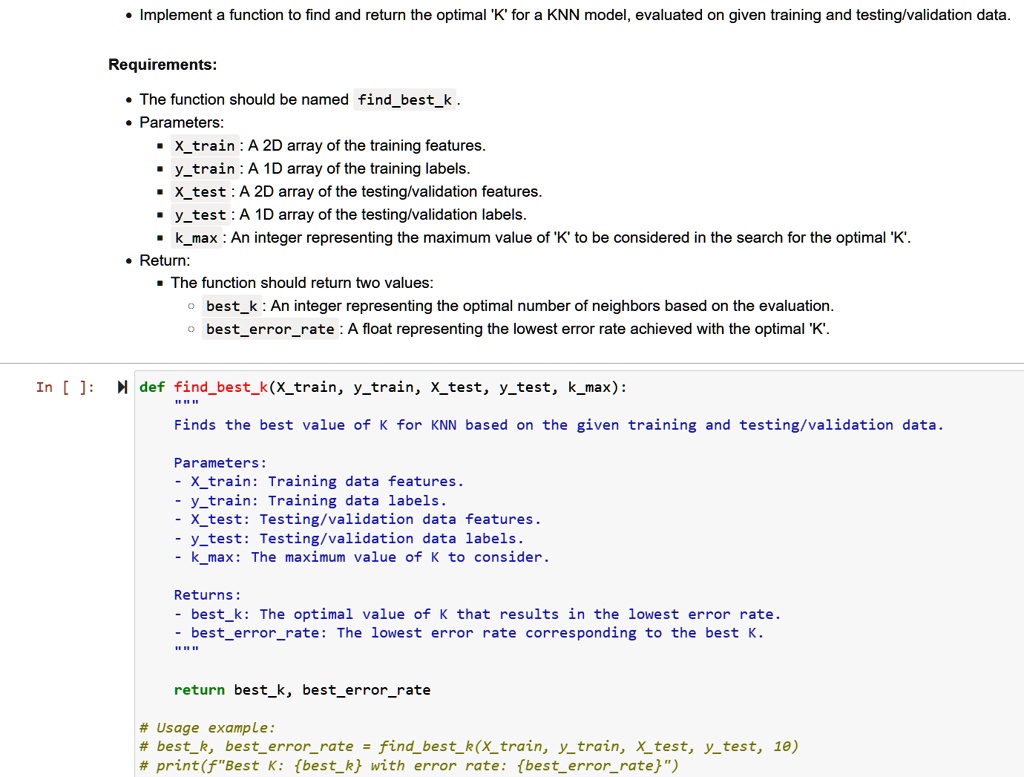
Implement a function to find and return the optimal 'K' for a KNN model, evaluated on given training and testing/validation data.
Requirements:
The function should be named find_best_k.
• Parameters:
X_train: A 2D array of the training features.
y_train: A 1D array of the training labels.
X_test: A 2D array of the testing/validation features.
y_test: A 1D array of the testing/validation labels.
k_max: An integer representing the maximum value of 'K' to be considered in the search for the optimal 'K'.
Return:
The function should return two values:
best_k: An integer representing the optimal number of neighbors based on the evaluation.
best_error_rate: A float representing the lowest error rate achieved with the optimal 'K'.
In []: def find_best_k(X_train, y_train, X_test, y_test, k_max):
Finds the best value of K for KNN based on the given training and testing/validation data.
Parameters:
X_train: Training data features.
y_train: Training data labels.
X_test: Testing/validation data features.
y_test: Testing/validation data labels.
k_max: The maximum value of K to consider.
Returns:
best_k: The optimal value of K that results in the lowest error rate.
best_error_rate: The lowest error rate corresponding to the best K.
return best_k, best_error_rate
# Usage example:
#best_k, best_error_rate = find_best_k(X_train, y_train, X_test, y_test, 10)
# print(f"Best K: {best_k} with error rate: {best_error_rate}")