Ace - AI Tutor
Ask Our Educators
Textbooks
My Library
Flashcards
Scribe - AI Notes
Notes & Exams
Download App
Winchester Uni

Winchester U.

Divider

Questions asked

ANSWERED

Supreeta N verified

Numerade educator

Given is the differential equation [ frac{d P}{d t}=2 P(7-P), ] with initial value ( P(0)=5 ). Which one of the following statements is true? As ( t ) increases from ( 0, P ) increases without limit. As ( t ) increases from ( 0, P ) increases to a positive finite limit. As ( t ) increases from ( 0, P ) decreases to a positive finite limit. As ( t ) increases from ( 0, P ) decreases to zero.

View Answer
divider
ANSWERED

Craig West verified

Numerade educator

Find ( frac{d x}{d y} ) at ( (1,1) ), given that ( ln (x+y)=2 x+y ).

View Answer
divider
ANSWERED

Supreeta N verified

Numerade educator

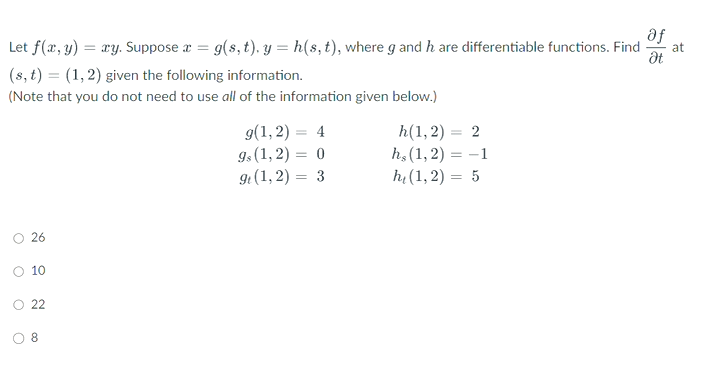
Let ( f(x, y)=x y ). Suppose ( x=g(s, t), y=h(s, t) ), where ( g ) and ( h ) are differentiable functions. Find ( frac{partial f}{partial t} ) at ( (s, t)=(1,2) ) given the following information. (Note that you do not need to use all of the information given below.) [ egin{array}{rlrl} g(1,2) & =4 & h(1,2) & =2 \ g_{s}(1,2) & =0 & h_{s}(1,2) & =-1 \ g_{t}(1,2) & =3 & h_{t}(1,2) & =5 end{array} ] 26 10 22 8
View Answer
divider
ANSWERED

Supreeta N verified

Numerade educator

Consider the surface with equation ( x^{2}+y^{2}=4 ) in ( R^{3} ). The surface is a: A) Paraboloid B) Sphere C) Double Cone D) Cylinder Consider the surface with equation ( x^{2}+y^{2}+z^{2}=4 ) in ( R^{3} ). The surface is a: A) Paraboloid B) Sphere C) Double Cone D) Cylinder Consider the surface with equation ( x^{2}+y^{2}+z^{2}=1 ) in ( R^{3} ). The surface is a: A) Paraboloid B) Sphere C) Double Cone D) Cylinder

View Answer
divider
ANSWERED

Hoan Nguyen verified

Numerade educator

Given is a function ( f(x, y) ). with ( f_{x}(a, b)=f_{y}(a, b)=f_{y y}(a, b)=0 . f_{x y}(a, b) eq 0 ) and all second-order partial derivatives are continuous at the critical point ( (a, b) ). What can be said about the critical point using the second derivative test? The critical point is a local minimum. The critical point is a saddle point. Nothing. as the second derivative test is inconclusive. The critical point is a local maximum.

View Answer
divider
ANSWERED

Supreeta N verified

Numerade educator

The decay of a radioactive mass ( m ) is modeled by ( frac{d m}{d t}=-0.032 m ) where ( t ) is taken in years. Determine the time ( T ) in years for the mass ( m ) to halve. ( T approx 21.7 ) years ( T approx 41.2 ) years ( T approx 11.6 ) years ( T approx 32.5 ) years

View Answer
divider
ANSWERED

Tanvi Garg verified

Numerade educator

Q3) The general solution of the first order differential equation is given by y(x) = 1/x(e^{2x} + C). Find the particular solution for which y =0 and x=1. A) y(x) = 1/x(e^{2x} + e^{2}) B) y(x) = 1/x(-e^{2x} - e^{2}) C) y(x) = 1/x(-e^{2x} + e^{2}) D) y(x) = 1/x(e^{2x} - e^{2})

View Answer
divider
ANSWERED

Tanvi Garg verified

Numerade educator

Q2) The general solution of the first order differential equation is given by ( y(x)=cos (x)-C e^{x} ). Find the particular solution for which ( y=0 ) and ( x=0 ). A) ( y(x)=cos (x)-2 e^{x} ) B) ( y(x)=cos (x)+e^{x} ) C) ( y(x)=cos (x)+2 e^{x} ) D) ( y(x)=cos (x)-e^{x} )

View Answer
divider
ANSWERED

Tanvi Garg verified

Numerade educator

Q1) The general solution of the first order differential equation is given by ( y(x)=frac{1}{x}(cos (pi x)+C) ). Find the particular solution for which ( y=0 ) and ( x=1 ). A) ( y(x)=frac{1}{x}(cos (pi x)+1) ) B) ( y(x)=frac{1}{x}(cos (pi x)-1) ) C) ( y(x)=frac{1}{2 x}(2 cos (pi x)-1) ) D) ( y(x)=frac{1}{2 x}(2 cos (pi x)+1) )

View Answer
divider
ANSWERED

Supreeta N verified

Numerade educator

A small lake has a river flowing in and a river flowing out. The lake itself holds constantly ( 10000 mathrm{~m}^{3} ) of water. The rivers flowing in and out both have flows of ( 20 mathrm{~m}^{3} ) per second. The river that is flowing in is polluted with 50 grams ( (0.05 mathrm{~kg}) ) of poison per ( m^{3} ), which instantly mixes with the water in the lake. The river flowing out has the same concentration of poison as the rest of the lake. If ( P(t) ) is the amount (in ( mathrm{kg} ) ) of poison in the lake at time ( t ) (in seconds), which of the following differential equations models this mixing problem? Here are the options to choose from ( underline{A}, mathrm{~B}, mathrm{C}, mathrm{D} ) [ egin{array}{l} frac{d P}{d t}=-left(1-frac{P}{10000} ight) \ frac{d P}{d t}=frac{P}{20}-50 \ frac{d P}{d t}=0.1+frac{P}{500} \ frac{d P}{d t}=1-frac{P}{500} end{array} ]

View Answer
divider