Ace - AI Tutor
Ask Our Educators
Textbooks
My Library
Flashcards
Scribe - AI Notes
Notes & Exams
Download App
xavier davis

xavier d.

Divider

Questions asked

BEST MATCH

For a certain decomposition reaction Kc = 21.2 at 298 K, what is ΔG°rxn for this reaction?

View Answer
divider
BEST MATCH

Question 1 (2 points) What is an equivalent decimal value of binary number 101 ?

View Answer
divider
BEST MATCH

Which of the following situations best illustrates the principle of empiricism? Using logic to deduce that "birds of a feather flock together." Asking an expert in social psychology whether "birds of a feather flock together." Observing the friends you have to see if they tend to form relationships with people who are similar to them. Just knowing in your gut that "birds of a feather flock together."

View Answer
divider
BEST MATCH

Solve the initial value problem by using power series: y'' + xy' - 2y = 0, \quad y(0) = 1, \quad y'(0) = 0 Assume the form y(x) = \sum_{n=0}^{\infty} c_n x^n. \quad Then y'(x) = \sum_{n=1}^{\infty} n c_n x^{n-1} y''(x) = \sum_{n=2}^{\infty} n(n-1) c_n x^{n-2} y'''(x) = \sum_{n=0}^{\infty} (n+1)(n+2) c_{n+2} x^n \text{ (Note: shift of index of summation must be used here)} xy'(x) = \sum_{n=1}^{\infty} n c_n x^n -2y(x) = \sum_{n=0}^{\infty} -2 c_n x^n Then y'' + xy' - 2y = \sum_{n=0}^{\infty} [(n+2)(n+1) c_{n+2} + \Box c_{n+1} + \Box c_n] x^n Requiring that the individual terms of this series for the left side of the differential equation vanish gives the recurrence relation c_{n+2} = \Box c_{n+1} + \Box c_n \text{ for } n = 0, 1, 2, ...

View Answer
divider
BEST MATCH

A network connection is congested because of which there are multiple network fluctuations and latency issues. You as a network administrator plan on solving this issue by using a network device to send signals to the sender or receiver of the data packets that the network is congested. Which one of the following will you use in this scenario? a. Implicit signaling b. Backpressure c. Admission policy d. Explicit signaling

View Answer
divider
BEST MATCH

PORTFOLIO RISK 50 40 40, 28 30 20 10 0 0 10 20 30 40 50 60 70 80 90 100 NUMBER OF STOCK IN THE PORTFOLIO Based on the data presented in the previous graph, which of the following statements are true? Check all that apply. A portfolio of 40 stocks has a diversifiable risk of 8%. A portfolio of 80 or more stocks could eliminate almost half of the risk. The market portfolio would have a standard deviation of about 40%.

View Answer
divider
BEST MATCH

[12 points] Assume that $i_s(t) = 0.01\sin(10^4t - 90)$. Find the currents $i_R(t)$, $i_L(t)$, $i_C(t)$ and the voltage $v(t)$. Write your final answer here: $i_R(t) = 0.01\cos(10^4t - 180)$ $i_L(t) = 0.05\cos(10^4t + 90)$ $i_C(t) = 0.05\cos(10^4t - 90)$ $v(t) = 10\cos(10^4t - 180)$

View Answer
divider
BEST MATCH

Assume a client opened a TCP connection to the server. During the TCP connection establishment, the client sent the server a window of 4096 bytes and the server sent an Initial Sequence Number to the client of 310. Assume no data or acks are lost throughout the connection. Answer the following questions corresponding to the sequence of events that occurs after the connection is established. a) After the connection is opened, the server sent 1024 bytes. How many more bytes can the server send before receiving any ACKS from the client? b) Before sending any more data (beyond the 1024 it already sent in part a), the server receives an ACK with an ACK sequence number of 1236 and a window of 4096. How many more bytes, beyond what it sent already in part a, can the server send without receiving any more ACKs? c) The server then sent a segment containing 1024 byes. What is the sequence number on that segment? d) The server after having sent the data in parts a and b, receives an ACK. What is the highest possible ACK sequence number in that ACK?

View Answer
divider
BEST MATCH

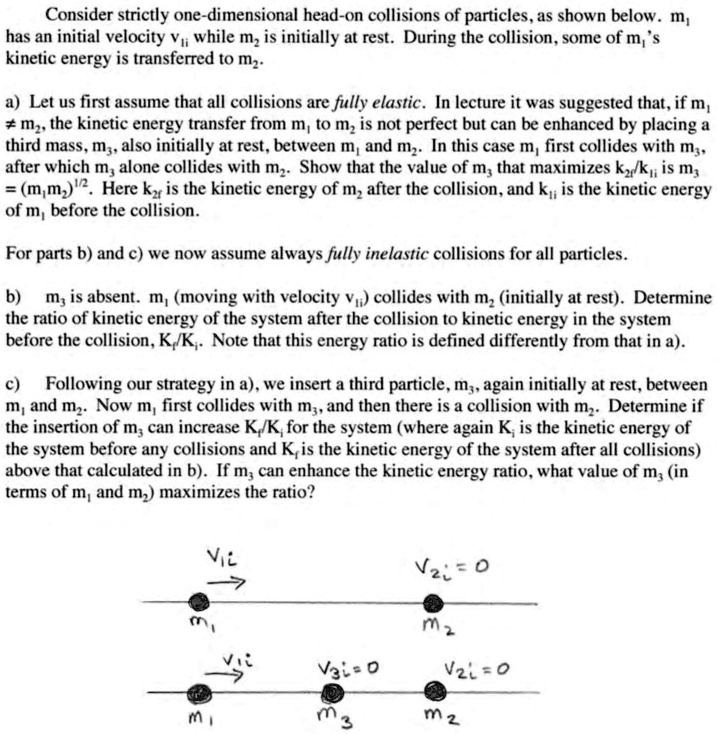
Consider strictly one-dimensional head-on collisions of particles, as shown below. m? has an initial velocity v?? while m? is initially at rest. During the collision, some of m?'s kinetic energy is transferred to m?. a) Let us first assume that all collisions are fully elastic. In lecture it was suggested that, if m? ?m?, the kinetic energy transfer from m? to m? is not perfect but can be enhanced by placing a third mass, m?, also initially at rest, between m? and m?. In this case m? first collides with m?, after which m? alone collides with m?. Show that the value of m? that maximizes $k_{2f}/k_{1i}$ is m? = $(m_1m_2)^{1/2}$. Here $k_{2f}$ is the kinetic energy of m? after the collision, and $k_{1i}$ is the kinetic energy of m? before the collision. For parts b) and c) we now assume always fully inelastic collisions for all particles. b) m? is absent. m? (moving with velocity v??) collides with m? (initially at rest). Determine the ratio of kinetic energy of the system after the collision to kinetic energy in the system before the collision, $K_f/K_i$. Note that this energy ratio is defined differently from that in a). c) Following our strategy in a), we insert a third particle, m?, again initially at rest, between m? and m?. Now m? first collides with m?, and then there is a collision with m?. Determine if the insertion of m? can increase $K_f/K_i$ for the system (where again $K_i$ is the kinetic energy of the system before any collisions and $K_f$ is the kinetic energy of the system after all collisions) above that calculated in b). If m? can enhance the kinetic energy ratio, what value of m? (in terms of m? and m?) maximizes the ratio?
View Answer
divider
BEST MATCH

A first order low pass filter has a break frequency of 900 Hz. Calculate the phase lag caused by the filter if a sine wave of peak amplitude 10 and frequency 600 Hz is applied as the input. Give your answer in degrees rounded to the nearest integer value. Note that, as a lag angle is asked for, you should give your answer as a positive value.

View Answer
divider