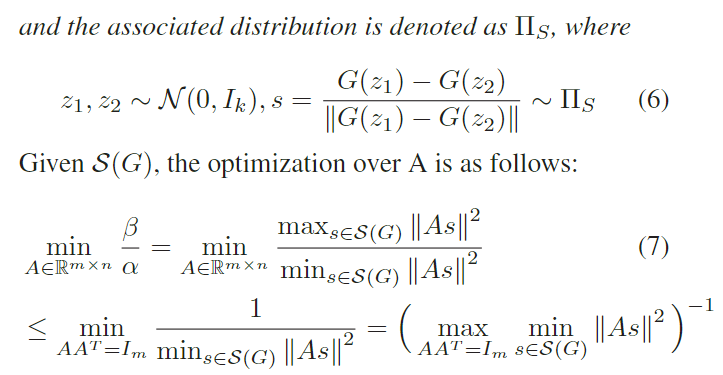
and the associated distribution is denoted as \( \Pi_{S} \), where
\[
z_{1}, z_{2} \sim \mathcal{N}\left(0, I_{k}\right), s=\frac{G\left(z_{1}\right)-G\left(z_{2}\right)}{\left\|G\left(z_{1}\right)-G\left(z_{2}\right)\right\|} \sim \Pi_{S}
\]
Given \( \mathcal{S}(G) \), the optimization over \( \mathrm{A} \) is as follows:
\[
\begin{array}{l}
\min _{A \in \mathbb{R}^{m \times n}} \frac{\beta}{\alpha}=\min _{A \in \mathbb{R}^{m \times n}} \frac{\max _{s \in \mathcal{S}(G)}\|A s\|^{2}}{\min _{s \in \mathcal{S}(G)}\|A s\|^{2}} \\
\leq \min _{A A^{T}=I_{m}} \frac{1}{\min _{s \in \mathcal{S}(G)}\|A s\|^{2}}=\left(\max _{A A^{T}=I_{m}} \min _{s \in \mathcal{S}(G)}\|A s\|^{2}\right)^{-1}
\end{array}
\]