Question 1: Pure Nash equilibrium in a Partnership Game
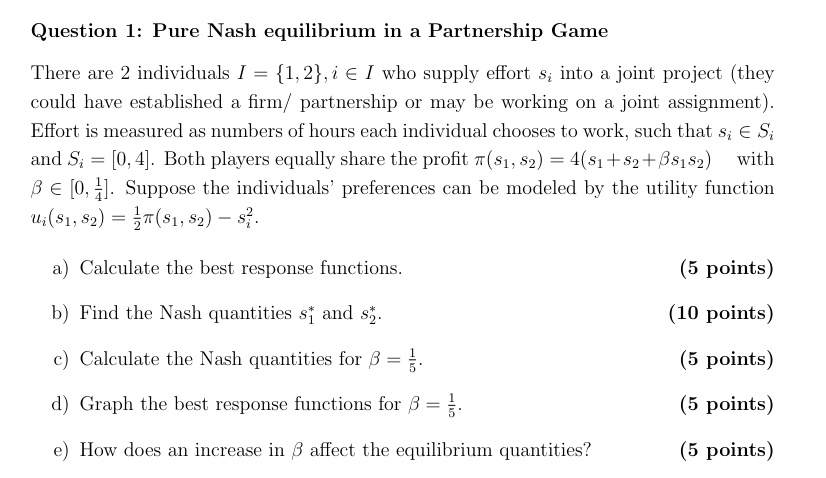
There are 2 individuals I = {1, 2}, i ∈ I who supply effort s<sub>i</sub> into a joint project (they
could have established a firm/ partnership or may be working on a joint assignment).
Effort is measured as numbers of hours each individual chooses to work, such that s<sub>i</sub> ∈ S<sub>i</sub>
and S<sub>1</sub> = [0, 4]. Both players equally share the profit π(s<sub>1</sub>, s<sub>2</sub>) = 4(s<sub>1</sub>+s<sub>2</sub>+βs<sub>1</sub>s<sub>2</sub>) with
β∈ [0,1]. Suppose the individuals' preferences can be modeled by the utility function
u<sub>i</sub>(s<sub>1</sub>, s<sub>2</sub>) = 1/2π(s<sub>1</sub>, s<sub>2</sub>) - s<sub>i</sub><sup>2</sup>.
a) Calculate the best response functions.
(5 points)
b) Find the Nash quantities s<sub>1</sub><sup>*</sup> and s<sub>2</sub><sup>*</sup>.
(10 points)
c) Calculate the Nash quantities for β = 1/5.
(5 points)
d) Graph the best response functions for β = 1/5.
(5 points)
e) How does an increase in β affect the equilibrium quantities?
(5 points)