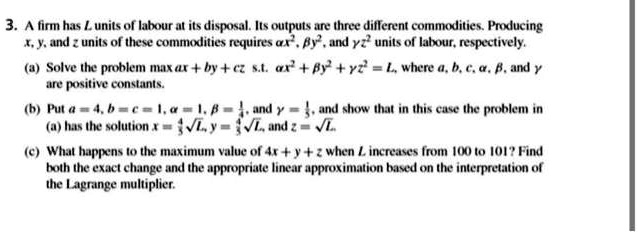
3. A firm has $L$ units of labour at its disposal. Its outputs are three different commodities. Producing
x, y, and z units of these commodities requires $ax^2$, $\beta y^2$, and $yz^2$ units of labour, respectively.
(a) Solve the problem max $ax + by + cz$ s.t. $ax^2 + \beta y^2 + yz^2 = L$, where a, b, c, $\alpha$, $\beta$, and $\gamma$
are positive constants.
(b) Put $a = 4$, $b = c = 1$, $\alpha = 1$, $\beta = \frac{1}{4}$, and $\gamma = \frac{1}{2}$, and show that in this case the problem in
(a) has the solution $x = \frac{4}{5}\sqrt{L}$, $y = \sqrt{L}$, and $z = \sqrt{L}$.
(c) What happens to the maximum value of $4x + y + z$ when $L$ increases from 100 to 101? Find
both the exact change and the appropriate linear approximation based on the interpretation of
the Lagrange multiplier.