3. Costly Signal
Gazelles are commonly at risk of being prey for cheetahs in Africa. Chasing a gazelle can not
only be exhausting for a cheetah, but catching the quick animals is not a guarantee. A cheetah
wants to find a tasty but lazy gazelle to chase, while a gazelle wishes not to be chased at all.
A gazelle can jump high in the air and kick out its legs in a display, or signal, of its physical
fitness, attempting to tell a threatening cheetah that it would be a waste of time to chase them.
This \"stotting\" is also exhausting, and dangerous because if not believed, the cheetah has a
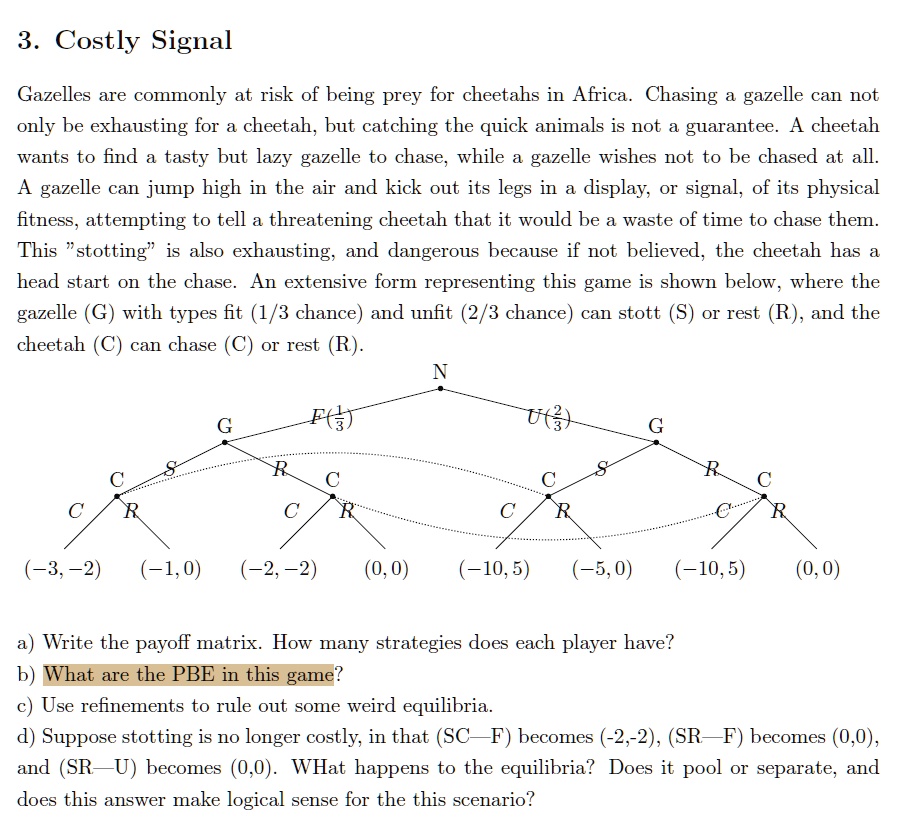
head start on the chase. An extensive form representing this game is shown below, where the
gazelle (G) with types fit (1/3 chance) and unfit (2/3 chance) can stott (S) or rest (R), and the
cheetah (C) can chase (C) or rest (R).
N
G
F($\frac{1}{3}$)
U($\frac{2}{3}$)
G
R
R
C
C
C
C
C
R
C
R
C
R
C
R
(-3,-2) (-1,0) (-2,-2) (0,0) (-10,5) (-5,0) (-10,5) (0,0)
a) Write the payoff matrix. How many strategies does each player have?
b) What are the PBE in this game?
c) Use refinements to rule out some weird equilibria.
d) Suppose stotting is no longer costly, in that (SC-F) becomes (-2,-2), (SR-F) becomes (0,0),
and (SR-U) becomes (0,0). WHat happens to the equilibria? Does it pool or separate, and
does this answer make logical sense for the this scenario?