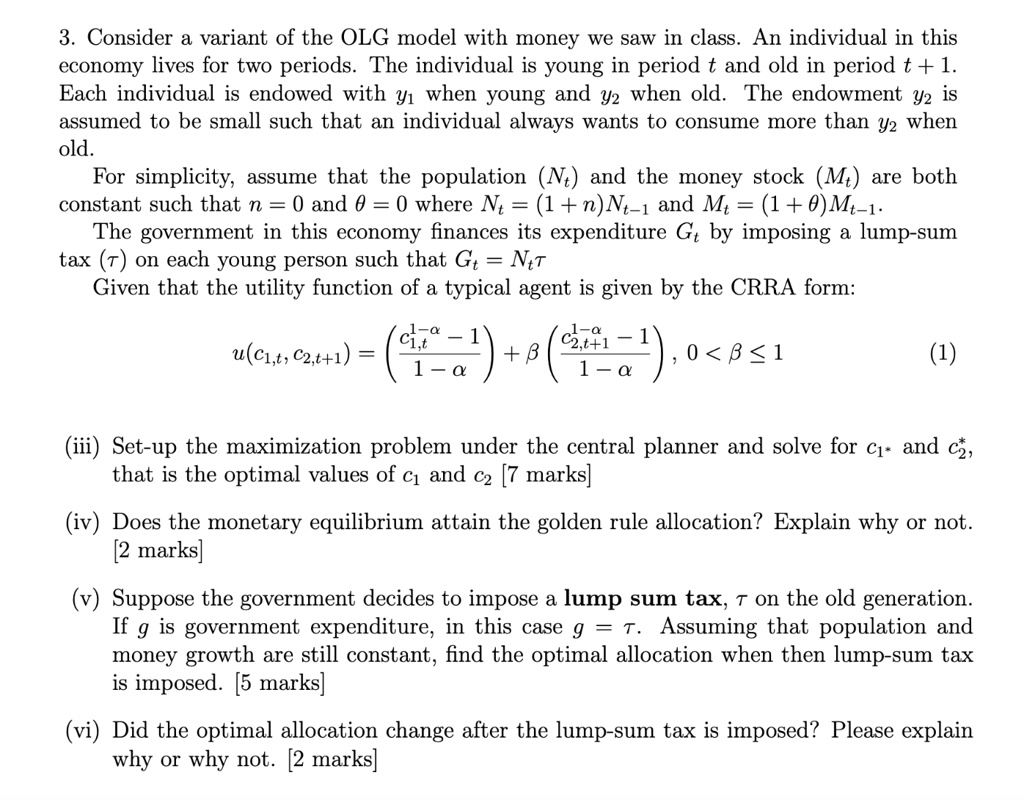
3. Consider a variant of the OLG model with money we saw in class. An individual in this
economy lives for two periods. The individual is young in period $t$ and old in period $t + 1$.
Each individual is endowed with $y_1$ when young and $y_2$ when old. The endowment $y_2$ is
assumed to be small such that an individual always wants to consume more than $y_2$ when
old.
For simplicity, assume that the population ($N_t$) and the money stock ($M_t$) are both
constant such that $n = 0$ and $\theta = 0$ where $N_t = (1 + n)N_{t-1}$ and $M_t = (1 + \theta)M_{t-1}$.
The government in this economy finances its expenditure $G_t$ by imposing a lump-sum
tax ($\tau$) on each young person such that $G_t = N_t\tau$
Given that the utility function of a typical agent is given by the CRRA form:
$u(c_{1,t}, c_{2,t+1}) = \left(\frac{c_{1,t}^{1-\alpha}}{1 - \alpha}\right) + \beta \left(\frac{c_{2,t+1}^{1-\alpha}}{1 - \alpha}\right), \quad 0 < \beta \le 1$
(1)
(iii) Set-up the maximization problem under the central planner and solve for $c_1^*$ and $c_2^*$,
that is the optimal values of $c_1$ and $c_2$ [7 marks]
(iv) Does the monetary equilibrium attain the golden rule allocation? Explain why or not.
[2 marks]
(v) Suppose the government decides to impose a lump sum tax, $\tau$ on the old generation.
If $g$ is government expenditure, in this case $g = \tau$. Assuming that population and
money growth are still constant, find the optimal allocation when then lump-sum tax
is imposed. [5 marks]
(vi) Did the optimal allocation change after the lump-sum tax is imposed? Please explain
why or why not. [2 marks]