Ace - AI Tutor
Ask Our Educators
Textbooks
My Library
Flashcards
Scribe - AI Notes
Notes & Exams
Download App
yolanda roda

yolanda r.

Divider

Questions asked

BEST MATCH

Which of the following is considered a "Younger" (i.e., < 35) stage of the household life cycle? A single parent II B single II C single III D full nestl 1 E empty nestl 1

View Answer
divider
BEST MATCH

. What pathway do bacteria use to generate fatty acids from lipids for use in the TCA cycle? deamination Kreb's cycle β- oxidation Entner-Doudoroff pathway pentose phosphate pathway

View Answer
divider
BEST MATCH

A ___\ psychological process is one that is found to be true or applicable for most people of most cultures

View Answer
divider
BEST MATCH

â—» in all, how many paperback copies were sold? | paperback copies [-/5.66Polnts] DETAILS MY NOTES ASK YOUR TEACHER There were 31,000 hardback copies of a certain novel sold before the paperback versior in all, how many paperback coples were sold? paperback copies novel were sold

View Answer
divider
BEST MATCH

explain the working of an electroencephalogram what kind of information does the electroencephalogram provide

View Answer
divider
BEST MATCH

This image is no longer available. Visit tinypic.com for more information.

View Answer
divider
BEST MATCH

Question 3 of 3 (1 point) Atempt 1 of Unlimited View question in a popup 11.7 Section Exercise 16 A brisk walk at 4 miles per hour burns an average of 290 calories per hour. If the standard deviation of the distribution is 9 calories, find the probability that a person who walks 1 hour at the rate of 4 miles per hour will burn the given number of calories. Assume the random variable is normally distributed. Refer to the table of values (Area Under the Standard Normal Distribution) as needed. If necessary, round intermediate calculations to the nearest hundredth. Part: 0 / 3 Part 1 of 3 (a) More than 260 calories The probability that a randomly selected person burns more than 260 calories is %.

View Answer
divider
BEST MATCH

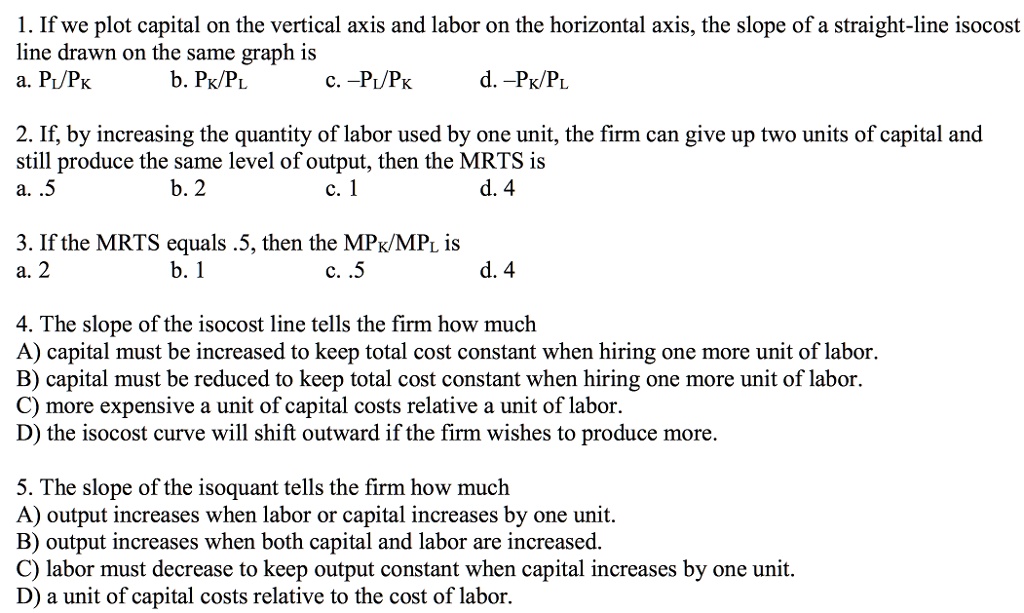
1. If we plot capital on the vertical axis and labor on the horizontal axis, the slope of a straight-line isocost line drawn on the same graph is a. $P_L/P_K$ b. $P_K/P_L$ c. $-P_L/P_K$ d. $-P_K/P_L$ 2. If, by increasing the quantity of labor used by one unit, the firm can give up two units of capital and still produce the same level of output, then the MRTS is a. .5 b. 2 c. 1 d. 4 3. If the MRTS equals .5, then the $MP_K/MP_L$ is a. 2 b. 1 c. .5 d. 4 4. The slope of the isocost line tells the firm how much A) capital must be increased to keep total cost constant when hiring one more unit of labor. B) capital must be reduced to keep total cost constant when hiring one more unit of labor. C) more expensive a unit of capital costs relative a unit of labor. D) the isocost curve will shift outward if the firm wishes to produce more. 5. The slope of the isoquant tells the firm how much A) output increases when labor or capital increases by one unit. B) output increases when both capital and labor are increased. C) labor must decrease to keep output constant when capital increases by one unit. D) a unit of capital costs relative to the cost of labor.
View Answer
divider
BEST MATCH

$\qquad + \qquad v \qquad -$ $\qquad i \rightarrow \bullet 1 \qquad 2 \bullet$ If the current at the terminals of the element shown above is defined as: $i = 0$, $t < 0$; $i = 40te^{-500t} A$, $t \ge 0$. (a) Find the expression for the charge accumulating? (b) Find the charge that has accumulated at $t = 1 \text{ ms} (m \sim 10^{-3})$?

View Answer
divider
BEST MATCH

In the context of decision-making, values best reflect: Preferences Intuitive processes Evaluations Uncertainty

View Answer
divider