Ace - AI Tutor
Ask Our Educators
Textbooks
My Library
Flashcards
Scribe - AI Notes
Notes & Exams
Download App
yolanda rodriguez

yolanda r.

Divider

Questions asked

BEST MATCH

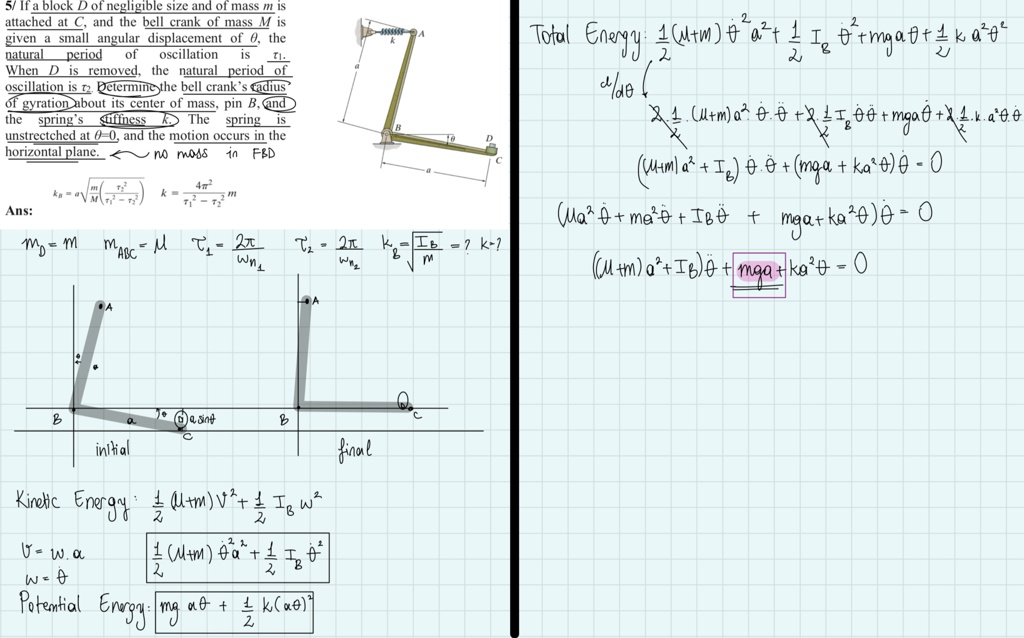
5/ If a block D of negligible size and of mass m is attached at C, and the bell crank of mass M is given a small angular displacement of $\theta$, the natural period of oscillation is $\tau_1$. When D is removed, the natural period of oscillation is $\tau_2$. Determine the bell crank's radius of gyration about its center of mass, pin B, and the spring's stiffness k. The spring is unstretched at $\theta=0$, and the motion occurs in the horizontal plane. no mass in FBD Ans: $m_D = m$ $m_{ABC} = M$ $\tau_1 = \frac{2\pi}{\omega_{n1}}$ $\tau_2 = \frac{2\pi}{\omega_{n2}}$ $k_B = \sqrt{\frac{I_B}{M}} = ? k = ?$ $k_B = a\sqrt{\frac{m}{M}\frac{(\tau_1^2 - \tau_2^2)}{(\tau_1^2 - \tau_2^2)}}$ $k = \frac{4\pi^2}{(\tau_1^2 - \tau_2^2)}m$ initial final Kinetic Energy: $\frac{1}{2}(M+m)V^2 + \frac{1}{2}I_B\omega^2$ $V = \omega \cdot a$ $\omega = \dot{\theta}$ $\frac{1}{2}(M+m)a^2\dot{\theta}^2 + \frac{1}{2}I_B\dot{\theta}^2$ Potential Energy: $mg~a\theta + \frac{1}{2}k(a\theta)^2$ Total Energy: $\frac{1}{2}(M+m)a^2\dot{\theta}^2 + \frac{1}{2}I_B\dot{\theta}^2 + mga\theta + \frac{1}{2}ka^2\theta^2$ $\frac{d}{d\theta}$ $2 \cdot \frac{1}{2}(M+m)a^2\dot{\theta}\ddot{\theta} + 2 \cdot \frac{1}{2}I_B\dot{\theta}\ddot{\theta} + mga\dot{\theta} + 2 \cdot \frac{1}{2}ka^2\theta\dot{\theta} = 0$ $((M+m)a^2 + I_B)\dot{\theta}\ddot{\theta} + (mga + ka^2\theta)\dot{\theta} = 0$ $(M\dot{a}^2\ddot{\theta} + ma^2\ddot{\theta} + I_B\ddot{\theta} + mga + ka^2\theta)\dot{\theta} = 0$ $((M+m)a^2 + I_B)\ddot{\theta} + mga + ka^2\theta = 0$
View Answer
divider
BEST MATCH

Given the following proposed mechanism, $$2 NO_2 + Cl_2 \rightarrow 2 NO_2Cl$$ (overall reaction) Mechanism $$NO_2 + Cl_2 \rightarrow NO_2Cl + Cl.$$ slow $$NO_2 + Cl. \rightarrow NO_2Cl$$ fast The intermediate in this reaction is ______ and the rate law for the overall reaction is ______ $$NO_2$$ and Rate $$= k[NO_2][Cl_2]^2$$ Cl and Rate = $$k[NO_2]^2[Cl_2]$$ Cl and Rate = $$k[NO_2Cl] [Cl_2]$$ Cl and Rate = $$k[NO_2][Cl_2]$$ $$NO_2$$ and Rate = $$k[NO_2][Cl_2]$$

View Answer
divider
BEST MATCH

Which of the following events would produce a deductible loss? Erosion of personal use land due to rain or wind Termite infestation of a personal residence over a several year period

View Answer
divider
BEST MATCH

SELECT ALL THAT APPLY. Which of the following accurately describe the characteristics of energy dense foods? Learning Objective 2 SELECT ALL THAT APPLY. Which of the following accurately describe the characteristics of energy dense foods? High energy density foods are often lower in water content (% of food made of water) High energy density foods are also high in nutrient density High energy density foods generally have a shorter shelf-life High energy density foods can be higher in fat (leading to a higher energy density)

View Answer
divider
BEST MATCH

Consider the function \( f \) defined by \( f(x)=3 x \arccos (x) \) where \( -1 \leq x \leq 1 \). (a) Sketch the graph of \( f \) indicating clearly any intercepts with the axes and the coordinates of any local maximum or minimum points. (b) State the range of \( f \). (c) Solve the inequality \( |3 x \arccos (x)|>1 \).

View Answer
divider
BEST MATCH

What line of evidence in addition to bone morphology shows that Australopithecus afarensis was bipedal? Group of answer choices DNA evidence Cave drawings Foot prints in volcanic ash Tools found by a skeleton All the above

View Answer
divider
BEST MATCH

PROBLEM 2: Write center and radius of convergene for the following 3 infinite series in Table below. Give step by step work to get your answers. HINT 1: (m)! = m(m-1)(m - 2) x ... X 1. ex 1: (m + 3)! = (m + 3)(m + 2)(m + 1)(m)! ex 2: (3n)! = 3n(3n-1)(3? – 2) × ... ? 1. ex 3: (3(n + 1))! = (4n+ 4)! = (4n+4)(4n+3)(4n+ 3)(4n+1)(4n)! HINT 2: Let $B_m = \left(\frac{m+1}{m}\right)^{4m} = \left(1 + \frac{1}{m}\right)^{4m}$ then for $\lim_{m \to \infty} B_m = e^4$ Infinite Series Radius of Convergence $\sum_{n=0}^{\infty} \frac{(2n)! n!}{4^n (3n)!} (z - 2 - i3)^n$ center $\sum_{n=0}^{\infty} \left(\frac{z - 10}{4 + i3}\right)^{2n}$ Hint: this is the Geometric series with $q = \left(\frac{z - 10}{4 + i3}\right)^2$ $\sum_{n=0}^{\infty} \frac{(4n + 1)!}{8^n \times (2n + 1)! (2n)^{2n}} z^n$

View Answer
divider
BEST MATCH

Burke asserts that the power to inflict pain generally causes terror and invokes the sublime. Question 5 options: True False

View Answer
divider
BEST MATCH

Suppose that the graph below is the graph of $f'(x)$, the derivative of a function $f(x)$. Find the open intervals where $f(x)$ is a) increasing, or b) decreasing. a) List any interval(s) on which $f(x)$ is increasing. Select the correct choice below and fill in any answer boxes within your choice. A. (Type your answer in interval notation. Simplify your answer. Use integers or fractions for any numbers in the expression. Use a comma to separate answers as needed.) B. The function $f(x)$ is never increasing. b) List any interval(s) on which $f(x)$ is decreasing. Select the correct choice below and fill in any answer boxes within your choice A. (Type your answer in interval notation. Simplify your answer. Use integers or fractions for any numbers in the expression. Use a comma to separate answers as needed.) B. The function $f(x)$ is never decreasing.

View Answer
divider
BEST MATCH

If you borrow $200 at 8 percent annual interest and repay it in one lump sum at the end of one year, you will have to pay Multiple Choice $216. $200. $208

View Answer
divider