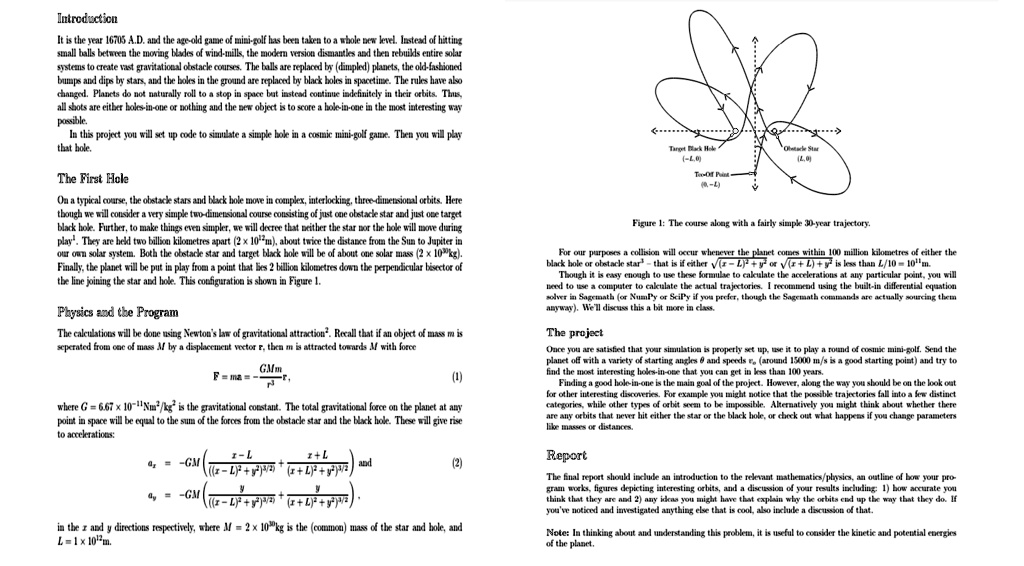
For this project, can I get the details step by step. you can use Sagemath for differentiation, how to set up the simulation and how does kinetic and potential energy help finding the solution. how to find the graph etc. Instructions are given in the picture.
Introduction: It is the year 16705 A.D. and the age-old game of mini-golf has been taken to a whole new level. Instead of hitting small balls between the moving blades of windmills, the modern version dismantles and then rebuilds entire solar systems to create vast gravitational obstacle courses. The balls are replaced by (dimpled) planets, the old-fashioned bumps and dips by stars, and the holes in the ground are replaced by black holes in spacetime. The rules have also changed. Planets do not naturally roll to a stop in space but instead continue indefinitely in their orbits. Thus, all shots are either holes-in-one or nothing and the new object is to score a hole-in-one in the most interesting way possible.
The First Hole: On a typical course, the obstacle stars and black hole move in complex, interlocking, three-dimensional orbits. Here though we will consider a very simple two-dimensional course consisting of just one obstacle star and just one target black hole. Further, to make things even simpler, we will decree that neither the star nor the hole will move during play. They are held two billion kilometers apart (2 x 10^12 m, about twice the distance from the Sun to Jupiter in our own solar system. Both the obstacle star and target black hole will be of about one solar mass (2 x 10^30 kg). Finally, the planet will be put in play from a point that lies 2 billion kilometers down the perpendicular bisector of the line joining the star and hole. This configuration is shown in Figure 1.
For our purposes, a collision will occur whenever the planet comes within 100 million kilometers of either the black hole or obstacle star - that is if either sqrt((x - L)^2 + y^2) or sqrt((x + L)^2 + y^2) is less than L/10 = 10^11 m. Though it is easy enough to use these formulae to calculate the accelerations at any particular point, you will need to use a computer to calculate the actual trajectories. I recommend using the built-in differential equation solver in Sagemath (or NumPy or SciPy if you prefer, though the Sagemath commands are actually sourcing them anyway). We'll discuss this a bit more in class.
Physics and the Program: The calculations will be done using Newton's law of gravitational attraction. Recall that if an object of mass m is separated from one of mass M by a displacement vector r, then m is attracted towards M with force:
F = -GMm/r^2
where G = 6.67 x 10^-11 Nm^2/kg^2 is the gravitational constant. The total gravitational force on the planet at any point in space will be equal to the sum of the forces from the obstacle star and the black hole. These will give rise to accelerations:
a_x = -GM(x - L)/((x - L)^2 + y^2)^(3/2)
a_y = -GM*y/((x - L)^2 + y^2)^(3/2)
The project: Start the planet off with a variety of starting angles and speeds (around 15000 m/s is a good starting point) and try to find the most interesting holes-in-one that you can get in less than 100 years. Finding a good hole-in-one is the main goal of the project. However, along the way you should be on the lookout for other interesting discoveries. For example, you might notice that the possible trajectories fall into a few distinct categories, while other types of orbits seem to be impossible. Alternatively, you might think about whether there are like masses or distances.
The final report should include an introduction to the relevant mathematics/physics, an outline of how your program works, figures depicting interesting orbits, and a discussion of your results including: 1) how accurate you think that they are and 2) any ideas you might have that explain why the orbits end up the way that they do. If you've noticed and investigated anything else that is cool, also include a discussion of that.
Note: In thinking about and understanding this problem, it is useful to consider the kinetic and potential energies of the planet.