Ace - AI Tutor
Ask Our Educators
Textbooks
My Library
Flashcards
Scribe - AI Notes
Notes & Exams
Download App
yvonne cook

yvonne c.

Divider

Questions asked

BEST MATCH

Solve each of the following logarithmic equations by first getting a single log all by itself on one side of the equation. Then write the equation in exponential form log2(x – 4) = 5 – log2x

View Answer
divider
BEST MATCH

A price floor is only effective when set above the market equilibrium. Group of answer choices True False

View Answer
divider
BEST MATCH

Determine the molar absorptivity of the acidic form of bromocresol green at 445 nm and at 615 nm

View Answer
divider
BEST MATCH

is this a good research question does increased parent engagment with children with ASD under age 6 improve outcome of better social and commuication skills ?

View Answer
divider
BEST MATCH

A concentric band of data on a hard disk drive is known as a ________. Track Sector Cluster Cylinder

View Answer
divider
BEST MATCH

181. When information asymmetry exists in a market, government: A. always steps in to try to correct it. B. never steps in to try to correct it. C. sometimes steps in to try to correct it. D. only steps in to correct it if it can ensure complete information.

View Answer
divider
BEST MATCH

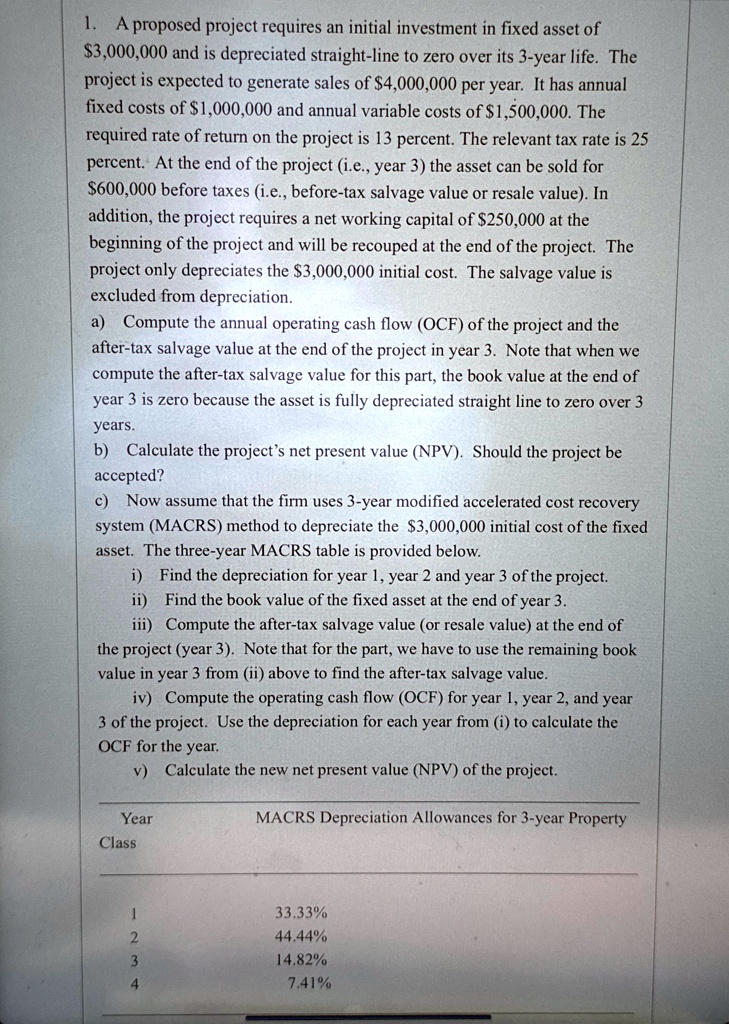
A proposed project requires an initial investment in fixed assets of $3,000,000 and is depreciated straight-line to zero over its 3-year life. The project is expected to generate sales of $4,000,000 per year. It has annual fixed costs of $1,000,000 and annual variable costs of $1,500,000. The required rate of return on the project is 13 percent. The relevant tax rate is 25 percent. At the end of the project (i.e., year 3), the asset can be sold for $600,000 before taxes (i.e., before-tax salvage value or resale value). In addition, the project requires a net working capital of $250,000 at the beginning of the project and will be recouped at the end of the project. The project only depreciates the $3,000,000 initial cost. The salvage value is excluded from depreciation. a) Compute the annual operating cash flow (OCF) of the project and the after-tax salvage value at the end of the project in year 3. Note that when we compute the after-tax salvage value for this part, the book value at the end of year 3 is zero because the asset is fully depreciated straight line to zero over 3 years. b) Calculate the project's net present value (NPV). Should the project be accepted? c) Now assume that the firm uses a 3-year modified accelerated cost recovery system (MACRS) method to depreciate the $3,000,000 initial cost of the fixed asset. The three-year MACRS table is provided below. i) Find the depreciation for year 1, year 2, and year 3 of the project. ii) Find the book value of the fixed asset at the end of year 3. iii) Compute the after-tax salvage value (or resale value) at the end of the project (year 3). Note that for this part, we have to use the remaining book value in year 3 from (ii) above to find the after-tax salvage value. iv) Compute the operating cash flow (OCF) for year 1, year 2, and year 3 of the project. Use the depreciation for each year from (i) to calculate the OCF for the year. v) Calculate the new net present value (NPV) of the project. Year Class MACRS Depreciation Allowances for 3-year Property 1 2 3 4 33.33% 44.44% 14.82% 7.41%
View Answer
divider
BEST MATCH

Negate the following statement without using any negative words ("no", "not", "none", "zero", etc): "Every book written by any professor in any university in Canada satisfies the property that there is an odd-numbered page containing a word whose first letter is its last letter or a letter that comes after it in the alphabet."

View Answer
divider
BEST MATCH

Q3) What do you mean by global warming? Write any 5 suggestions for reducing global warming. [3 Marks] (Minimum one page) Note: students must type the answers in word file and sketches/drawings may be in image format.

View Answer
divider
BEST MATCH

Let $P_x(e^{j\omega})$ be the power spectrum of a wide-sense stationary process $x(n)$ and let $\lambda_k$ be the eigenvalues of the $M \times M$ autocorrelation matrix $R_x$. Szeg?'s theorem states that if $g(.)$ is a continuous function then $\lim_{M \to \infty} \frac{g(\lambda_1) + g(\lambda_2) + \dots + g(\lambda_M)}{M} = \frac{1}{2\pi} \int_{-\pi}^{\pi} g[P_x(e^{j\omega})]d\omega$ Using this theorem, show that $\lim_{M \to \infty} [\det R_x]^{1/M} = \exp \left\{\frac{1}{2\pi} \int_{-\pi}^{\pi} \ln[P_x(e^{j\omega})]d\omega\right\}$

View Answer
divider