Ace - AI Tutor
Ask Our Educators
Textbooks
My Library
Flashcards
Scribe - AI Notes
Notes & Exams
Download App
zachary azorin

zachary a.

Divider

Questions asked

BEST MATCH

The approximate phase angle of oscillations is: A). 1.2 rad B). 0.9 rad C). 0.3 rad D). 1.9 r

View Answer
divider
BEST MATCH

----- is the amount of energy needed to start a chemical reaction. Activation of energy Active site Holoenzyme Biotin

View Answer
divider
BEST MATCH

5. In the circuit shown below, calculate the average power absorbed by the resistor and the capacitor. Find the average power supplied by the voltage source. $5\angle30^\circ$ V I 4? $-j2$ ?

View Answer
divider
BEST MATCH

Pathophysiology

View Answer
divider
BEST MATCH

3) In this question, we will examine when it is appropriate to use transformations as opposed to polynomial regression. y \\ y = x^3 a) Would a transformation or polynomial regression fit the data best, why? What transformation/polynomials would we use? b) Depending on your answer to part a), explain how and why your polynomial/transformation works. c) Can we perform the usual regression inference in this setting?

View Answer
divider
BEST MATCH

33. \lim_{x \to 0} \frac{x^3 - 5x^2}{x^2} 34. \lim_{t \to 5} \frac{4t^2 - 100}{t - 5} 35. \lim_{x \to 1^+} \frac{x^2 - 5x + 6}{x - 1} 36. \lim_{x \to 4} \frac{(x^2 - 10x + 24)^2}{x - 7} 37. \lim_{x \to 6^+} \frac{\sqrt{x - 6}}{x - 1} 38. \lim_{x \to 2} \frac{\sqrt{(x - 3)(x - 2)}}{x - 1} 39. \lim_{\theta \to 0^+} \csc \theta 40. \lim_{x \to 0^-} \csc x 41. \lim_{x \to 0^+} (-10 \cot x) 42. \lim_{\theta \to \frac{\pi}{2}^+} \frac{1}{3 \tan \theta} 43. \lim_{\theta \to 0} \frac{2 + \sin \theta}{1 - \cos^2 \theta} 44. \lim_{\theta \to 0} \frac{\sin \theta}{\cos^2 \theta - 1} 45. Location of vertical asymptotes Analyze the following limits and find the vertical asymptotes of f(x) = \frac{x - 5}{x - 5}

View Answer
divider
BEST MATCH

The sum of all real solutions of the equation |x|^(2)-3|x|+2=0 is

View Answer
divider
BEST MATCH

Round the number to the nearest hundred-thousandth. 2.42708876 2.42708876 rounded to the nearest hundred-thousandth is

View Answer
divider
BEST MATCH

Problem #3: Find the following derivative (assuming that $r(t)$ is differentiable). $\frac{d}{dt}[r''(t) \cdot (r'(t) \times r(t))]$ (A) $r''(t) \cdot (r'(t) \times r(t))$ (B) $r'''(t) \cdot (r(t) \times r'(t))$ (C) $r'''(t) \cdot (r(t) \times r''(t))$ (D) $r'(t) \cdot (r'''(t) \times r(t))$ (E) $r''(t) \cdot (r(t) \times r'''(t))$ (F) $r'''(t) \cdot (r'(t) \times r(t))$ (G) $r'(t) \cdot (r(t) \times r'''(t))$ (H) $r''(t) \cdot (r''(t) \times r(t))$

View Answer
divider
BEST MATCH

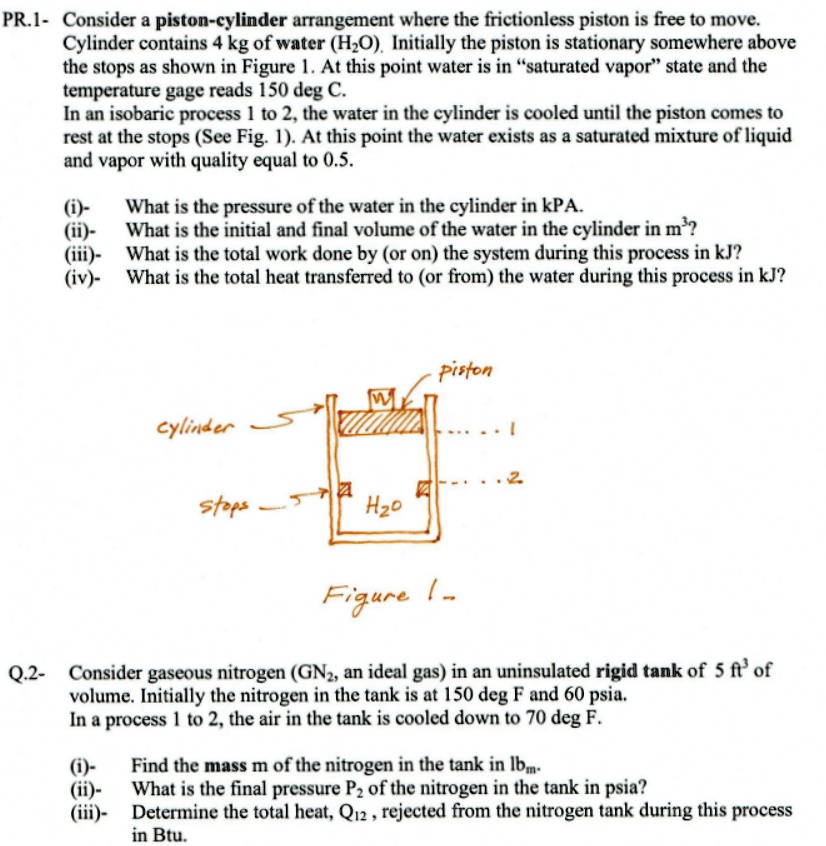
PR.1- Consider a piston-cylinder arrangement where the frictionless piston is free to move. The cylinder contains 4 kg of water (H2O). Initially, the piston is stationary somewhere above the stops as shown in Figure 1. At this point, water is in a "saturated vapor state" and the temperature gauge reads 150 deg C. In an isobaric process from 1 to 2, the water in the cylinder is cooled until the piston comes to rest at the stops (See Fig.1). At this point, the water exists as a saturated mixture of liquid and vapor with a quality equal to 0.5. (i) - What is the pressure of the water in the cylinder in kPa? (ii) - What is the initial and final volume of the water in the cylinder in m^3? (iii) - What is the total work done by (or on) the system during this process in kJ? (iv) - What is the total heat transferred to (or from) the water during this process in kJ?
View Answer
divider