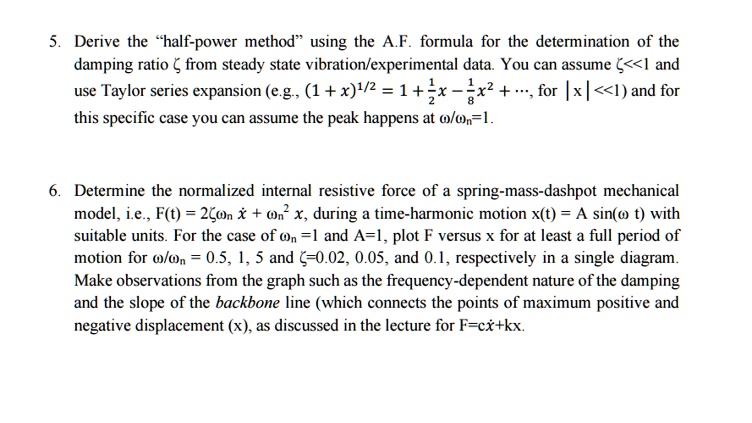
5. Derive the \"half-power method\" using the A.F. formula for the determination of the
damping ratio $\zeta$ from steady state vibration/experimental data. You can assume $\zeta << 1$ and
use Taylor series expansion (e.g., $(1 + x)^{1/2} = 1 + \frac{1}{2}x - \frac{1}{8}x^2 + ...$, for $|x| << 1$) and for
this specific case you can assume the peak happens at $\omega/\omega_n = 1$.
6. Determine the normalized internal resistive force of a spring-mass-dashpot mechanical
model, i.e., $F(t) = 2\zeta\omega_n \dot{x} + \omega_n^2 x$, during a time-harmonic motion $x(t) = A \sin(\omega t)$ with
suitable units. For the case of $\omega_n = 1$ and $A = 1$, plot F versus x for at least a full period of
motion for $\omega/\omega_n = 0.5, 1, 5$ and $\zeta = 0.02, 0.05, and 0.1$, respectively in a single diagram.
Make observations from the graph such as the frequency-dependent nature of the damping
and the slope of the backbone line (which connects the points of maximum positive and
negative displacement ($x$), as discussed in the lecture for $F = cx + kx$.