Ace - AI Tutor
Ask Our Educators
Textbooks
My Library
Flashcards
Scribe - AI Notes
Notes & Exams
Download App
zachary herrera

zachary h.

Divider

Questions asked

BEST MATCH

Suppose f(n)=38(0.73)nf(n)=38(0.73)n. What is the 1-unit growth factor? What is the 2-unit growth factor? What is the 8-unit growth factor? What is the 1/3-unit growth factor? What is the 1/4-unit growth factor?

View Answer
divider
BEST MATCH

Question 5 of 10 noA door with a width \( w=85.0 \mathrm{~cm} \) is pushed open with a force? a b c d \( \vec{F} \) Calculate the magnitude of the torque \( \tau_{\mathrm{a}} \) about an axis through the hinges in Case (a). \[ \tau_{\mathrm{a}}= \] \( \square \) \( \mathrm{N} \cdot \mathrm{m} \) Calculate the magnitude of the torque \( \tau_{\mathrm{b}} \) about an axis through the hinges in Case (b). \[ \tau_{\mathrm{b}}=\quad \square \quad \mathrm{N} \cdot \mathrm{~m} \] Calculate the magnitude of the torque \( \tau_{\mathrm{c}} \) about an axis through the hinges in Case (c). \[ \tau_{\mathrm{c}}=\quad \square \quad \mathrm{N} \cdot \mathrm{~m} \]

View Answer
divider
BEST MATCH

3) An ideal parallel-plate capacitor consists of a set of two parallel plates of radius R, separated by a very small distance d. This capacitor is connected to a DC voltage source. After a long time, the energy stored in the capacitor is $U_0$. While still connected to the DC voltage source, the separation between the plates is now doubled. How much energy is now stored in the capacitor? A) $4U_0$ B) $2U_0$ C) $U_0$ D) $ rac{1}{2}U_0$ E) $ rac{1}{4}U_0$

View Answer
divider
BEST MATCH

How do drugs that promote the release of norepinephrine (NE) affect receptor activation?

View Answer
divider
BEST MATCH

QUESTION 1 pchart The following fraction nonconforming control chart with $n=100$ is used to control a process Upper Control Chart 0.095 Central Line 0.050 Lower Control Chart 0.005 a. Find the equivalent control chart for the number of nonconforming. (4 marks) b. Use the Poisson approximation to the binomial to find the probability of a type I error. (4 marks) c. Use the normal approximation to obtain the probability of type II error if the process fraction nonconforming, $p$ shifts to 0.16. (6 marks)

View Answer
divider
BEST MATCH

U^(3). Use the rule for order of operations to simplify the expression as much as possible: 4[4+2(9*4-29)]

View Answer
divider
BEST MATCH

Exercise 2 Determine which of the following statements are true and which are false. Justify your answer. (a) Any matrix $m \times n$ is equivalent by rows to a single matrix in REF. (b) Any matrix $m \times n$ is equivalent by rows to a single matrix in RREF. (c) Two matrices that are equivalent by rows have the same RREF. (d) All matrices that are equivalent by rows to the same matrix have the pivots in the same positions.

View Answer
divider
BEST MATCH

P3. A bead of mass m slides along a stiff parabolic wire with no friction, as shown below. In its initial state, the wire curve can thus be described by z=Ax^2. The parabolic wire is free to rotate about the z-axis with rate θ(t) in parts a-b. a) Find the equations of motion using d'Alembert's Principle, assuming θ(t) is a free variable. b) Find the equations of motion using Lagrange's equations, assuming θ(t) is a free variable. c) Rewrite the EOM for the case of constant θ, enforced by a motor. d) For the constant θ case, find the constraint force F acting between the wire and the bead. e) For the constant θ case, find the equilibrium bead position(s). f) Explain how you would derive the EOM if a friction coefficient of μ existed between the bead and the wire (do not actually find the EOM) Hint: Use cylindrical coordinates x, θ, z to formulate the problem.

View Answer
divider
BEST MATCH

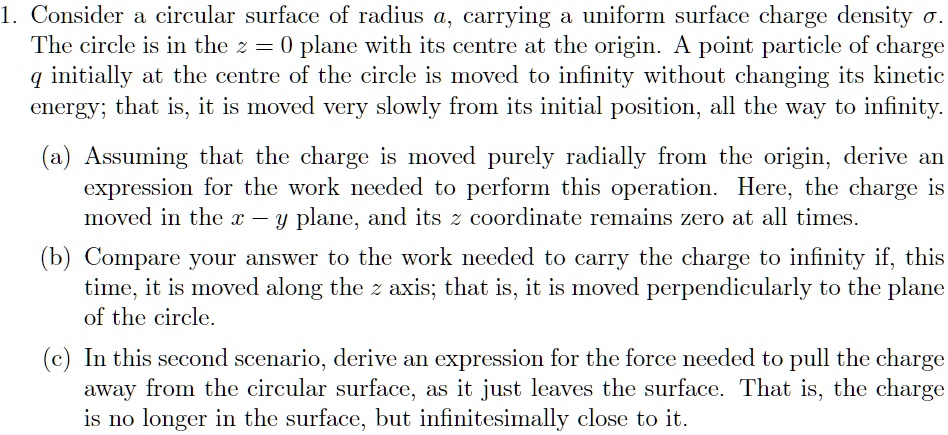
1. Consider a circular surface of radius a, carrying a uniform surface charge density ?. The circle is in the z = 0 plane with its centre at the origin. A point particle of charge q initially at the centre of the circle is moved to infinity without changing its kinetic energy; that is, it is moved very slowly from its initial position, all the way to infinity. (a) Assuming that the charge is moved purely radially from the origin, derive an expression for the work needed to perform this operation. Here, the charge is moved in the x - y plane, and its z coordinate remains zero at all times. (b) Compare your answer to the work needed to carry the charge to infinity if, this time, it is moved along the z axis; that is, it is moved perpendicularly to the plane of the circle. (c) In this second scenario, derive an expression for the force needed to pull the charge away from the circular surface, as it just leaves the surface. That is, the charge is no longer in the surface, but infinitesimally close to it.
View Answer
divider
BEST MATCH

Right Triangle Shorter Leg f Longer Leg g Hypotenuse h A 3 5 B 5 12 C 24 25

View Answer
divider