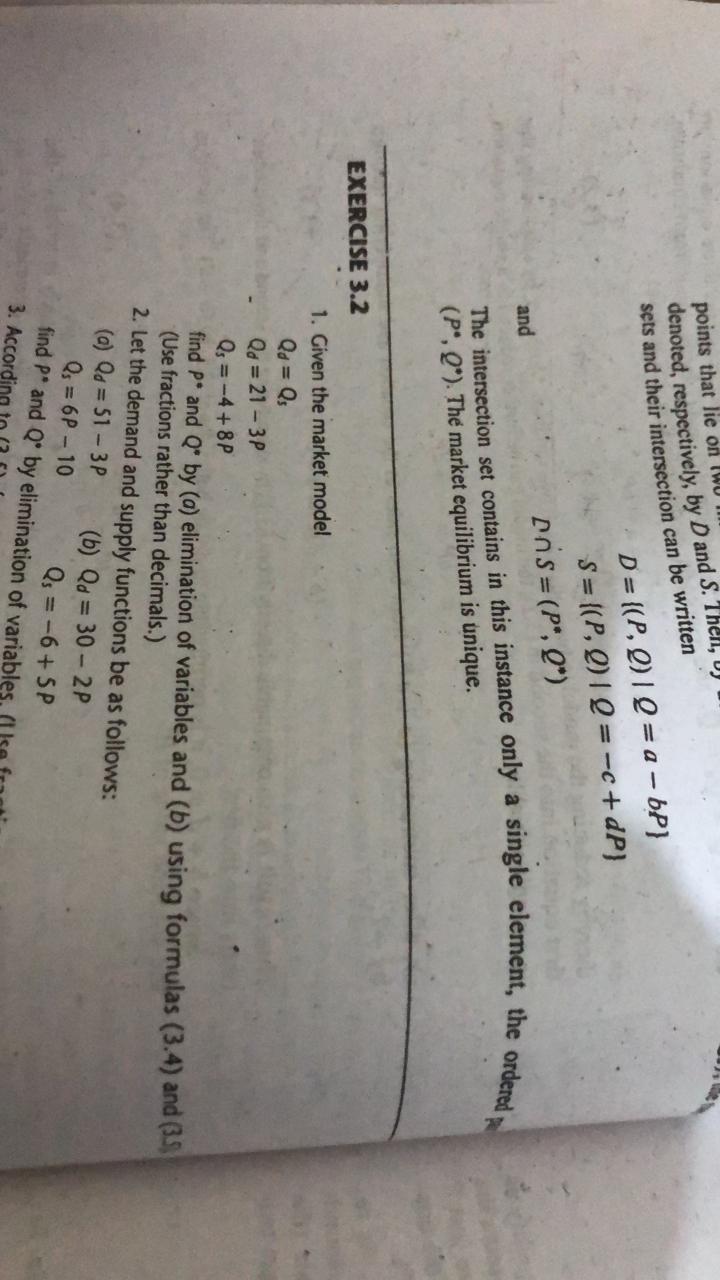
senots and their intersection can be written
\[
\begin{array}{l}
D=\{(P, Q) \mid Q=a-b P\} \\
S=\{(P, Q) \mid Q=-c+d P\}
\end{array}
\]
and
\( \left[\cap S=\left(P^{*}, Q^{*}\right)\right. \)
The intersection set contains in this instance only a single element, the ordered \( \left(P^{*}, Q^{*}\right) \). The market equilibrium is unique.
EXERCISE \( 3.2 \)
1. Given the market model
\[
\begin{array}{l}
Q_{d}=Q_{s} \\
Q_{d}=21-3 P \\
Q_{s}=-4+8 P
\end{array}
\]
find \( P^{*} \) and \( Q^{*} \) by \( (a) \) elimination of variables and \( (b) \) using formulas \( (3.4) \) and \( (35) \) (Use fractions rather than decimals.)
2. Let the demand and supply functions be as follows:
(a) \( Q_{d}=51-3 P \)
(b) \( Q_{d}=30-2 P \)
\( Q_{s}=6 P-10 \)
\( Q_{s}=-6+5 P \)
3. Accordina tan \( \rho^{\circ} \) and \( Q^{\circ} \) by elimi