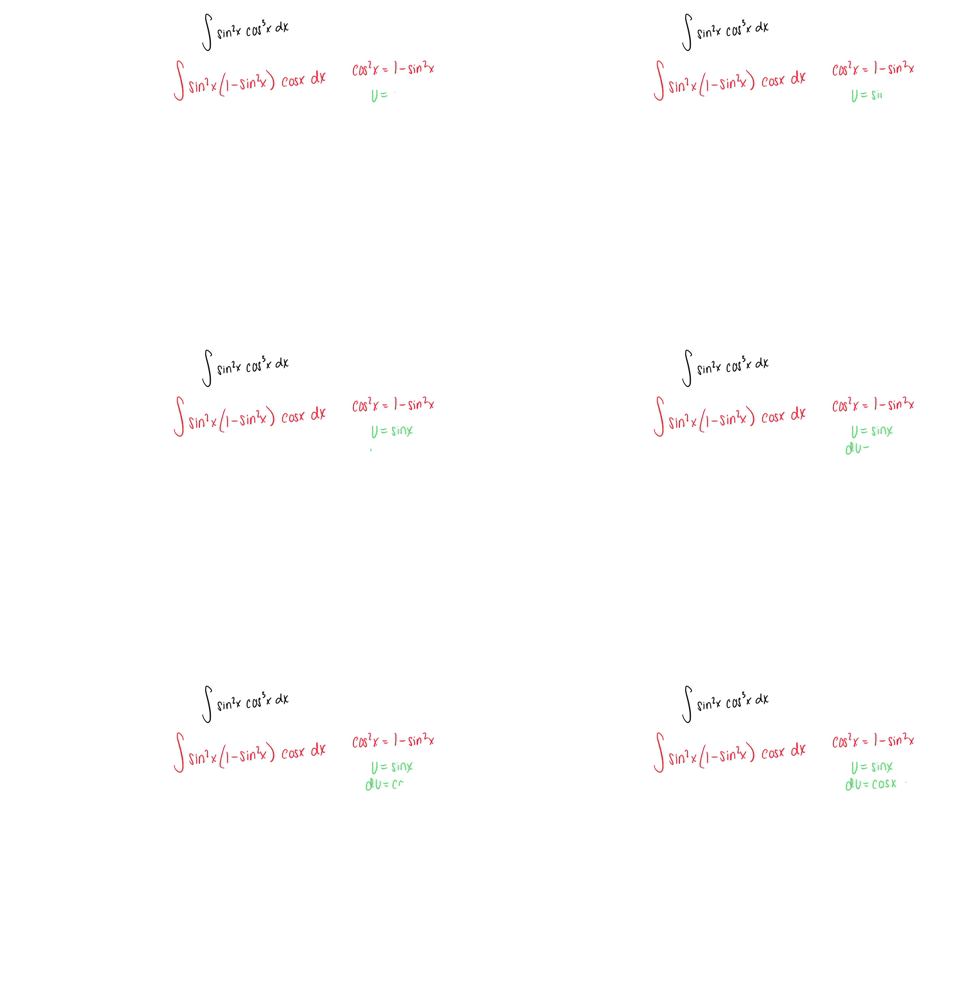
Evaluate the integral.$$\int \sin ^{2} x \cos ^{3} x d x$$
In Exercises $1-26,$ assume that the coordinates of the points $P$, $Q, R, S,$ and $O$ are as follows:$$P(-1,3) \quad Q(4,6) \quad R(4,3) \quad S(5,9) \quad O(0,0)$$For each exercise, draw the indicated vector (using graph paper and compute its magnitude. In Exercises $7-20$, compute the sums using the definition given on page $698 .$ In Exercises $21-26,$ use the parallelogram law to compute the sums.$$\overrightarrow{S Q}+\overrightarrow{O R}$$
In Exercises $1-26,$ assume that the coordinates of the points $P$, $Q, R, S,$ and $O$ are as follows:$$P(-1,3) \quad Q(4,6) \quad R(4,3) \quad S(5,9) \quad O(0,0)$$For each exercise, draw the indicated vector (using graph paper and compute its magnitude. In Exercises $7-20$, compute the sums using the definition given on page $698 .$ In Exercises $21-26,$ use the parallelogram law to compute the sums.$$\overrightarrow{O P}+\overrightarrow{O Q}$$
You have a bag of 15 soccer balls containing: 1 solid red soccer ball, 2 solid green soccer balls, 3 red/green striped soccer balls, 4 solid blue soccer balls, and 5 green/blue striped soccer balls. What is the probability that you reach into the bag and pull out a striped soccer ball?Write your answer as a decimal rounded to the nearest thousandth (three decimal places), if necessary.
Suppose a company has 10,000 employees and multiple salary structures based on the job role of each employee. The salaries are generally distributed with a population mean of μ = $60,000 and a population standard deviation σ = $15,000. What is the probability that a randomly selected employee has an annual salary less than $45,000?
The beam from a lighthouse is visible for a distance of $3 \mathrm{mi}$. To the nearest square mile, what is the area covered by the beam as it sweeps in an arc of $150^{\circ} ?$
Prove the statement is false by finding a counter example.Any positive integer $n>7$ can be written as the sum of three or fewer squares of positive integers.
Nora drew non-square rectangle. then she drew the length of each side from end to end to make a line segment that represent the perimeter. write an equation that represents the perimeter of the model shown
The graph of the cubic function f(x) = x^3 is shown.
What are the domain, range, and end behavior of the function?Select the domain and the range of the function as an inequality, using set notation, and using interval notation.
Domain:Inequality: (select) Set notation: {x | (select)} Interval notation: (select)
Range:Inequality: (select) Set notation: {y | (select)} Interval notation: (select)
End behavior: As x → +∑, f(x) → -∑ As x → -∑, f(x) → +∑