Anjana Saravanan

University of California, Berkeley
Academic Mentor

Biography

I'm currently a rising sophomore pursuing a Mechanical Engineering degree at Berkeley. In my free time, I play piano, paint, and learn languages (German, Spanish, and starting Tamil). I have a wide range of interests, from creative writing to web development to volunteerism to artificial intelligence, and I pursue all of my projects with intensity and excitement.

Education

BS Mechanical Engineering
University of California, Berkeley

Educator Statistics

Numerade tutor for 6 years
61 Students Helped

Topics Covered

Understanding Electromagnetic Waves: A Comprehensive Guide
Understanding Reflection and Refraction of Light: A Comprehensive Guide
Explore the Fascinating World of Wave Optics - Unleash Its Potential
Understanding Temperature and Heat: A Comprehensive Guide
Unlocking the Secrets of Thermal Properties: Understanding Matter
Understanding the First Law of Thermodynamics: Key Concepts
Understanding the Second Law of Thermodynamics: Key Principles

Anjana's Textbook Answer Videos

06:57
Physics for Scientists and Engineers with Modern Physics

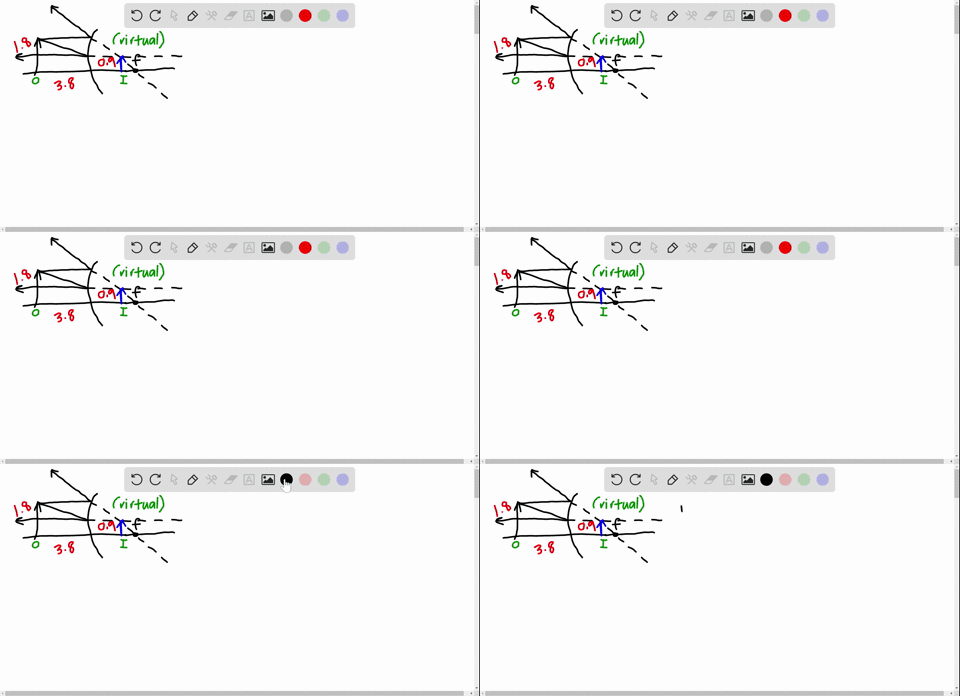
A 1.80 -m-tall person stands 3.80 $\mathrm{m}$ from a convex mirror and notices that he looks precisely half as tall as he does in a plane mirror placed at the same distance. What is the radius of curvature of the convex mirror? (Assume that $\sin \theta \approx \theta )$ IHint: The viewing angle is half.

Chapter 32: Light: Reflection and Refraction
Anjana Saravanan
02:29
Physics Principles with Applications

(I) An ideal gas expands isothermally, performing $3.40 \times 10^{3} \mathrm{J}$ of work in the process. Calculate (a) the change in internal energy of the gas, and (b) the heat absorbed during this expansion.

Chapter 15: The Law of Thermodynamics
Anjana Saravanan
05:00
Physics Principles with Applications

(1) A gas is enclosed in a cylinder fitted with a light frictionless piston and maintained at atmospheric pressure. When 1400 kcal of heat is added to the gas, the volume is observed to increase slowly from 12.0 $\mathrm{m}^{3}$ to 18.2 $\mathrm{m}^{3}$ . Calculate $(a)$ the work done by the gas and $(b)$ the change in internal energy of the gas.

Chapter 15: The Law of Thermodynamics
Anjana Saravanan
02:34
Physics Principles with Applications

(I) One liter of air is cooled at constant pressure until its volume is halved, and then it is allowed to expand
isothermally back to its original volume. Draw the process on a $P V$ diagram.

Chapter 15: The Law of Thermodynamics
Anjana Saravanan
02:51
Physics Principles with Applications

(I) Sketch a $P V$ diagram of the following process: 2.0 $\mathrm{L}$ of ideal gas at atmospheric pressure are cooled at constant pressure to a volume of 1.0 $\mathrm{L}$ , and then expanded isother-
mally back to 2.0 $\mathrm{L}$ , whereupon the pressure is increased at constant volume until the original pressure is reached.

Chapter 15: The Law of Thermodynamics
Anjana Saravanan
03:28
Physics Principles with Applications

(II) A 1.0 -L volume of air initially at 4.5 atm of (absolute) pressure is allowed to expand isothermally until the pressure is 1.0 $\mathrm{atm}$ . It is then compressed at constant pressure to its initial volume, and lastly is brought back to its original pressure by heating at constant volume. Draw the process on a $P V$ diagram, including numbers and labels for the axes.

Chapter 15: The Law of Thermodynamics
Anjana Saravanan
1 2 3 4 5 ... 10