Carl David Cepeda

University of the Philippines
Senior High School Teacher

Biography

I am a licensed chemical engineer from Las Piñas City. Eldest among my siblings, I have been a breadwinner of the family since then. This makes me become more motivated and persistent in life. During my free time, I play that guitar or surf the internet.

Education

MS Chemical Engineering
University of the Philippines
BS Chemical Engineering
University of the Philippines - Los Baños

Educator Statistics

Numerade tutor for 6 years
361 Students Helped

Topics Covered

Stand Out with Differentiation Strategies | Boost Your Business
Unlocking Insights with Descriptive Statistics: A Comprehensive Guide
Exploring Probability Topics: From Basics to Advanced Strategies
Functions
Mastering Equations and Inequalities: Your Guide to Mathematical Success
Solving Systems of Equations and Inequalities: A Comprehensive Guide
Mastering Matrices: An Introduction to the Fundamentals
Solving Systems of Linear Equations Made Easy: Tips & Tricks
Differential Equations Made Simple: Expert Tips & Resources
Unlocking the Power of Functions: Boost Your Programming Skills
Unlock the Power of Vectors: Discover Their Limitless Possibilities
Master Vector Calculus with Our Comprehensive Guide
Vector Functions: Understanding the Basics
Mastering Partial Derivatives: Essential Techniques and Tips
The Central Limit Theorem: Understanding Statistical Sampling
Unlocking the Power of Chi Square Tests and the F Distribution
Maximizing Accuracy with Effective Sampling and Data Analysis
The Dot Product
The Cross Product
Lines and Planes in Space
Arc Length and Surface Area
Understanding the Normal Distribution: A Comprehensive Guide
Mastering Chemical Reactions and Stoichiometry for Optimal Results
Unlocking the Power of Chemical Reactions: A Comprehensive Guide
Effective Solutions for Your Business Needs

Carl David's Textbook Answer Videos

06:57
Fundamentals of Differential Equations

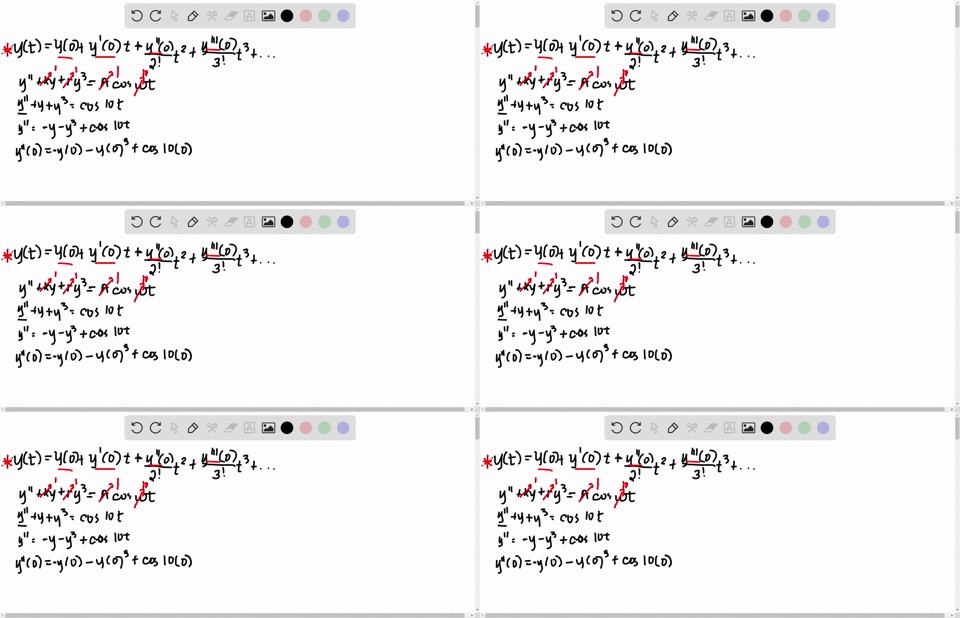
Duffing's Equation. In the study of a nonlinear spring with periodic forcing, the following equation arises:
$$
y^{\prime \prime}+k y+r y^{3}=A \cos \omega t
$$
Let $k=r=A=1$ and $\omega=10$. Find the first three nonzero terms in the Taylor polynomial approximations to the solution with initial values $y(0)=0, y^{\prime}(0)=1$.

Chapter 8: Series Solutions of Differential Equations
Section 1: Introduction: The Taylor Polynomial Approximation
Carl David Cepeda
03:32
Calculus

In Exercises $1-22,$ find $\partial f / \partial x$ and $\partial f / \partial y .$
$$f(x, y)=\int_{x}^{y} g(t) d t \quad(g$ continuous for all $t)$$

Chapter 14: Partial Derivatives
Section 3: Partial Derivatives
Carl David Cepeda
05:01
Calculus

In Exercises $35-40,$ find the partial derivative of the function with respect to each variable.
$$\begin{array}{c}{\text { Work done by the heart (Section 3.9, Exercise } 49} \\ {W(P, V, \delta, v, g)=P V+\frac{V \delta v^{2}}{2 g}}\end{array}$$

Chapter 14: Partial Derivatives
Section 3: Partial Derivatives
Carl David Cepeda
04:44
Calculus

In Exercises $35-40,$ find the partial derivative of the function with respect to each variable.
$$\begin{array}{c}{\text { Wilson lot size formula (Section } 4.5, \text { Exercise } 51} \\ {A(c, h, k, m, q)=\frac{k m}{q}+c m+\frac{h q}{2}}\end{array}$$

Chapter 14: Partial Derivatives
Section 3: Partial Derivatives
Carl David Cepeda
06:47
Calculus

In Exercises $51-54,$ verify that $w_{x y}=w_{y x}.$
$$w=\ln (2 x+3 y)$$

Chapter 14: Partial Derivatives
Section 3: Partial Derivatives
Carl David Cepeda
04:46
Calculus

In Exercises $51-54,$ verify that $w_{x y}=w_{y x}.$
$$w=e^{x}+x \ln y+y \ln x$$

Chapter 14: Partial Derivatives
Section 3: Partial Derivatives
Carl David Cepeda
1 2 3 4 5 ... 59

Carl David's Quick Ask Videos

08:19
Algebra

A pool measuring 14 meters by 16 meters is surrounded by a path of uniform? width, as shown in the figure. If the area of the pool and the path combined is 840 square? meters, what is the width of the? path?

Carl David Cepeda
04:51
Intro Stats / AP Statistics

A new process for producing synthetic gems yielded six stones weighting 0,43;
0,52; 0,46; 0,49; 0,60 and 0,56 carats, respectively, in its first run. Find a 90%
confidence interval estimate for the mean carat weight from this process.
(Assume that the population of carats of all gems produced by this new
process is approximately normally distributed.)

Carl David Cepeda
03:44
Algebra


P(z > c) = 0.2259

Carl David Cepeda
1