I am a college graduate who majored in Mechanical Engineering. I am enthusiastic and driven. I have loved math from elementary school to college and will continue to love math for the rest of my life. At ASU I received a grade of A+ in Calculus I, Calculus II, and Differential Equations. I received an A in Linear Algebra as well. These are all subjects I feel extremely confident in. Math has always been very intuitive for me and I feel that I can teach others how to use their own intuition to take their ability even further. There is a difference between memorization and understanding, and this difference is highlighted within the subject of mathematics. If one can understand the mathematical reasoning behind the procedure for a certain problem, then one will never forget how to solve the problem. My videos will focus on developing an understanding of the procedure used to solve the problem using intuitive and concise explanations rather than simply describing the necessary steps to complete the problem.
Find parametric equations for the path of a particle that moves along the circle $x^{2}+(y-1)^{2}=4$ in the manner described.(a) Once around clockwise, starting at $(2,1)$(b) Three times around counterclockwise, starting at $(2,1)$(c) Halfway around counterclockwise, starting at $(0,3)$
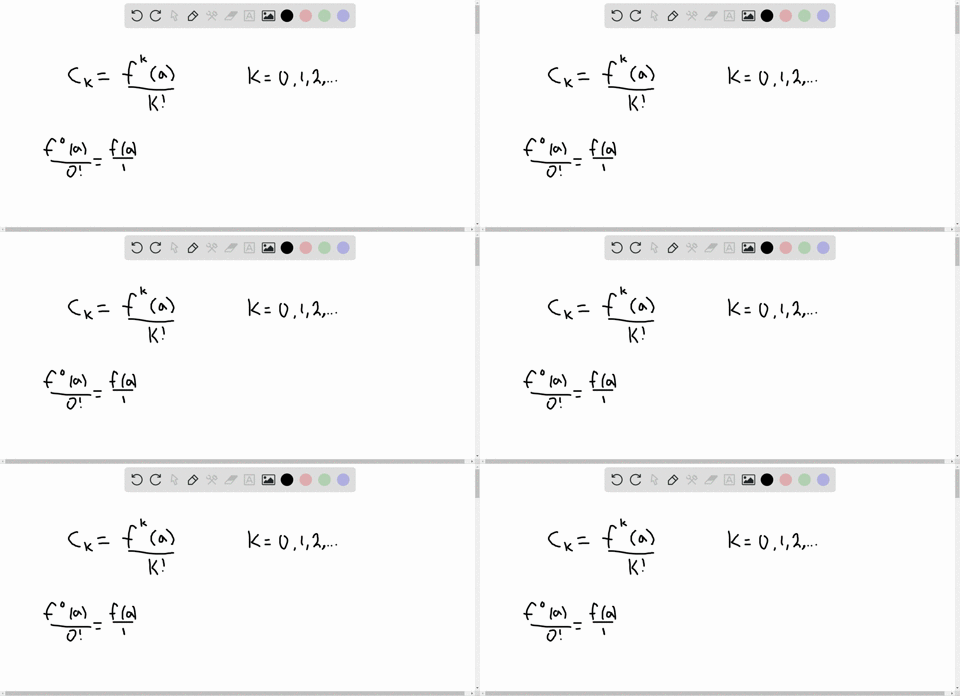
How do you find the coefficients of the Taylor series for $f$ centered at $a ?$
How do you find the interval of convergence of a Taylor series?
In terms of the remainder, what does it mean for a Taylor series for a function $f$ to converge to $f ?$
Write the Maclaurin series for $e^{2 x}$
a. Find the first four nonzero terms of the Taylor series for the given function centered at a.b. Write the power series using summation notation.$$f(x)=1 / x, a=1$$