Jeffrey Russell

University of South Carolina
Calculus Tutor

Biography

Hello! I am a Mathematics major in my senior year at the University of South Carolina. I am passionate about several subjects in math and love helping others understand how topics in Calculus, Linear Algebra, Trigonometry, and more work on a deep and intuitive level. Mathematics is a beautiful and fascinating field with so many wonderful ideas to offer. In addition to math, I also enjoy computer science, music, and games.

Education

BS Mathematics
University of South Carolina

Educator Statistics

Numerade tutor for 6 years
432 Students Helped

Topics Covered

Stand Out with Differentiation Strategies | Boost Your Business
Mastering the Basics of Parametric Equations: A Comprehensive Guide
Polar Coordinates: Understanding the Basics and Applications
Unlocking the Power of Functions: Boost Your Programming Skills
Functions
Mastering Exponential and Logarithmic Functions: Your Ultimate Guide
Exploring the World of Derivatives: A Comprehensive Guide
Mastering Linear Functions: A Comprehensive Guide
Mastering Quadratic Functions: Unlocking Their Power
Mastering Polynomials: Essential Tips and Tricks | [Brand Name]
Rational Functions: Understanding Their Properties and Applications
Mastering Equations and Inequalities: Your Guide to Mathematical Success

Jeffrey's Textbook Answer Videos

04:28
Calculus Early Transcendentals

$3-32$ Differentiate the function.
$H(x)=\left(x+x^{-1}\right)^{3}$

Chapter 3: Differentiation Rules
Section 1: Derivatives of Polynomials and Exponential Functions
Jeffrey Russell
02:06
Essential Calculus Early Transcendentals

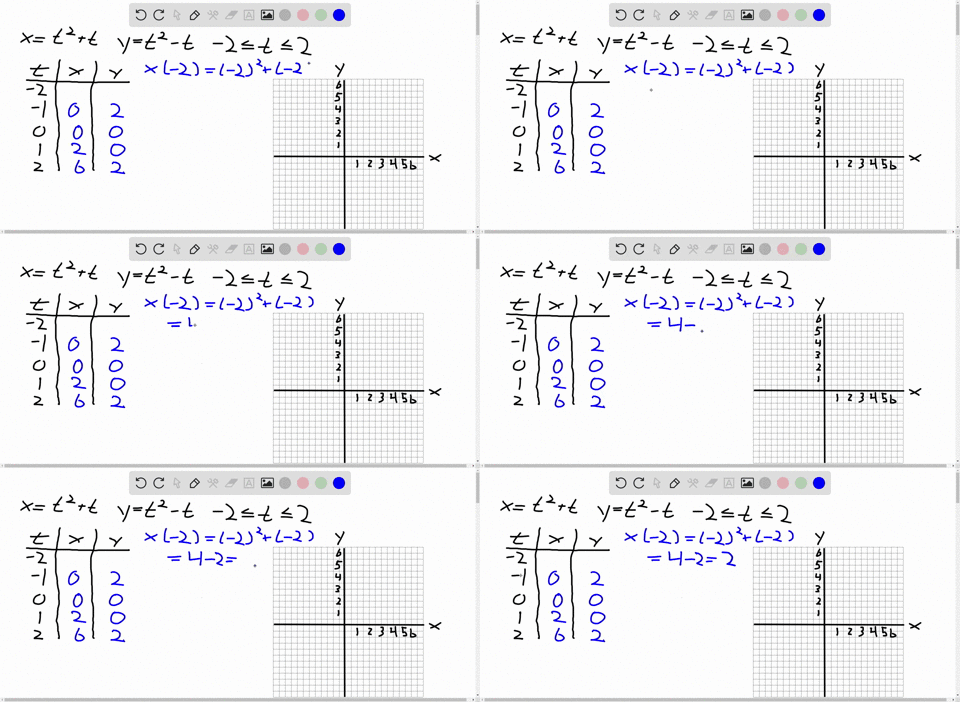
$1-4=$ Sketch the curve by using the parametric equations to
plot points. Indicate with an arrow the direction in which the
curve is traced as $t$ increases.
$$x=t^{2}+t, \quad y=t^{2}-t, \quad-2 \leqslant t \leqslant 2$$

Chapter 9: PARAMETRIC EQUATIONS AND POLAR COORDINATES
Section 1: Parametric Curves
Jeffrey Russell
02:17
Essential Calculus Early Transcendentals

$1-4=$ Sketch the curve by using the parametric equations to
plot points. Indicate with an arrow the direction in which the
curve is traced as $t$ increases.
$$x=t^{2}, \quad y=t^{3}-4 t, \quad-3 \leq t \leqslant 3$$

Chapter 9: PARAMETRIC EQUATIONS AND POLAR COORDINATES
Section 1: Parametric Curves
Jeffrey Russell
02:06
Essential Calculus Early Transcendentals

$1-4=$ Sketch the curve by using the parametric equations to
plot points. Indicate with an arrow the direction in which the
curve is traced as $t$ increases.
$$x=\cos ^{2} t, \quad y=1-\sin t, \quad 0 \leqslant t \leqslant \pi / 2$$

Chapter 9: PARAMETRIC EQUATIONS AND POLAR COORDINATES
Section 1: Parametric Curves
Jeffrey Russell
01:18
Essential Calculus Early Transcendentals

$1-4=$ Sketch the curve by using the parametric equations to
plot points. Indicate with an arrow the direction in which the
curve is traced as $t$ increases.
$$x=e^{-t}+t, \quad y=e^{t}-t, \quad-2 \leqslant t \leqslant 2$$

Chapter 9: PARAMETRIC EQUATIONS AND POLAR COORDINATES
Section 1: Parametric Curves
Jeffrey Russell
02:24
Essential Calculus Early Transcendentals

$5-8$ "
(a) Sketch the curve by using the parametric equations to plot
points. Indicate with an arrow the direction in which the
curve is traced as $t$ increases.
(b) Eliminate the parameter to find a Cartesian equation of the
curve.
$$x=3-4 t, \quad y=2-3 t$$

Chapter 9: PARAMETRIC EQUATIONS AND POLAR COORDINATES
Section 1: Parametric Curves
Jeffrey Russell
1 2 3 4 5 ... 70